Here's a question I know many are wondering about: why did China wait until now to use rare earths as leverage against the US? Why not in the first Trump administration when the US started the trade hostilities? Or when the Biden administration unleashed the chips export controls 3 years ago?
I just watched a fascinating explanation by a Chinese analyst and, unexpectedly, a big part of the explanation is... helium.
I had no idea but as he explains (source here: https://t.co/eUbbU5QIHW), all the way until 2022 China imported 95% of its helium and most of it was controlled by the US. Of the world's ten largest helium producers, four were American companies, and the remaining six all used American technology.
Helium isn't just a party balloons gas: it has plenty of industrial applications for things such as quantum computing, rocket technology, MRI machines, as a coolant for chip lithography equipment, etc.
In a nutshell what he's explaining is that with helium the US had an even stronger card to play if China ever used the rare earths card.
This raised huge alarm bells inside China. In an article published in late 2022 in the journal Frontiers in Environmental Science (https://t.co/eZhyv438LK), several researchers from PetroChina’s Beijing-based Research Institute of Petroleum Exploration and Development stressed that China would be greatly affected if the US imposed a “stranglehold” blockade on helium exports.
So over the past few years there were gigantic efforts in China to break the "helium shackles," with seven helium extraction facilities going into production, and China also switching imports from the US in favor of imports from friendly countries like Russia.
China's research ecosystem also went into overdrive to find solutions to the helium dependency issues, with China's Academy of Sciences awarding its annual 2024 "Outstanding Science and Technology Achievement Prize" to a new helium extraction technology project (https://t.co/eWs163mfaO) because "these scientific and engineering achievements broke the long-standing monopoly of the US and ensured the security of China's helium resources" (https://t.co/d7YquWKFGS)
The result: by the end of 2024 China had cut its helium dependence on the US to less than 5% (https://t.co/wOxm8VRZJj). The "helium shackles" were broken.
That's what most people don't realize: power isn't about intentions or rhetoric - it's about what you can actually do. Many wonder why countries almost never retaliate when the US imposes sanctions or export controls. The answer is simple: they can't. They lack the alternatives, the technology, the supply chains.
China is the first country that systematically worked to eliminate every single pressure point, with humongous efforts. It's not just helium: it's chips, energy, telecommunication, pharmaceuticals, etc.
That's why the rare earth card can finally be played now. Not because China suddenly became aggressive, but because they have developed the capabilities to say "no."
Last word: as a European, this is both depressing and inspiring. Depressing because it highlights the immense magnitude of the task at hand to become genuinely sovereign and develop our own capabilities to say "no." Inspiring because China demonstrated that it can actually be done, and relatively fast if we execute competently. Although with the current crop of folks at the helm in Europe, that last part is admittedly a very, very big "if"...
Im Kampf um die globale KI-Herrschaft investieren US-Tech-Milliardäre mit 2,2 Billionen Dollar die Hälfte der gesamten deutschen Wirtschaftsleistung eines Jahres in KI Rechenzentren. https://t.co/ezJjoeI67I
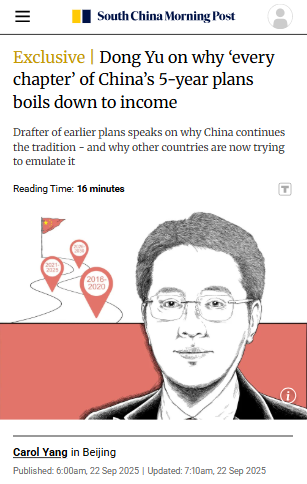
It's exceptionally rare for former Chinese officials to reveal the inner workings of the system, all the more so when it involves detailing the mechanics of China's famous 5-year plans.
Dong Yu, interviewed by the SCMP (link: https://t.co/q3inkXE8qz) helped draft China's 11th, 12th, and 13th five-year plans and he's now VP of the China Institute for Development Planning at Tsinghua University. In other words, the guy knows China's planning process in and out, both in theory and in practice.
I'll let you read the interview in full for yourself, but here were the parts that stood out for me:
1) What I hadn't realized, but which makes complete sense when you think about it, is the extent to which 5-year plans are not as much a mere forecasting exercise or even an economic blueprint but first and foremost a mass behavioral/psychological exercise.
Dong Yu makes 3 points around this:
- He emphasizes that "planning targets are not the same as forecasts. A target is not only based on technical calculations, but also takes into account how it shapes expectations." In other words the targets have a psychological dimension that's critical in determining actual outcomes, they have a self-fulfilling dimension.
- He says that "today, we have placed expectations in a position of unprecedented importance, and much of our work now revolves around shaping these expectations." Which basically means that to him planning is fundamentally about managing collective psychology.
- Lastly he argues that "the more uncertain the future feels, the more vital planning becomes... It is precisely in such moments that planning can provide much-needed stability and direction." In other words, the mere existence of a plan helps create psychological stability that enables economic activity.
2) The elaboration of the plan is more bottom-up than top-down.
This may come as a surprise to many people still under the impression that everything in China is decided in Beijing (or even solely by Xi Jinping himself 😅) - especially when it comes to the country's 5-year plans which are largely seen as a top-down exercise - but as Dong Yu reveals the process is surprisingly bottom-up.
For one thing the national plan is based on the targets set by China's provinces, which are often defined by the provinces themselves beforehand in the process.
The proactiveness of local governments is what Dong Yu highlights as "one of China's key strengths": he says that they "conduct extensive analyses and forecasts on industrial development" in their jurisdictions, and that this "widespread engagement and effort from top to bottom" is essential to the planning process.
3) The 5-year plan is not only about planning, but is part of a "full process, from formulation to implementation" which is intrinsically linked to China's political system, specifically its capacity to deliver "consistency and stability in carrying out long-term plans."
Dong Yu says that means replicating the 5-year plan process is very difficult for other countries: "Other countries are trying to learn from this model, but so far they mostly copy the form of the plans or isolated policies. The full process, from formulation to implementation, is unique and not easy to replicate."
4) He says that there is one key overarching objective behind all 5-year plan chapters: they are all fundamentally organized around improving people's living standards ("household income") rather than pure technocratic objectives around industrial targets or infrastructure.
There are of course many various ways to go about this and his personal philosophy is that "we shouldn't only focus on slicing the pie; we must also think about how to make a bigger pie. Only when the pie grows larger does dividing it become easier."
5) The are many other interesting tidbits in the article but I'll end on what Dong Yu says about both "involution" (cutthroat zero-sum competition) and "overcapacity", which are two hot topics today.
On involution, a problem Xi Jinping recently highlighted as a one of the key issues to solve for China (https://t.co/2XWu49HkNF), Dong Yu says that it is a difficult balance to strike because "part of what we call involution is market-driven competition, and we do not need to see it as entirely negative."
As he puts it the goal isn't to eliminate competition but to ensure "the sound development of the ecosystem by preventing excessive competition from eroding the growth prospects of smaller enterprises." To him the real issue with involution is when the cutthroat competition "undermines small and medium-sized businesses, especially in sectors that are related to people's livelihoods."
On "overcapacity", it looks like Dong Yu doesn't quite believe in the narrative - which is largely driven by the West. As he puts it: "This 'overcapacity' is largely a mischaracterisation when viewed in the context of global supply and demand."
Using electric vehicles as an example, he argues that "Chinese products have already far surpassed their competitors in both quality and value for money, yet their current sales volume and market share remain below what they should achieve due to various external barriers." He asks rhetorically: "Are other companies or governments really suggesting that people should just accept higher prices and lower-quality goods?"
His basic point: overcapacity is a Western narrative to protect inferior, more expensive products from legitimate market competition.
That's it, please go read the entire interview (https://t.co/q3inkXE8qz): again it's very rare to hear a former Chinese official speak so openly about the inner workings of the system; we should have more of this!
@Glenn_Diesen In order to be able to act in the same way as autocracies, democracy inevitably applies double standards. When two equal powers fight for supremacy, democracy is more likely to develop into autocracy than vice versa. War is peace, peace is war.
„Europa möchte eine der größeren Mächte der Welt werden, seine militärische Verteidigungsfähigkeit aufbauen, den wirtschaftlichen Rückfall hinter die USA und China umdrehen und seine europäischen Freiheitswerte verteidigen.“ https://t.co/AzS6feJ4B3
AI OVERPRODUCTION
China seeks to commoditize their complements. So, over the following months, I expect a complete blitz of Chinese open-source AI models for everything from computer vision to robotics to image generation.
Why? I’m just inferring this from public statements, but their apparent goal is to take the profit out of AI software since they make money on AI-enabled hardware. Basically, they want to do to US tech (the last stronghold) what they already did to US manufacturing. Namely: copy it, optimize it, scale it, then wreck the Western original with low prices.
I don’t know if they’ll succeed.
But here’s the logic:
(1) First, China noticed that DeepSeek’s release temporarily knocked ~$1T off US tech market caps.
(2) Second, China’s core competency is exporting physical widgets, more than it is software.
(3) Third, China’s other core competency is exporting things at such massive scale that all foreign producers are bankrupted and they win the market. See what they’re doing to German and Japanese cars, for example.
(4) Fourth, China is well aware that it lacks global prestige as it’s historically been a copycat. With DeepSeek, becoming #1 in AI is now something they actually consider possibly achievable, and a matter of national pride.
(5) Fifth, DeepSeek has gone viral in China and its open source nature means that everyone can rapidly integrate it, down to the level of local officials and obscure companies. And they are doing so, and posting the results for praise on WeChat.
(6) Finally, while DeepSeek was obscure before recent events, it’s now a household name, and the founder (Liang Wengfeng) has met both with Xi but also the #2 in China, Li Qiang. They likely have unlimited resources now.
So, if you put all that together, China thinks it has an opportunity to hit US tech companies, boost its prestige, help its internal economy, and take the margins out of AI software globally (at least at the model level).
They will instead make their money by selling inexpensive AI-enabled hardware of increasing quality, from smart homes and self-driving cars to consumer drones and robot dogs.
Basically, China is trying to do to AI what they always do: study, copy, optimize, and then bankrupt everyone with low prices and enormous scale.
I don’t know if they’ll succeed at the app layer. But it could be hard for closed-source AI model developers to recoup the high fixed costs associated with training state-of-the-art models when great open source models are available.
Last, I agree it’s surprising that the country of the Great Firewall is suddenly the country of open source AI. But it is consistent in a different way, which is that China is just focused on doing whatever it takes to win — even to the point of copying partially-abandoned Western values like open source, which seemed like the hardest thing to adopt.
On that point: they did build censorship into the released DeepSeek AI models, but in a manner that’s easily circumvented outside China. So, you might conclude they don’t really care what non-Chinese people are saying outside China in other languages, so long as this doesn’t “interfere with China’s internal affairs.”
Anyway —this is an area I’ve been watching, and my reluctant conclusion is that China is getting better at software faster than the West is getting better at hardware.
@manusai Research all grid expansion measures of the DSO and TSO in Germany up to 2035 and present them graphically on a map of Germany. Also mark current grid bottlenecks. Explain the map with a descriptive text that describes the chronological sequence of the expansion measures.
Quantensprung: Microsoft veröffentlicht seinen ersten Quantenchip auf Basis eines völlig neuen Materials. Fällt Moore’s Law? Think: KI verbessert Chip-Architektur, Größere Rechenpower verbessert KI und so weiter… immer bessere Chips ermöglichen bessere KI und vice versa.
While everyone’s focused on Trump, Microsoft created a new state of matter.
It's going to change everything.
Here's what you need to know about Microsoft's Majorana 1 Quantum Chip:🧵
Nobody seems to have come up with a full transcript of Wang Yi, China's top diplomat, at the Munich Security Conference so I have made one https://t.co/2PLO6W2jSO