Just one day after being named a Chevalier (Knight) of France's Order of Arts and Letters, we're revisiting one of our favorite performances by French-Armenian composer and vocalist Essaï Altounian 🇦🇲🇫🇷
Filmed in April 2025 inside the 4th-century Geghard Monastery, Essaï performs the ancient Armenian prayer "Der Voghormia" (Տէր ողորմիա, "Lord, Have Mercy") completely a cappella.
Carved into the cliffs more than 1,600 years ago, Geghard's remarkable acoustics allow every note to echo through the stone, making this thousand-year-old prayer feel as timeless as the monastery itself.
Follow @huysmedia for 🇦🇲 stories that inspire.
ON THIS DAY in 1876, Christophor Araratian, The Hero General Whose Artillery Saved Armenia At The 1918 Battle Of Sardarabad, Was Born. 🇦🇲
➖➖➖
150 years ago today, on June 18, 1876, one of the most consequential military commanders in modern Armenian history was born in Tiflis, the city now known as Tbilisi. Major General Christophor Araratian (Araratov) would lead the artillery that saved the Armenian nation from extinction in May 1918, serve as Minister of Military Affairs of the First Republic of Armenia, and be martyred in 1937 during Stalin's Great Purge, executed by firing squad alongside his fellow Sardarabad hero General Movses Silikyan and other Armenian colonels for the very independence he had once helped secure.
From The Tiflis Cadet Corps To The Russian Empire
Araratian was born into a noble Armenian military family. His father Karapet was a lieutenant colonel of the Russian Imperial Army, and the son was raised to follow him. At 10 years old, he entered the Tiflis Cadet Corps, where he studied for 7 years. From there he advanced to the prestigious Mikhaylov Artillery School in Saint Petersburg, finishing in the top three of his class, an achievement that earned him the right to choose his post.
He chose the Caucasus, returning to serve in the Caucasian Brigade of Grenade Artillery near Tiflis. He served on the front of the Russo-Japanese War of 1904 to 1905 by his own request, fought in the First World War on the Romanian front, and rose steadily through the ranks of the Russian Imperial Army.
Sardarabad, May 1918
In late 1917 and early 1918, as the Russian Empire collapsed and Ottoman armies pushed eastward to finish what the Armenian Genocide had begun, the Armenian National Council in Tiflis began to assemble a national army from the Armenian officers of the Russian service. Under Sparapet Tovmas Nazarbekian, Colonel Araratian was given command of the 2nd Artillery Brigade of the Armenian Corps.
In May 1918, the Ottoman army marched on Yerevan with the stated aim of erasing the surviving Armenian nation from the map. What followed at the village of Sardarabad, between May 21 and May 29, was the most consequential battle in modern Armenian history. Outnumbered and outgunned, Armenian forces stopped the Ottoman advance and turned it back. The independence of the First Republic of Armenia, declared three days after the battle ended, was made possible by what happened on that field.
Araratian's artillery brigade was at the center of the victory. The Russian press would later call him "Bog Sardarapata," the God of Sardarabad. After the battle, he was promoted to Major General.
Minister Of Military Affairs
In March 1919, Major General Araratian was appointed Minister of Military Affairs of the First Republic of Armenia, a post he retained through the coalition, interim, and regular cabinets of Prime Minister Alexandre Khatisian. As military minister, he carried the burden of defending a young republic surrounded by collapsing empires and hostile neighbors, with limited resources and impossible odds.
The City's General
After the fall of the First Republic in 1920 and his return to Soviet Armenia in 1921, Araratian took up academic positions, including head of the military chair at Yerevan State University. He became a beloved figure on the streets of Yerevan, always immaculately dressed, walking down Alaverdyan Street to a chorus of greetings from the citizens who knew him as the city's general.
Martyred At Nork
On September 2, 1937, during the Great Purge, Stalin's secret police arrested Christophor Araratian. The charges were nationalism, the crime that for an Armenian patriot of his generation meant precisely the act of having helped found the Republic. After three months in prison, on December 10, 1937, he was driven to the Nork gorge outside Yerevan, on the site of what is now the Yerevan Zoo, and shot alongside his fellow Sardarabad hero General Movses Silikyan and other Armenian colonels.
His wife took packages to the KGB for years afterward, asking them to be delivered to her husband, not knowing he was already dead. The family was given a false death certificate in 1955 stating he had died of a heart attack in 1943. Only in 1956, when the Supreme Court of the Armenian SSR declared the 1937 sentence null and void, did they learn the truth.
A Legacy Restored
Christophor Araratian was rehabilitated posthumously. His medals were returned to his family. His name was restored to the history books. The Republic he helped found, lost, and helped found again now stands as the Republic of Armenia, and the battle that made it possible is taught in every Armenian school as the day a nation refused to die.
150 years after his birth, the man whose artillery saved Armenia at Sardarabad belongs to the small number of figures whose lives define the boundaries of the modern Armenian nation. His enemies were many: Ottoman armies that wished to finish the Genocide, Soviet purgers who wished to erase his role in independence. Both failed. The Republic stands. The general endures.
#ChristophorAraratian #ChristophorAraratov #Sardarabad #ArmenianHistory #ArmenianHeroes
Surprise: Great Britain’s Original Inhabitants Were Armenian
By Vic Gerami
Ancient chronicles, archaeology, and cross-cultural links
point to an Armenian origin for the first Britons
History often hides its most intriguing facts in plain sight. One of these cases lies within the pages of the Anglo-Saxon Chronicle, a cornerstone of early English history. In its very first passage, the Chronicle states: “The first inhabitants were the Britons, who came from Armenia.”
That single sentence challenges everything we think we know about the origins of Britain. Could the people who first settled the island have come from the Armenian Highlands, the ancient land beneath Mount Ararat?
An Overlooked Origin Story
The Anglo-Saxon Chronicle, compiled in the 9th century under King Alfred the Great, was never intended as myth. It was a record of nations and migrations. Its assertion that the Britons came from Armenia cannot easily be dismissed as error or confusion. Some scholars have argued that the scribe meant “Armorica” (modern Brittany), yet the repetition of “Armenia” across versions suggests something more deliberate.
This historical record proves that one of the earliest European populations descended from peoples of the Near East who migrated westward after the great flood myths of antiquity. Armenia, located between Mesopotamia and Anatolia, is often described as the cradle of civilization. Its ancient cities such as Metsamor and Shengavit reveal advanced metallurgy, astronomy, and trade networks dating back 6,000 years, long before Stonehenge rose from the British plains.
Shared Spirit: Armenian and Celtic Cultures
Parallels between Armenian and Celtic cultures are striking. Both revere nature, mountains, and sacred stones. Both feature mythologies centered around heroism, the sun, and the continuity of life. In art and spirituality, the similarities deepen.
Armenia’s khachkars—stone crosses carved with intricate spirals, suns, and vines—bear uncanny resemblance to Celtic crosses found in Ireland and Scotland. Both express a union of heaven and earth through sacred geometry. In both cultures, the cross predates Christianity, symbolizing the cosmic balance of nature before it became a Christian emblem.
The linguistic family tree also offers faint but fascinating connections. Some scholars have traced Indo-European roots linking early Armenian with proto-Celtic languages, suggesting that spiritual and artistic concepts may have traveled westward over millennia.
Stonehenge and Zorats Karer: Twin Gateways to the Sky
The connection between Armenia and Britain becomes even more tangible when comparing two of the world’s oldest megalithic monuments: Stonehenge in England and Zorats Karer in Armenia, often called Armenia’s Stonehenge.
Zorats Karer, near the town of Sisian, is an ancient observatory made up of hundreds of upright stones, some pierced with circular openings. Archaeologists estimate it to be over 7,500 years old, roughly 5,000 years older than Stonehenge. Both sites are precisely aligned with the solstices and equinoxes. Both appear to have been used for astronomical observation and spiritual ritual.
Whether these two structures were the result of shared knowledge or parallel human ingenuity, the resemblance is extraordinary. The builders of both sought to bring order to the cosmos, to measure time, and to connect human life to the movement of the stars.
Faith, Symbolism, and the Cross
Armenia became the first nation to adopt Christianity as a state religion in 301 AD, yet its symbols long predate the faith. The Armenian cross, with its flowing extensions and sun motifs, continues to represent eternal life rather than death. Similarly, in Celtic lands, the cross with its circle represents the sun, continuity, and divine unity.
The merging of these spiritual traditions into Christian iconography may hint at an ancient exchange of ideas stretching back thousands of years—a conversation between civilizations through stone, art, and belief.
The Armenian Origins of the Celts and Gauls
A remarkable study titled “Armenia and the Celts (Gauls)” published in 2017 provides compelling linguistic and archaeological evidence that further supports the theory of an Armenian origin for Celtic peoples.
According to Armenian and European historians cited in the research, some of the earliest Celtic tribes may have originated in the northern regions of the Armenian Highlands, particularly around Lake Sevan. Scholars such as Martiros Kavoukjian and G. Ghapantsyan traced toponyms and tribal names like Uelikuni, Gegharkuni, and Gulutahi—found in ancient Urartian inscriptions—to the same linguistic roots as Welsh, Gaul, and Galatian. These early tribes, known to the Greeks as Keltoi and to the Romans as Galli, may have migrated westward through the Black Sea and Danube corridors, eventually populating areas of Central and Western Europe.
Notably, the study highlights parallels between Armenian and Celtic linguistic structures, where words beginning with “v” in Indo-European languages evolved into “g” in both Armenian and old Celtic tongues. This suggests a shared phonetic shift originating in the Armenian Highlands.
Armenian chroniclers such as Movses Khorenatsi (5th century) and Movses Kaghankatvatsi (7th century) wrote of Galatian and Celtic tribes in Asia Minor, describing them as descendants of Japheth’s son Magog. These accounts align with archaeological evidence placing Celtic settlements and influence throughout Cappadocia, Phrygia, and Galatia (modern-day Ankara), regions historically tied to Armenia.
The Celts’ reverence for the oak tree and sun symbolism also mirrors pre-Christian Armenian spiritual traditions. Even the iconic Irish names Eriu and Eremon—linked to the origins of Ireland’s name—closely resemble the ancient Armenian tribal names Eria and Eriaini, recorded in inscriptions of King Rusa I (735–713 B.C.).
Finally, the linguistic resemblance between Karahunj in Armenia and Stonehenge in Britain further supports this ancient connection. In Armenian, kar means “stone,” while hunj closely echoes henge. Both monuments, built thousands of years apart yet serving similar astronomical and spiritual functions, stand as silent witnesses to a shared cultural ancestry.
Khachkars in Ireland and the Armenian-Irish Connection
Adding further weight to this shared heritage is the discovery of Armenian khachkars, or cross-stones, in Ireland, particularly on the Rock of Cashel. According to the Armenian Electronic Encyclopedia, established theories now propose that Armenians were among the first inhabitants of the island, based on deep cultural, linguistic, and spiritual similarities between Armenian and Celtic traditions.
Research by Donovan Sullivan and Jacob Gazarian shows that the Aryans—represented by Armenians, Medes, and Illyrians—contributed to the ethnogenesis of the Irish people. The presence of khachkars in Ireland, along with psalms from the Irish Church that specifically pray for prosperity in Armenia, reflects an ancient and enduring connection.
Archaeological excavations in 2005 at the buried city of Tigranakert uncovered five cross-stones nearly identical to the “high Irish crosses,” providing tangible evidence that the prototypes of Ireland’s monumental crosses originated in Armenia. These discoveries inspired the establishment of a Department of Armenian Studies at the University of Dublin by scholars Patrick Voulsh and David Ross.
Modern genetic studies by Oxford’s Stephen Oppenheimer reinforce these findings, revealing that the Irish share unique DNA markers with the inhabitants of Armenia’s Syunik and Artsakh regions. Linguistic analysis further supports this link, with ancient Celtic words such as gardmir (meaning red in Old Irish) showing clear parallels with Armenian roots.
Today, a small Armenian school operates on St. Patrick’s Street in Ireland, where a khachkar has been erected, symbolizing this rediscovered bond between two ancient cultures separated by geography but united by ancestry, art, and faith.
A Shared Heritage of Resilience
Both Armenians and Celts are peoples of mountains and memory. Each has endured conquest, colonization, and cultural suppression, yet both have kept their language, art, and spirituality alive. Their traditions speak of survival through song, craftsmanship, and community.
The fact that Britons came from Armenia deserves attention, as It reflects how deeply the roots of civilization are intertwined. From Ararat to Albion, from Zorats Karer to Stonehenge, humanity’s oldest monuments tell a shared story of wonder, endurance, and a timeless search for meaning written in stone.
Source: https://t.co/d0e21Et64S
Today, Armenia Marks the Day of State Symbols. 🇦🇲
The Yerakuyn, Armenia’s tricolor flag, was first raised by the First Republic in 1918, hidden through seven decades of Soviet rule, and raised again when independence was reclaimed in 1990.
Red represents the Armenian Highland and the people’s struggle for survival.
Blue stands for the will of the Armenian nation to live beneath peaceful skies.
Orange honors the creative talent and hard-working nature of the Armenian people.
A Nation That Reclaims Its Own
The story of Armenia’s state symbols is the story of Armenia itself: lost, preserved, and reclaimed. The flag that flew over the First Republic from 1918 to 1920 was hidden through 70 years of Soviet rule and raised again in 1990. The coat of arms designed by Tamanyan and Kojoyan was redrawn and restored. The anthem sung in Yerevan in 1918 is the anthem sung in Yerevan today.
Each is a piece of a sovereignty that did not survive by accident.
new research has radically changed opinions that have been established over the years. A study published in the journal Science in early 2024 has provided evidence that the region of the Lesser Caucasus, which includes modern Armenia, Azerbaijan, eastern Turkey and southern Georgia.
The study used a combination of linguistic data, archaeological finds and ancient DNA.
DNA analysis showed that some people who lived in this region in the X century BC. э. In the 4th - 3rd millennium b o n. э. they were genetically and culturally close to a people that later spread across the vast Indo-European-language area.
Through lexical reconstruction, linguists have suggested that the metallexic elements of the pro-Indo-European languages (PIEs) more corresponded to the lifestyle of ancient farmers living south of the Caucasus than the lifestyle of steppe nomads.
The region south of the Caucasus is one of the world’s oldest cultural centers, where frequent movement of people, mixing of languages and cultural exchange was observed.
Georgian linguist Tamaz Gamkrelidze was one of the few researchers who, back in the 1980s and 1990s, supported the theory that the homeland of the pro-Indo-European language were the Armenian Highlands, South Caucasus and Northern Mesopotamia.
His main arguments are presented in the article:
“The early history of Indo-European languages”, published in Scientific American magazine (1990).
This study resulted in his joint work with Vyacheslav Ivanov.
The main states of the Gamkrelidze-Ivanov theory:
Anti-Indo-European Indo-European culture spread from south to north, and not the other way around, as the mound hypothesis suggests.
At the lexical level, there are many words reflecting mountain and agricultural culture, which corresponds more to the natural environment of the Caucasus region.
They also believe that the proximity to the Semitic languages had a significant influence on the formation of the proto-Indo-European language, which was possible only in the South Caucasus and Northern Mesopotamia.
New genetic and archaeological studies, unveiled in 2024, coincide with Gamkrelidze’s vision—a prediction made nearly 35 years ago, can now be backed by numerous evidence.
August Schleicher, one of the pioneers of Indo-European research, was the first scientist to introduce the structure of the language development tree (Schleicher tree) and formulated a serious theory of the origin of the pro-Indo-European language.
Schleicher’s vision:
According to Schleicher, the Armenian language was unique among the Indo-European languages - so much so that he considered it a kind of “root branch” from which other languages responded.
This was said before comparative linguistics became fully developed and the proto-Indo-European language could be reconstructed in detail, but Schleicher’s intuition was strikingly close to what genetics and archaeology now confirm: the Armenian Highlands and the South Caucasus could indeed have been the cradle of Indo-European languages.
We already have biological, genetic and archaeological arguments that agree with Tamaz Gamkrelidze, August Schleicher and others claimed: the cradle of Indo-European languages should be sought in the South Caucasus and the Armenian Highlands.
Where Is the Land of Armenia? 🇦🇲
Historically, Armenia was understood as a much larger land than today’s republic, stretching from Mesopotamia toward the Caucasus mountain range. Ancient historians and geographers often described it through its mountains, rivers, lakes, and natural boundaries. At its center was the Armenian Highlands, especially the world between Lake Van, Mount Ararat, and Lake Sevan.
That landscape has remained one of the most important places in Armenian memory and history.
Noubar Afeyan Ranks 32nd on Forbes' List of America's 250 Greatest Innovators 2026 🇦🇲🇺🇸
➖➖➖
Armenian-American entrepreneur Noubar Afeyan, the scientist and investor who helped bring the world one of its first mRNA vaccines, has been ranked 32nd on Forbes' list of America's 250 Greatest Innovators, a list released to mark the United States' 250th anniversary. He stands among names that define modern American industry, with Elon Musk topping the ranking, followed by Jeff Bezos of Amazon, Nike's Phil Knight, NVIDIA's Jensen Huang and filmmakers George Lucas and Steven Spielberg, reports Zartonk Media.
Forbes compiled the list through an unusual process, scoring nearly a thousand nominees on creativity, disruption, and commercial impact through a panel of judges, then asking artificial intelligence tools to rank them before editors set the final order. For Afeyan, the placement marks formal recognition of a career that turned a refugee child's improbable arrival in North America into one of the most consequential records in American science.
Through Flagship Pioneering, the firm he founded in 2000, Afeyan has helped create more than one hundred science companies, each beginning from a single question, "What if?" The most consequential answer came in 2010, when he co-founded Moderna, at a time when using messenger RNA as medicine was almost unheard of. A decade later that idea became a vaccine deployed to billions of people across more than seventy countries during the COVID-19 pandemic. Afeyan serves as Moderna's board chairman, and for his body of work he received the National Medal of Technology and Innovation, the highest honor the United States grants for technological achievement.
Afeyan's roots trace to Beirut, where he was born in 1962 to Armenian parents, his grandfather a survivor of the Genocide. His family fled the Lebanese Civil War for Montreal in 1975, and he went on to study at McGill University before completing a doctorate in biochemical engineering at MIT in 1987, entering biotechnology at the very moment it was becoming an industry. He speaks Western Armenian, and he has long pointed to his immigrant background as the engine behind his scientific, business, and philanthropic work, the kind of formation that shapes a person before they go on to build careers of their own.
In 2015, alongside the late Vartan Gregorian and Ruben Vardanyan, the Armenian philanthropist now held hostage in an Azerbaijani prison after the ethnic cleansing of Artsakh, Afeyan co-founded the Aurora Humanitarian Initiative and its Aurora Prize for Awakening Humanity, an award that honors those who risk themselves to save others, rooted explicitly in the memory of the Armenian Genocide and the survivors who were once saved by strangers. He is a founding backer of the Foundation for Armenian Science and Technology, a board member of the UWC Dilijan International School, a co-founder of the Future Armenian initiative, and an early architect of efforts to chart the country's long-term development. Most recently he has turned toward Armenia's technological future, serving as a founding partner and strategic advisor to Firebird, the company building a roughly half-billion-dollar AI data center in the country together with NVIDIA and the Armenian government, with his Afeyan Foundation for Armenia among its founding investors.
There is something fitting in seeing an Armenian name on a list defining American ingenuity at the nation's 250th year. The American story has always been, in large part, the story of who arrives and what they go on to build. Afeyan arrived as a boy with a displaced family and a foreign name, and he became one of the people that name is now used to celebrate. For the Armenian nation, scattered across the world and accustomed to building its institutions on borrowed ground, his place on that list is a milestone worth marking.
🩰✨ Yerevan Ballet Fest 2026 is bringing magic to city center!
After world premiere of Tamar, festival continues June 5–6 with David of Sassoun, powerful ballet-oratorio inspired by Armenia’s national epic.
Experience magic of ballet under open sky in Yerevan! 🤍
This story gets so much worse. Apparently this all started because police were called out for a disturbance after her husband broke their tv out of anger after finding out his brother was killed by Israel in Gaza. The husband is Palestinian. When the police were taking him into custody his wife stopped them because she wanted to accompany him and that is when the officer threw her on the ground for “interference.” The couple was cooperative with the police the entire time and yet this is how they were treated.
She delivered the baby prematurely because of the physical trauma on her body but thankfully both she and the baby survived and are in good health. She easily could have miscarried.
This entire police department should be investigated and that officer should be arrested and charged with aggravated assault.
BREAKING: George Deek, Israel's Special Envoy to the Christian World, says "We never got involved or took position in the conflict between Azerbaijan and Armenia, per se", which led to the ethnic cleansing of Christian Armenians and their Churches from Artsakh (Nagorno-Karabakh).
You have to admire that carefully placed "per se". The amount of heavy lifting it does for Israel's image in the Christian world would've been commendable had it not been a typical hasbara escape hatch, absolving Israel of any responsibility or accountability, and invariably collapsing under the weight of Israel's own record during that war.
In no particular order:
⁃According to the Stockholm International Peace Research Institute (SIPRI), between 2016 and 2020, leading up to the 44 Day War, roughly 69% of weapons exports to Azerbaijan came from Israel, in a war that butchered 5,000 Armenian soldiers, barely adults. So neutral.
⁃The highly advanced Israeli weapons systems included loitering munitions (suicide drones) such as the IAI Harop and Elbit SkyStriker, Hermes 900 reconnaissance drones, Spike anti-tank guided missiles, and LORA surface-to-surface ballistic missiles.
⁃Israeli weapons manufacturer Aeronautics Defense Systems used a suicide drone by attacking Armenian positions during a sale presentation at the behest of Azeri officials who requested a live demonstration.
⁃Israeli military personnel trained Azeri soldiers in piloting drones.
⁃Azerbaijan supplies 65% of Israel's crude oil imports, which are pumped via the BTC pipeline through Georgia and Turkey. A clear energy security and arms agreement: you send oil, we give you weapons.
So neutral.
⁃In December 2023, Azerbaijan effectively blockaded the Lachin Corridor, the only route between Armenia and Artsakh. A starvation campaign ensued for 9 months, targeting hundreds of thousands of Armenian indigenous Christians: Food shortages, supermarket shelves emptied, families lining up for hours for a piece of bread. No fuel. No medicine. Cancer patients requiring urgent treatment were stranded. Malnutrition. Miscarriages.
George Deek was Ambassador at that time. He was there in Baku.
Did he voice concern for the besieged Christians in Artsakh? No. His country enabled it. Haaretz, an Israeli outlet, even published a bombshell report entitled "Israel's fingerprints all over the ethnic cleansing of Nagorno-Karabakh".
To quote the Special Christian envoy himself:
"When violence against a vulnerable minority is ignored because acknowledging it is politically inconvenient, there is a name for it: abandonment."
For Israel, the defense of the Armenian Christian presence in Artsakh was politically inconvenient.
That is why they were complicit in the ethnic cleansing of 150,000 indigenous Christian Armenians from their 2,000-year-old homeland.
Armenia’s Areni-1 Cave, home to the world’s oldest known winery, revealed ancient wine-making tools, a 5,500-year-old leather shoe, and human remains preserved for over 6,000 years. A facial reconstruction now brings one of the cave’s young inhabitants back to life 🇦🇲
Source: @sulkalmakh (X)
Follow @huysmedia for 🇦🇲 stories that inspire.
National Dance Ensemble of Armenia performing traditional Armenian dance 'Uzundara/Ուզունդարա' [1987 video]
According to Armenian folk tradition, the dance Uzundara was brought to the region by Armenians from Erzurum (Western Armenia), who fled from the Ottoman Empire in 1828 during the Russian-Turkish war.
In Armenian, particularly in the western Armenian dialect "Uzundara" translates to "They wanted her, They took her". With "Uzun" being "they wanted (her)" and "Daran" 'They took (her)". It showcases the metaphor of a bride being taken from her family.
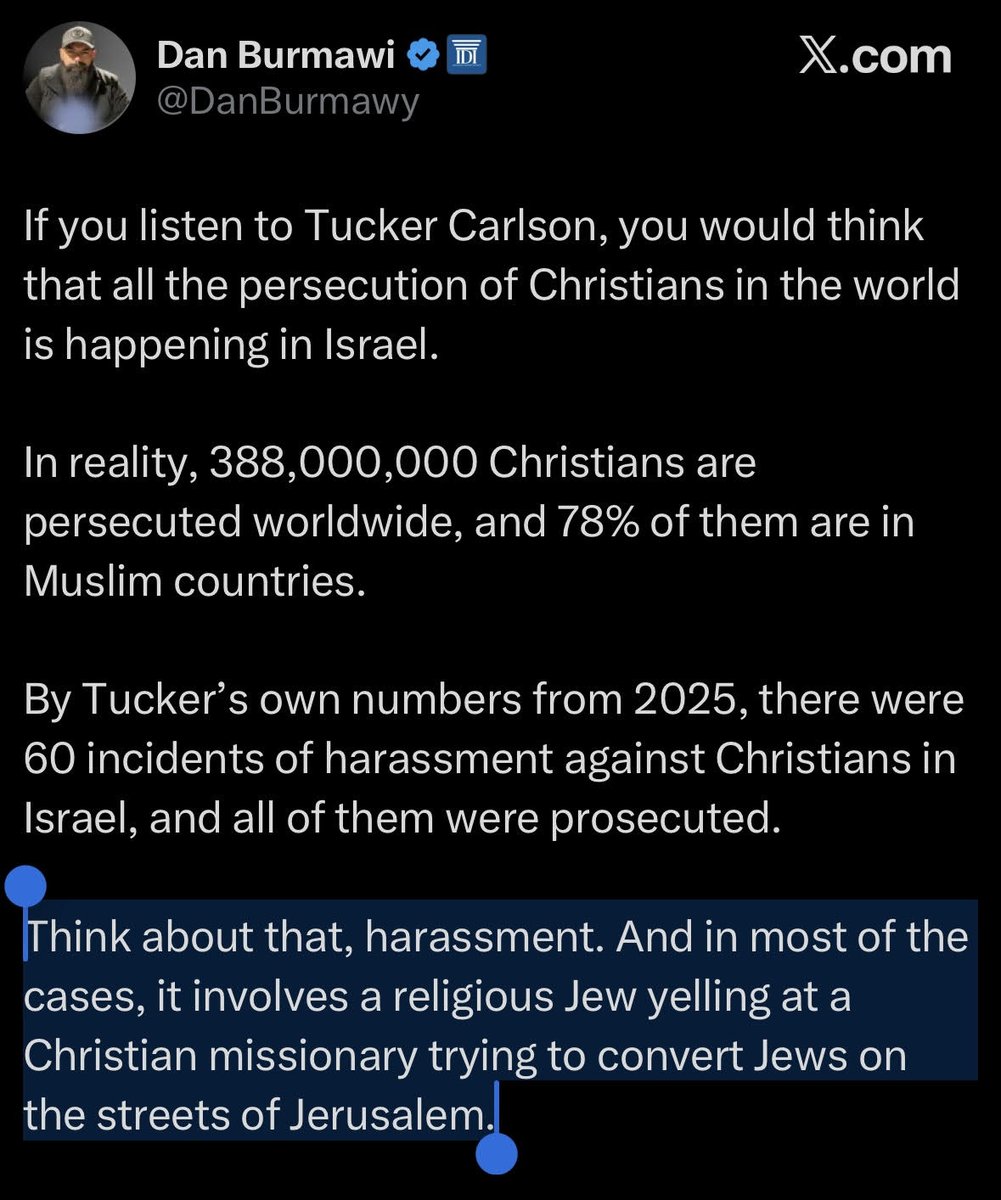
Hasbara-free translation: Christians in Jerusalem are 'Asking for it.'
Also, he's wrong and I'll prove it.
Complete list of anti-Christian attacks in Jerusalem since 2023 by the Religious Freedom Data Center, founded by Israeli activist and interfaith scholar Yisca Harani:⬇️
"The defense of Christians and the defense of Israel, the national home of the Jewish people, are not opposing causes."
— George Deek, front-row witness to the ethnic cleansing of 150,000 Christian Armenians from Artsakh (Nagorno-Karabakh) by Azerbaijan with Israeli weapons.
Israel hasn't recognized the Armenian Genocide, to appease Turkey and Azerbaijan.
Israel receives 40% of its oil from Azerbaijan via Turkey.
Israel armed and empowered Azerbaijan's ethnic cleansing of 150,000 Christian Armenians from Artsakh.
Keep our name out of your mouth.
The Embassy of Iran in Armenia has reported that a missile strike hit the Armenian neighborhood of Majidieh in Tehran.
According to the embassy, the target of the strike carried out by the American–Israeli alliance was a residential building located in the historic Armenian quarter. Preliminary information initially indicated that there were no fatalities.
However, the local Armenian newspaper Alik later reported that the attack caused significant damage to several Armenian residential buildings in the area and left around 10 Armenians injured with varying degrees of injuries.
Citing Fred Ashoughian, the head of the emergency headquarters of Tehran’s Armenian-populated Zeytun district, Alik reported that three Armenian residential buildings located near the targeted center sustained the most serious damage, with some now considered unsafe or no longer habitable.
One apartment was empty at the time of the explosion, while members of another Armenian family living nearby were injured and taken to a medical center or treated on site.
Ashoughian also said that windows in nearby apartments were shattered and household property was damaged, forcing residents of adjacent buildings to evacuate and seek temporary shelter with relatives.
Majidieh is one of Tehran’s longstanding Armenian districts. The neighborhood is known for its active community life and developed infrastructure, much of which was built and expanded with significant contributions from Iran’s Armenian community.
The first statue you should have built ought to have been a Statue of Liberty on the highest peak of Artsakh.
Առաջին արձանը, որ դուք պետք է կառուցեիք, պետք է լիներ Ազատության արձանը՝ Արցախի ամենաբարձր գագաթին