Vangrid x Gate Wallet is another interesting step for the Physical AI ecosystem. It brings more users into a network focused on real world data and participation.
More access can mean more contributors and more activity across the network.That kind of growth can become meaningful over time.
What I find interesting is how @vangrid_io connects edge nodes with real world ground truth.Physical AI needs data from the world, not just data created inside a model.The more diverse that data becomes, the more useful the network can be.That is where this approach starts to get really interesting.
The combination of edge nodes, multi-chain wallets, and real world data creates a strong loop.Users can participate while the network keeps collecting valuable ground truth.More participation can help expand the data layer behind Physical AI.And that data layer could become increasingly important as the space grows.
With Gate Wallet now integrated, Vangrid another distribution layer around its ecosystem. It is another connection between users, infrastructure, and physical-world data.The grid is still being built, one integration and one contributor at a time.Curious to see how far this network can expand from here.
Vangrid is building something that could become an important piece of infrastructure for the AI economy: a decentralized mapping and data network where information can be captured, attested, and settled onchain. Instead of treating data as something you simply have to trust, Vangrid is creating a system where the underlying activity can be verified.
The @vangrid_io Explorer is now live, and this is where things get interesting. Every capture, every attestation, and every settlement can be tracked through an onchain verification layer. With Base + EAS and Merkle-batched data, the network is designed to make large amounts of activity easier to verify while keeping the process transparent.
For those farming the Vangrid ecosystem, this is more than just another product update. The Explorer gives us a clearer view of the infrastructure being built behind the scenes and the onchain activity supporting it. Watching the ecosystem develop while understanding how the data layer actually works can be just as important as simply participating.
AI and autonomous systems will need reliable real-world data at massive scale. Vangrid is working toward a network where that data can be mapped, verified, and settled transparently. The grid is being built in public, and now we have a way to verify it ourselves.
Hey Everyone.
I’m giving away 2 Hazels WL spots to the community.
How to enter:
Follow: @0xhazels and @Rosaaa
Like and comment this post:https://t.co/Q2MpuKCBYH
Drop your Hazels UID below
Good luck everyone and let’s see who gets in.
What if you could prove your trading edge first and get access to capital after, instead of putting a large amount of your own money at risk from day one?
Lets Explain:
That’s the part of @agenticscredit new Polymarket partnership that caught my attention.
The model is pretty interesting. Traders can build an agent, put their strategy through real market conditions, and let performance speak for itself. Strong and consistent results can create a path toward a funded account, giving traders an opportunity to scale without relying entirely on their own capital.
There’s also a bigger idea behind this. AI agents are becoming more capable of executing strategies, while prediction markets like Polymarket are creating a growing environment for traders to test those strategies. Agentics Credit is connecting these two worlds with performance-based capital, which could make the relationship between skill, agents, and access to capital much more interesting.
I’m keeping a close eye on how this develops because the combination of AI agents, prediction markets, and funded trading feels like an area with a lot more room to evolve. If the execution matches the idea, this could become a very interesting part of the Agentics ecosystem.
Can blockchain verification work without blindly trusting a middleman?
Lets Explain:
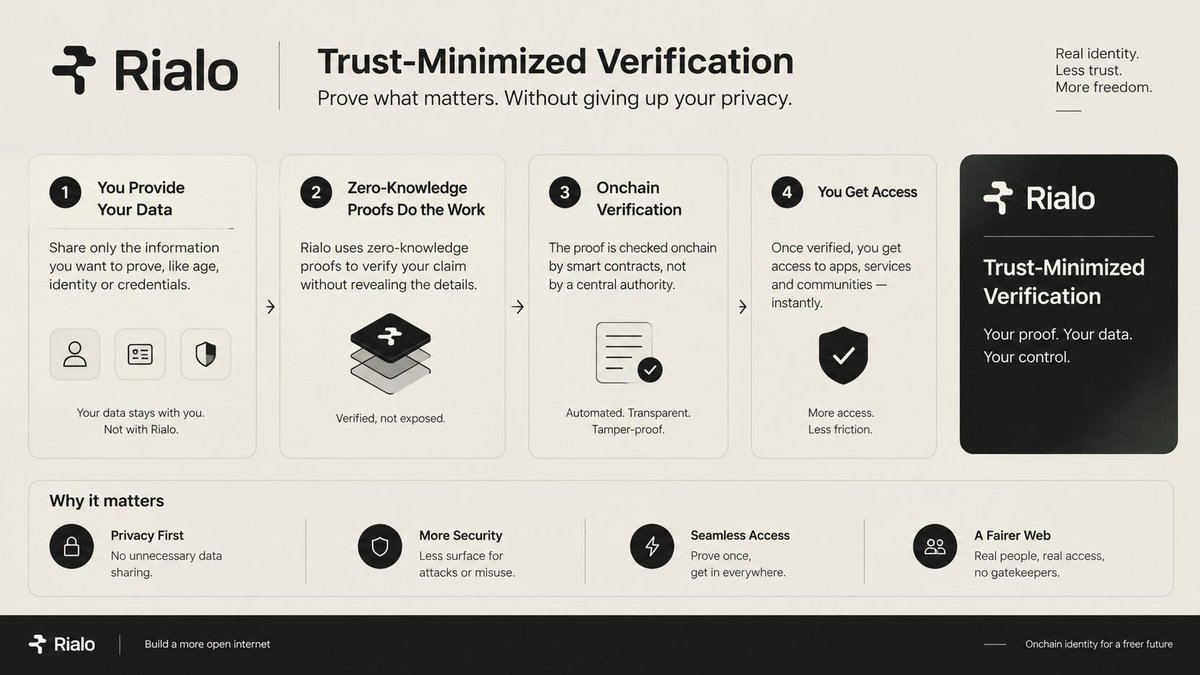
In most real-world systems, data is only as reliable as the party providing or verifying it. Rialo takes a different approach by bringing real-world information into onchain workflows with a focus on trust-minimized verification and verifiable infrastructure.
Instead of asking users and applications to simply “trust the source,” the goal is to make the result cryptographically verifiable. With verifiable computation and proofs, applications can check that a computation or data update followed the expected rules shifting the model from “trust me” to “verify it.”
The powerful part is combining verification with privacy. Sensitive information can be protected while applications still work with verifiable outcomes. That opens the door to more practical Real-World Data, confidential applications, automated workflows, and onchain services.
This is where Rialo becomes interesting: building infrastructure where proofs replace unnecessary trust assumptions. Real-world data → verifiable computation → onchain verification → real utility. Less blind trust. More cryptographic certainty. More possibilities for the real world onchain.
$125,000 $MNTD airdrop is getting closer, and the @PlayOnMint is starting to feel more real.
Every game, every XP, and every move up the leaderboard is adding up.Season 1 has been a fun journey so far, especially watching the competition get tougher.
Now the goal is simple: keep playing, keep stacking, and keep pushing higher.
What I like about MINT is that the progress actually feels connected to the time you put in. You’re not just watching a leaderboard, you’re actively fighting your way up it. There’s still time to improve the position, so I’m definitely not slowing down yet.
The final stretch could get very interesting.
$MNTD Season 1 is almost here, and the $125K reward pool makes the grind even more exciting.
Curious to see where everyone ends up when the season finally closes.For now, I’m staying focused on XP and climbing as high as possible.
Let’s see how far this grind can go.