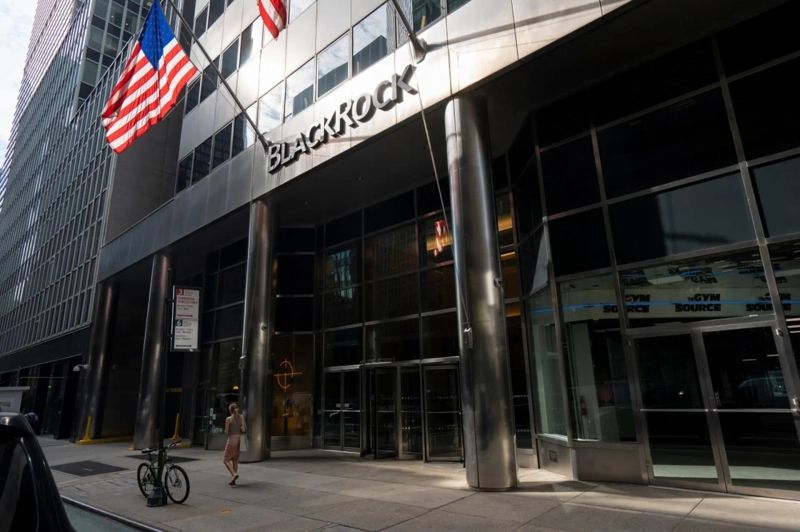
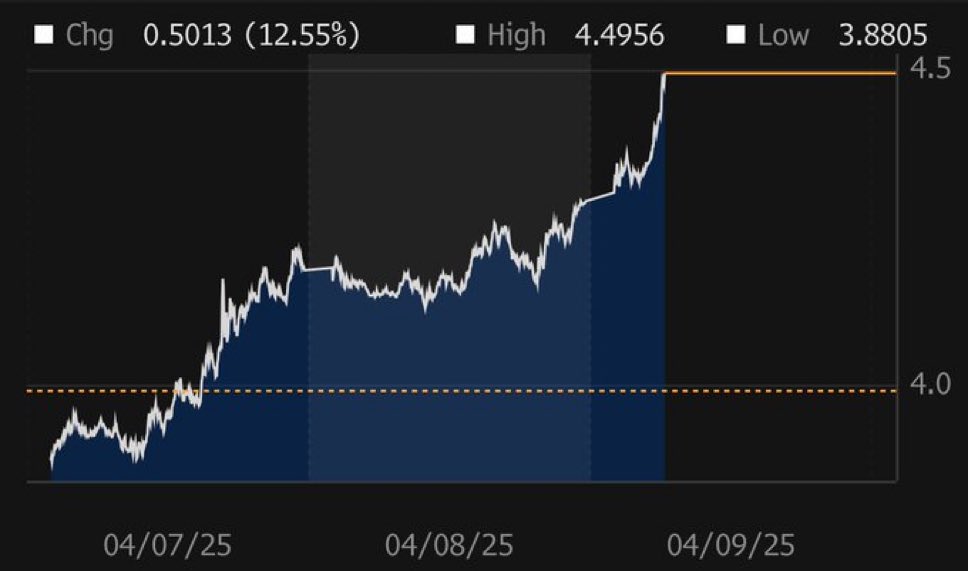
What’s happening with @BlackRock's private credit fund this week isn’t just a market story - it’s a structural problem in traditional finance.
Billions sit in opaque structures. When investors want their money back, the liquidity isn’t there.
This week:
- $1.2B in withdrawal requests
- Only 5% allowed to exit
-Nearly half of investors locked in
Sound familiar? That’s exactly what happened in the subprime crisis - nobody knew where the risk was.
Today, the private credit market is $1.8–2T, with $1.14T of bank loans tied to non-bank institutions.
The same opacity. The same liquidity mismatch.
👉 Onchain finance fixes this.
You don’t need to reveal who owns what, but you can see in real time:
- where positions sit
- leverage levels
- exposures
-systemic risk
Protocols already doing this:
- @aave
- @Morpho
- @maplefinance
- @SkyEcosystem
- @eulerfinance
Crises may still happen, but risk is visible before it spreads.
And this isn’t theoretical - it’s a central topic at the upcoming @ParisBlockWeek, where we’ll dive into how blockchain can prevent the next systemic shock: https://t.co/UQ8BDtRX9d
In a world with $1.8T+ of opaque private credit, that transparency can make all the difference.
I invested €13,930 in crypto in total.
All from 2017 to 2020.
Not a cent more of my fiat has gone into crypto since then.
Only out to filthy fiat (to feed my familia). My salary was simply too low to invest more, and I quit my job in 2022.
Luckily, I made great trades over the years: being early on ETH, later this cycle buying SOL, and finally rotating to HYPE at $12 USD.
But to be fair, it was airdrops that made me.
More precise, the DeFi summer airdrops:
- I farmed $YFI from day one
- Got $UNI, $CRV, $DYDX and almost all notable airdrops from DeFI summer
- The highest airdrop I’ve ever received was $120K USD in $INV for, wait for it, submitting a google form survey promising to help Inverse Finance.
Note: I hoped it would hit $500K, so I didn’t sell at $120K and ended up selling after a 50% drop.
Airdrops was the real 'seed' capital that I leveraged from 2022.
2024 was great in airdrops, too!
From $JTO, $ETFI, $KAITO (thx so much), to my last airdrop 3 months ago, Monad.
The point I'm making: without airdrops I wouldn't have made it to where I am today.
Even if I had put all ~14k EUR into ETH at $200, I would be barely 10x to to 140k EUR. Good money, but not life changing.
And we were super early back then!
Not anymore.
For someone who starts with the same €13,930, the chances of 'making it' are MUCH MUCH lower right now than in the 2018-2022 period.
Sure, ETH could do another 10x. BTC as well. Some moonshots will always appear but catching it with size are slim.
Worst? Is that the machine that made me, airdrops, are dying.
Although I believe they will make a come back, the stories of 100k for a google docs survey or a 20k airdrop for a few swaps are gone.
No surprise that degens turned to 100x perp trades and memecoins. Sadly, they failed to create the wealth effect that airdrops had.
This cycle was not a story of rags to riches, but rather a story of mid-wealth to rags.
So much value destruction that really became apparent when $MELANIA launched and later 10/10 hit.
Anyway... I don't plan to put more EUR into crypto. Only out.
I'll simply recycle my gains trading, airdrop farming etc until I either get generational wealth or lose enough that I will call quits.
And that's the problem: many crypto natives I talk to are like me. Only out, not in.
So institutions are supposed to be our saviours, buying our bags.
But I hope we can create opportunities for our younger selves, notably the Gen Z with 'just' €13,930 to actually make it.
Where are those opportunities? Who are building it?
RWAs, yield stablecoins, 'low-risk DeFi', neobanks etc. are all great products when you already made it because 5% yield on Aave is good enough for you.
But they are not wealth making machines that airdrops were.
What are those opportunities now in crypto? If any?
Markets on everything.
We’re proud to announce that $ICE, the owner of @NYSE and the largest exchange company in the world, is making a strategic investment of $2 billion into Polymarket, valuing us at $9 billion post-money.
Our partnership with ICE marks a major step in bringing prediction markets into the financial mainstream. But in addition to that, it’s a monumental step forward for DeFi. ICE is the one remaining founder-led exchange company, and Jeff is all-in on utilizing his assets, including NYSE, to usher in a new financial era of tokenization. We’re humbled to be working together on this endeavor. ICE will also begin distributing Polymarket data to thousands of financial institutions around the world. There is so much to build when you combine the force of ICE’s institutional scale and credibility with Polymarket’s consumer + cultural savvy and distribution.
The past two years have been surreal. Going from a write off to creating a category, watching our vision become a reality. The Polymarket origin story is funny because it's a rare case of the dream being identical to how things played out. If I learned one thing, it’s that bold ideas are everywhere, hidden in plain sight. It just takes someone crazy enough to spend their life willing it into existence. That’s entrepreneurship: willing things into existence.
I remember reading Robin Hanson’s literature on prediction markets and thinking - man, this is too good of an idea to just exist in whitepapers. There were a million reasons why it shouldn’t work, countless arguments of why not to do it, and the odds were against us, but we had to try.
At the onset of the pandemic, I quite literally had nothing to lose: 21, running out of money, 2.5 years since I dropped out and nothing to show for it. But I knew we were entering an era where ways to find truth would matter more than ever, and Polymarket could play a critical role in that. After all, nothing is more valuable than the truth. It’s still a work in progress, but we’re honored to have made the impact we have thus far.
I’d also like to give a special thank you to all of our users, builders, and community members who have been with us since 2020. Your support will not be forgotten 🔮
Last but not least, I am deeply grateful for all of the support and hard work of my brilliant team. I’m getting to live my wildest dreams, seemingly against all odds, and I don’t take it for granted.
The best is yet to come… 🇺🇸
Que Sera Sera
@BarterDeFi@Dune I have the "Ernest Hemingway once argued that he would make the shortest story that could touch anyone" type of story.
I diligently vibe-coded a small dashboard (spent like 3 mins), but it didn’t run because I was too low on Dune credits.
1) We’re launching something new! Not an upgrade. Not a fork.
Meet Barter’s Superposition v1. We introduce a new way to provide liquidity — Distributed Liquidity Layer inspired by Schrödinger’s idea of superposition. Your assets are in two states at once: 💳 Earning yield while being fully accessible 🗝️ There is no more need to lock your tokens in smart contracts. Available when you need them. Productive when you don’t.
1) Like in chess♟️, every transaction is a move that contributes to the bigger picture. This batch was a carefully planned sequence of transactions leading to optimal execution. https://t.co/ciUWvEE5qQ
The REAL reasons there are fewer liquid funds than VCs in crypto:
1. Volatility – Crypto's volatility is brutal. Most LPs can’t stomach it and tend to redeem near market bottoms in liquid funds, whereas they’re locked up in VC funds. VC positions also get marked at cost, hiding volatility. Psychologically, investing in a crypto VC is 1000x easier.
2. Investment pitch – Crypto VCs pitch themselves as tech VCs, so LPs compare them to tech VCs rather than crypto liquid funds. While most crypto VCs underperform liquid funds, they often outperform tech VCs—so LPs don’t even realize they’re underperforming. Plus, for tradfi allocators, pitching a "tech VC investment" to their IC is far easier than pitching a "crypto trader investment."
3. Liquid investing is very hard – Crypto trading is extremely PvP, requires constant adaptation, and most fail, getting liquidated, selling bottoms, etc. While outperforming as a VC is tough, simply returning more than you started with has historically been much easier.
4. Paper gains – Cycle after cycle, near the top, VCs are up massively on paper from locked positions. They leverage those TVPIs to raise new mega-funds from LPs lured by the numbers. LPs are finally catching on, which is why all VC tokens are underperforming this cycle... but that’s a topic for another post.
5. Performance vc BTC – Corollary of above points. Only liquid funds are benchmarked against BTC. Outperforming BTC is extremely hard, and most liquid funds have failed to do so, making LPs even less willing to allocate to them.
1) Roses are red, violets are blue, love unites people and intents unite them too.
Every day, we help execute plenty of transactions on intent-based systems, and some of them turn out to be unique and worth discussing. Let’s take a closer look at one of our recent transactions that might catch your eye 👀
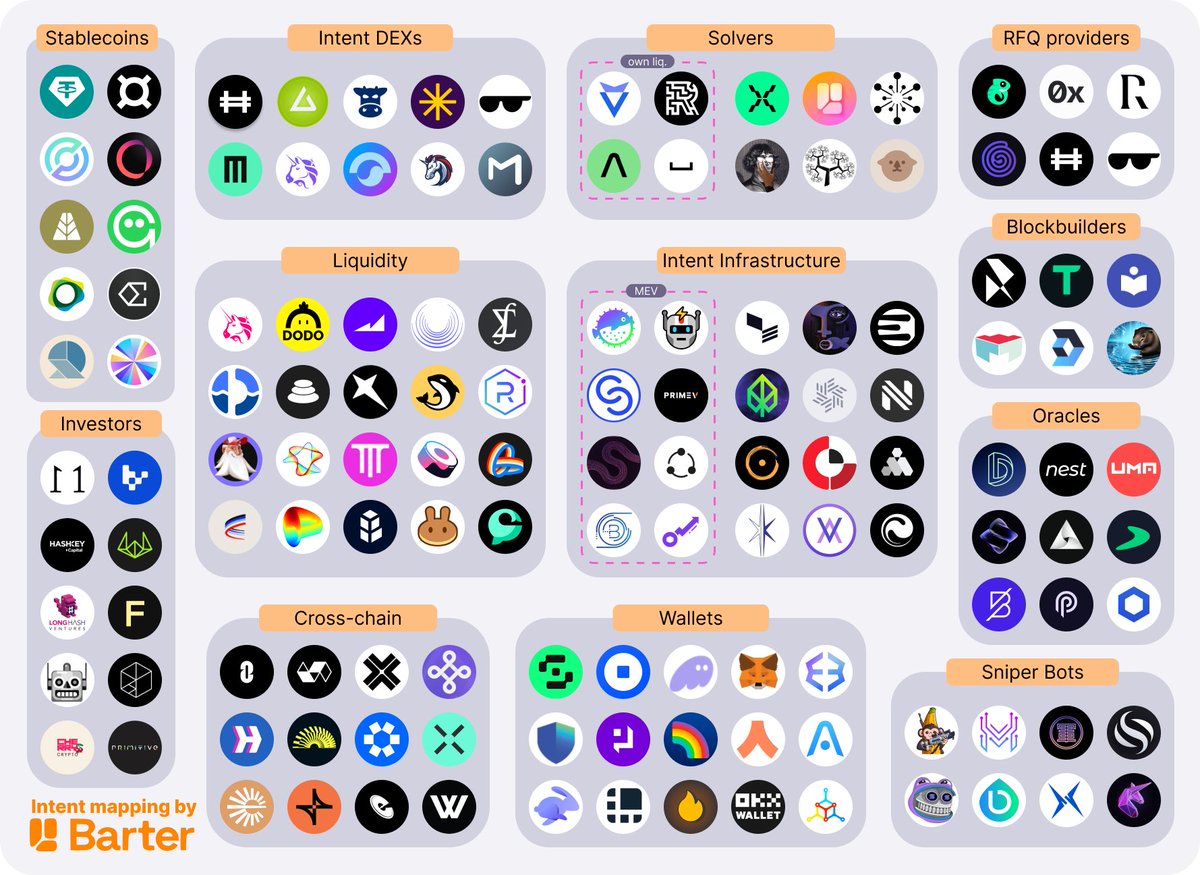
🧵1)Our team sincerely hopes that the old-school DeFi community is as tired of memes as we are, so we’ve prepared an Intent Landscape Mapping. It’s been a while since Intents have been in the spotlight, but we remain 100% committed to this narrative. Our plan is to unveil various Intent primitives and showcase new use cases for intents in a series of posts. But first, let’s quickly recap what we know about Intents and why they matter.