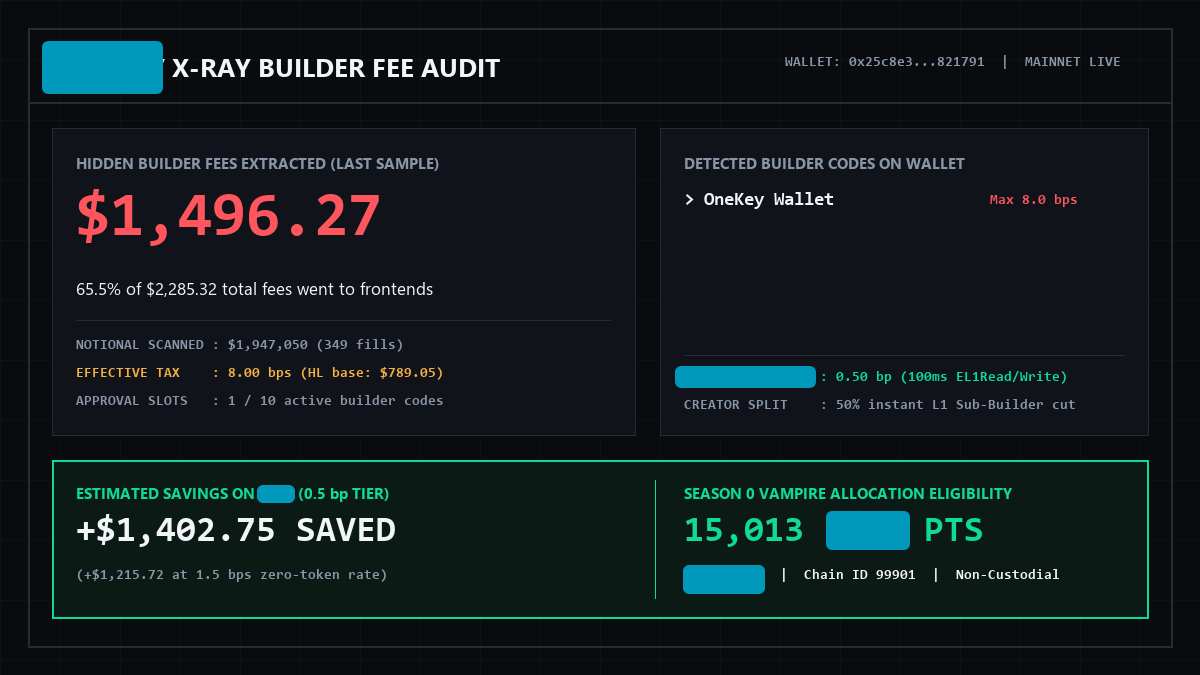
What percentage do frontends such as FOMO and Pumpfun, or wallets such as MetaMask and Phantom, actually capture?
Our tests showed that up to 10 percent of performance can be absorbed by these fees, with no meaningful advantage in return. This finding is set to become one of the primary drivers of the work we have pursued since the beginning.
Our agents must execute orders in milliseconds across every venue. With that capability in place.
I’m really out here cooking hard behind the scenes
I’ve got list of nearly 100 research projects with teams of agents than I can start simultaneously once I build a few more parts
@prometheus7even is a research institute and this may finally allow yall to understand the vision and what the goal is here
Oracle7 can already do real research on its own as a specialist, going to have near a hundred teams of specialists all running together on cpu and with the ability to collaborate and know what the other teams are working on
🫡
Context and task class work together.
In the current example, the context is that Bitcoin has an 87 percent probability of rebounding between 7 and 10 percent. However, more is required before this can be considered a move that changes the polarity of the market.
The task class recognizes that the market is in a zone of two-sided sweeps. Shorting a monthly support in this environment is characteristic of amateur and weekend traders.
Conformal inference will not authorize a position unless both the context and the task class are aligned. An agent will not be permitted to short the current level. It may, however, short the rebound after a buy has already been executed at 62,450 dollars, and only if the intention is to cover the bear trap.
Every decision is anchored in a context. Within that context there is a plan, a time horizon, and a logical sequence of conditions. The process resembles an orchestration of steps, coordinated across both price and time.
12.0.2 HAS BEEN RELEASED!
Oracle7 12.0 is out (release 12.0.2).
From a head you ask to one you work with, in one chat:
- Looks up what it does not hold, and keeps it with its source.
- Explains a topic to the size you ask, every sentence cited.
- Builds programs from plain words: 10 of 10 on a sealed test.
- Repairs your code until your own tests pass, and audits servers.
- Carries projects through: 23 of 23 checked by what actually ran.
- New: the Oracle7 Hybrid Game Engine, Developer Preview.
- Nothing lost: 263 right, 0 wrong on the 600-question reference.
No language model. No GPU. Every answer proved, cited or declined.
https://t.co/Dg7LVbyJJb
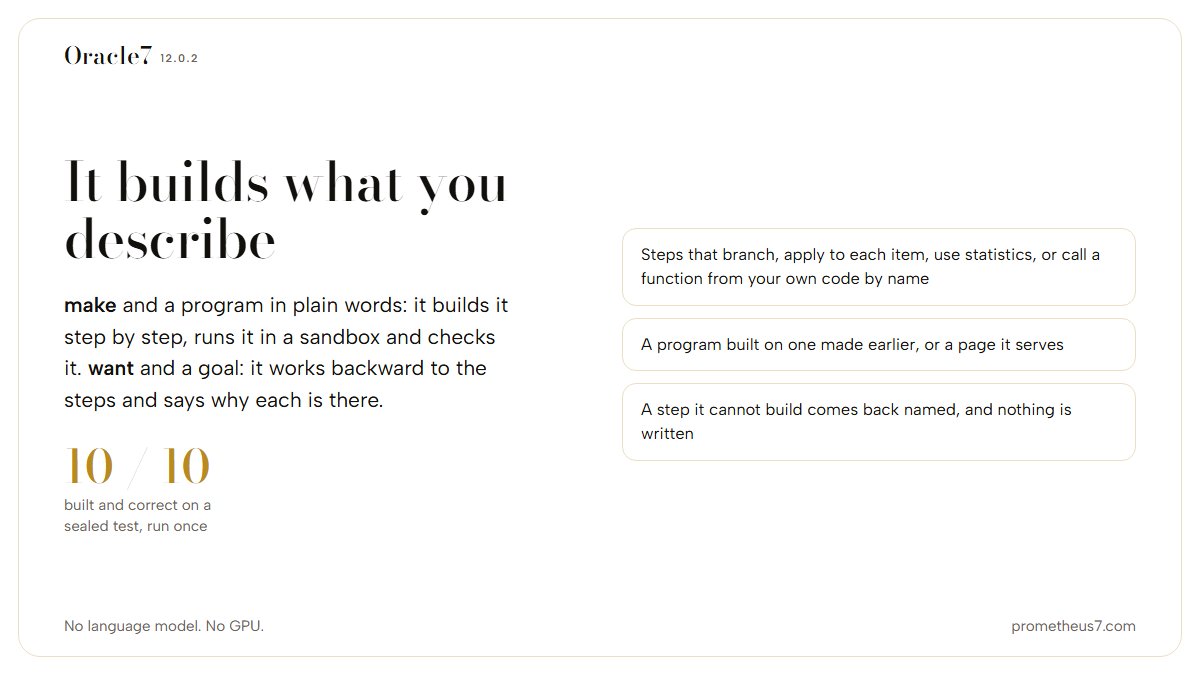
The usual view is that turning a plain description into a working program needs a very large trained model. Oracle7 12.0 does it on an ordinary CPU, step by step, and shows you every step.
Type make and a description: "make total: sum the amount column of numbers.csv where amount is over 10. expect 55." It reads the table in your sandbox, works out the steps and says why each one is there: read the file, parse it as csv, keep the rows over 10, take the amount column, convert to numbers, sum them, print. It builds the program, runs it in a sandbox, and checks the answer against the one you expected: 55, pass.
Steps can branch, apply to each item, use statistics, call a function from your own code by name, or build on a program made earlier. It can make a page and serve it. A step it cannot build comes back named, and nothing is written.
Or state a goal instead of steps, with want: it reads the tables it has, works backward from what you asked for, says why each step is there, then builds, runs and checks it.
On a sealed test of descriptions it had never seen, run once, it built 10 of 10. In 12.0.2 the build tool's own wording also works typed straight into the chat.
No language model. No GPU. Nothing runs until you say go.
https://t.co/Dg7LVbyJJb
About to get to posting for the 12.0.2 full oracle7 release
The oracle7 based game engine to release and the gta6 based oracle7 game called GTAOracle7 which is also releasing and that I will be live streaming for awhile on the oracle7 account
Literally been at it all day 🫡
Honestly really want to work on showcasing this better but one of the more interesting things you can do with oracle7 is run simulated worlds with characters that run on oracle7, talking, speaking and doing stuff all on their own, interacting and all that, because oracle7 is so small on a regular pc you have have hundreds to thousands of instances being individual characters or running individual or groups of mechanics.
This is already possible and I’ve got the @WanderAroundio game running completely on oracle7 as well as @GardenWithEliza which is another game from the @prometheus7 institute, working on a third game that is gta6 inspired as well as an entire site dedicated to games, either games oracle7 is playing or that you can plan with oracle7 as the characters and running the world
I’ll be adding more games too gonna try and get a bunch of old gameboy games and have then running on the site it’s not cpu intensive at all thankfully so I can probably get a good amount of games running and it works create for developing oracle7 as well
Finishing up some of the posts and then the 12.0 announcement will be out!
MONARK v0.10.0 is out.
Meet Genkan, our order gate: a Lean 4 kernel judges every order, allow or deny, before it goes out. 30 machine-checked theorems, among them: an allow always means an order that meets the rules.
https://t.co/s6ABeaEaXY
Announcement
As we move into a pivotal phase between experimentation and production, significant changes will appear across every aspect of the Monark project.
We have made our working workshop on GitHub private. The Monark repository remains public and will host only work that has already been finalized and validated. This is a minor adjustment, but we want to clarify it.
Updates will arrive in stages, beginning with the most useful elements that form the foundation on which crypto investment strategies will be built. These rest on the underlying logic that the crypto market follows. Additional layers will then separate noise from signal.
This separation has become essential. Over the past weeks we have worked on a gate that previously received only numbers and now receives both plans and numbers. In this first phase we want to emphasize strategy and conformal inference. At the same time, anyone who already has a strategy will be able to test it.
The problem facing crypto traders today is the volume of noise, the number of assets, and the proliferation of memecoins. We want our agents to be able to trade across ecosystems from a single account. This is possible through Near Intents or Particle Network and is already on our roadmap. However, it requires a filter, both technical and semantic, that removes residual noise.
A winning plan requires a broader, more preventive, and forward-looking view. It cannot remain fixed on whatever is currently amplified on Twitter. This will be our semantic layer. Dozens of ecosystems continue to advance, yet the relevant questions are where the action will concentrate and where the strongest trends will emerge earlier and with greater intensity than elsewhere. These questions must be answered by a clear plan, examined by both AI and human judgment.
We approach this differently. The semantic layer will function as a central core, a hub that feeds the other agents. It will operate like a weekly newsletter, but with substantially higher value.
We are focusing here because, within our catalog, this solution is expected to deliver the greatest added value both for users and for the Monark token. It is designed for traders, easily configurable, and accessible to those who simply hold the token.
Changes will run from the engine through the interface and into the way we communicate and share information.
I keep adding to my $OPACUS, $ORACLE7 and $MONARK positions at these levels.
The market can shake, sentiment can turn and charts can bleed, but I’m focused on what these teams are building.
I’m not here for every pump. I’m here for the long game.
The market can’t scare conviction out of me. 🦾
NFA / DYOR.