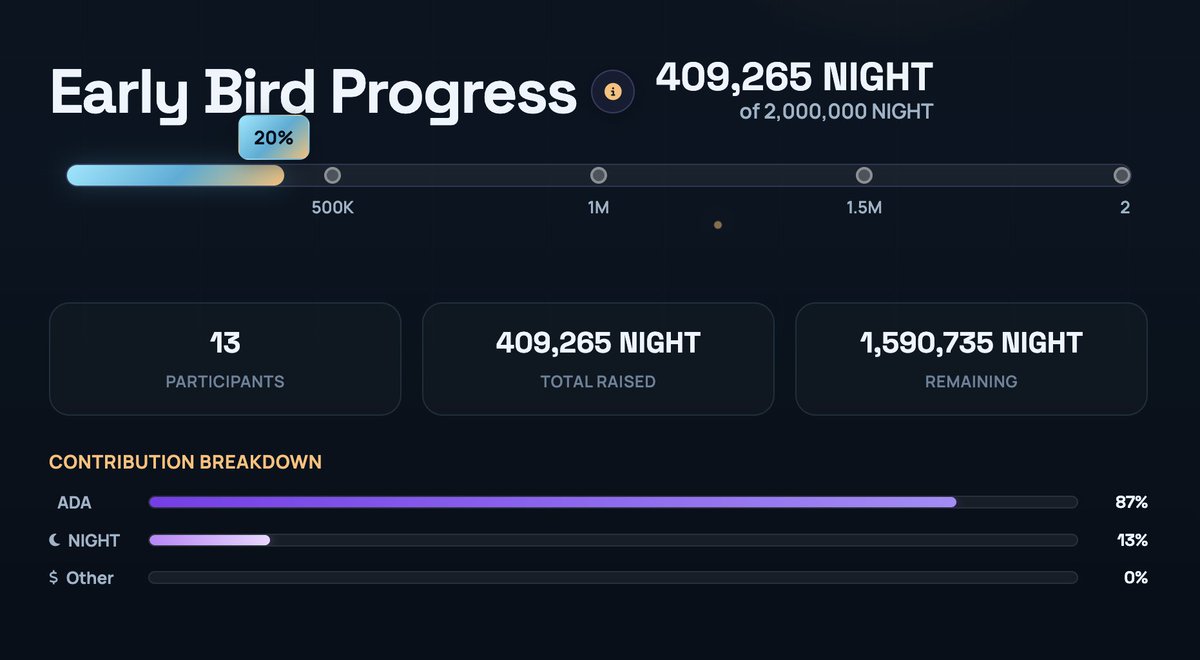
Early Bird: Sold out.
Phase 1 of the main sale opens this Thursday, May 14th.
For those who missed the first sale or those looking to increase exposure to the revenue-sharing model of a powerful Midnight DEX, this is the time!
Phase 2 will begin upon launch at a higher price.
LET THE NORTH STAR SHINE! ✨
The Early Bird ICO is officially sold out.
A huge thank you to the 74 visionaries backing our mission to launch the first ever revenue sharing DEX on Midnight.
We are grateful for your trust and we are committed to make you proud.
An upgraded public testnet is coming soon, with all the features shown in the tutorial.
We’re also preparing a step-by-step guide on how to use the DEX.
Don’t just believe what we say, try the product yourself.
Take action first, then decide if it’s worth the investment.
Here is a full walkthrough of everything coming to our DEX!
🙌 Non-Custodial Trading
🙌 AMM LP management
🙌 Token creation
All in one place guided by the North Star.
The progress is on-going and our Early Bird is now over 50% filled. Thank you!
https://t.co/kNIGWP8GEq
1,000 followers.
35% of the refundable ICO filled.
Public testnet links go live today, along with a full video tutorial on how to make your first swap.
A bright day for those of us who usually navigate by the North Star.
We have already filled 32% of the ICO and it hasn’t even been 24 hours yet.
We are now getting ready to launch the public testnet, where everyone will be able to make their first swap at midnight.
Who’s excited?
The refundable ICO is now open to the public and anyone can contribute.
Duration: Until the 2M $NIGHT cap is reached, 30 days have passed or the product (a non-custodial AMM style DEX on Midnight mainnet) is ready.
Type: First come, first served.
Multiple currencies are accepted, including CNTs. The value of each contribution is fixed at the time of contribution and any later volatility will not be taken into account.
This refundable early bird phase represents the lowest market cap entry, at a $400,000 valuation.
Our commitment to refund participants if the product is not delivered is meant to:
A) give you additional confidence and peace of mind and
B) raise the bar for future crowdfunding campaigns.
ICO Portal 👇
https://t.co/tTx0C3CDSF
Have been running tests on mainnet with real dual token deploys. Things are looking good. Ran into some issues with USD1 pairs on Bonk so I'm currently working on those.
USD1 requires a surprising amount of additional tweaking to keep pegged because of the slippage that naturally occurs from it. Even a 1-2% difference can cause an imbalance over time in the DLMM pool.
Have been running tests on mainnet with real dual token deploys. Things are looking good. Ran into some issues with USD1 pairs on Bonk so I'm currently working on those.
USD1 requires a surprising amount of additional tweaking to keep pegged because of the slippage that naturally occurs from it. Even a 1-2% difference can cause an imbalance over time in the DLMM pool.
"Mate, how do you stop sabotaging yourself in trading? Why do I always end up breaking my own rules?”
Time to drop my whole🧠"9-steps" psychological framework + end bonuses with the hope that you may find interesting ideas for your journey.
Disclaimer: before starting, it’s important to remember that psychology is highly individual. There is no universal fix. The goal isn’t perfection, but building a process that offers the highest statistical probability of correct behaviour over time, aligned with your goals, timeframe, personality, and the amount of emotional energy you can realistically sustain.
(Long post, if your attention timespan is level "Tiktoker", skip it as this post isn't for you)
👁️ First step 👁️
Identify where self-sabotage actually starts.
Most people think self-sabotage starts inside the trade but this is far from true.
It starts before the chart is even opened.
The first thing I do is a state check, not a market check.
I ask myself:
- Am I bored?
- Am I frustrated from a previous loss?
- Am I trying to “make something happen”?
- Am I trading to feel productive, in control, or validated?
If the answer to any of these is yes, then I already know one thing: my edge is compromised, regardless of how good the setup looks.
Self-sabotage is rarely technical, it’s contextual.
👁️ Second step 👁️
Separate execution from emotional regulation.
This is a hard pill to swallow:
If I’m using trading to regulate emotions, I’m not trading..I’m coping.
Common emotional drivers behind rule-breaking:
- Entering early to relieve impatience
- Oversizing to feel confident
- Revenge trading to restore self-esteem
- Overtrading to escape boredom
- Holding losers to avoid being wrong
The market is not a therapist.
It amplifies emotional imbalances instead of fixing them.
So my rule is simple:
I only trade when I don’t need the trade.
Neutral state > confident state.
👁️Third step 👁️
Redefine discipline (this is crucial)
Discipline is not willpower.
If discipline were willpower, everyone would be profitable after reading one book.
In reality, discipline fails when it conflicts with identity.
A slow, repetitive, boring execution style threatens people who:
- Associate value with intensity
- Confuse action with progress
- Need stimulation to feel engaged
- Seek validation through performance
That’s why many traders unconsciously sabotage consistency:
consistency feels empty to an ego addicted to highs.
The solution isn’t “try harder”.
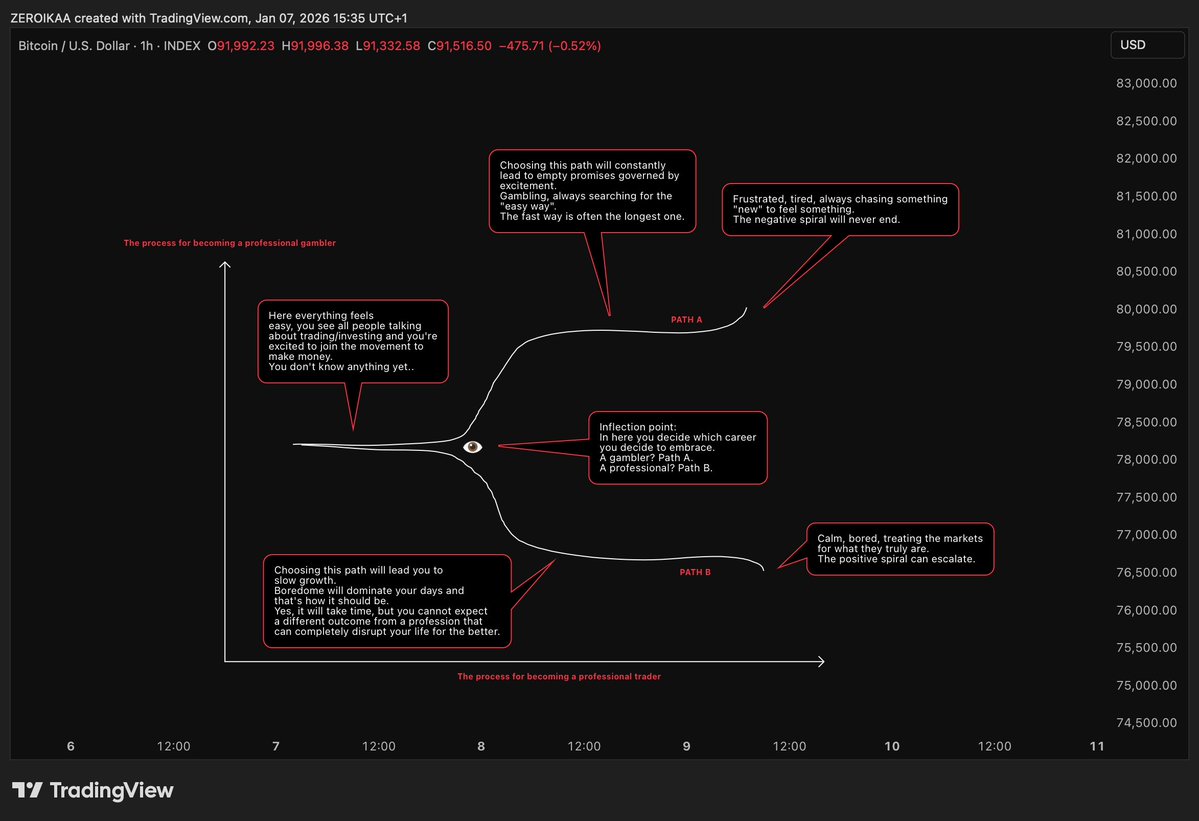
The solution is learning to tolerate boredom without acting.
👁️Fourth step 👁️
Build rules that protect you from future you.
Under stress, nobody becomes more rational.
We rationalize worse decisions.
That’s why rules must be:
- Predefined
- Written
- Mechanical
- Non-negotiable in the moment
What do you mean?
- Fixed risk per trade
- Max trades per session
- Mandatory cooldown after a loss
- No re-entries without a full reset
- No size increase after red days
Rules exist to protect you from the version of yourself that shows up under pressure.
If a rule can be “reinterpreted”, it will be.
If a rule will be "reinterpreted", your profitability will be.
👁️Fifth step 👁️
Treat boredom as a performance indicator.
This was a game changer for me.
High-quality trading feels:
- Uneventful
- Repetitive
- Emotionally flat
- Yes, sometimes disappointing
If I feel excitement, urgency, or adrenaline, that’s valuable information, not motivation.
Usually it means:
- I’m forcing something
- I’m anticipating instead of reacting
- I’m trading emotion, not structure
The market rewards restraint, not stimulation.
If you need excitement, trading will punish you until you don’t.
👁️ Sixth step 👁️
Losses must be operational, not psychological.
A loss should not change behaviour.
If it does, then:
- Risk was too high
- Expectations were unrealistic
- Identity was attached to outcome
Rules I live by:
- No “making it back”
- No immediate revenge trades
- No size adjustments to fix emotions
- No narrative after a loss
Losses are part of the whole distribution.
The moment I try to fix them, I step outside the system.
👁️Seventh step 👁️
Reduce outcome relevance to near zero.
No single trade matters.
No single day matters.
No single week matters.
The brain wants meaning while trading runs on probability.
The urge to “make today count” creates:
- Overtrading
- Forcing setups
- Emotional execution
My only real question is:
“Did I behave like someone who plans to still be here in 6 months?”
If yes → good day, regardless of PnL.
👁️ Eighth step 👁️
Stop mistaking intelligence for edge.
This one hurts.
❗️Understanding the market does not equal profitability ❗️
Smart traders often fail because:
- They override rules
- They reinterpret setups
- They seek confirmation
- They believe insight should be rewarded
The market doesn’t care how smart you are.
It rewards consistency, not cleverness.
If you need to feel smart, trading will humble you repeatedly.
Try to remain as humble as possible.
Try to stick to your idea with an open mind.
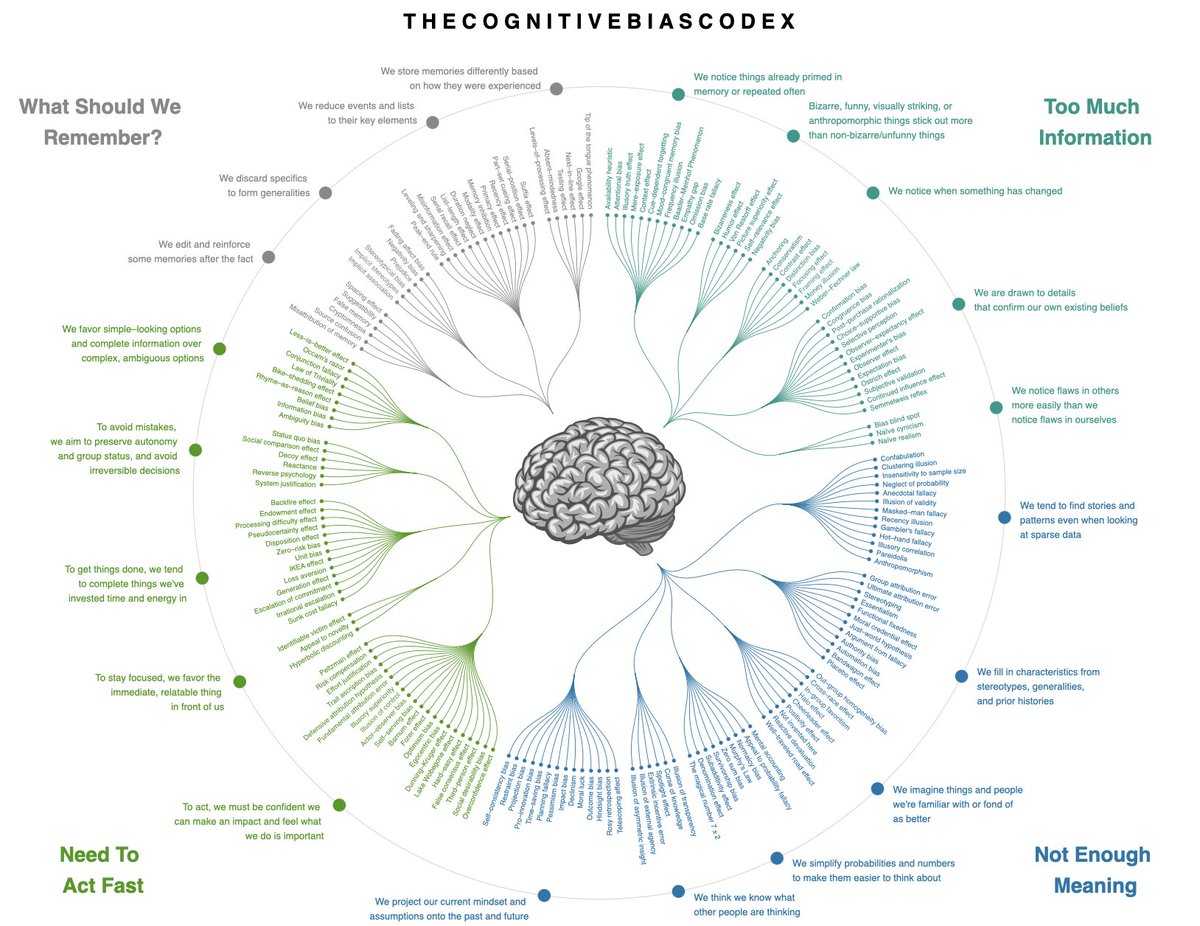
In this specific context I help myself with the "Cognitive Bias Codex" developed by Dr. Gary Fox, something extremely useful.
👁️ Ninth and final step 👁️
Make trading impersonal.
Auto-sabotage fades when trading stops being personal.
When it becomes:
- A process, not a proving ground
- A routine, not an escape
- Execution, not something to identify yourself with
The market will never judge you, test or challenge your intelligence.
It’s simply exposing how you behave
when money, uncertainty, and time pressure collide.
Master that and I promise you, strategy becomes the last thing you will think about.
👁️End bonuses 👁️
These are posts that you should save, print and attach on your wall:
- My trading routine: https://t.co/josMgig9ET
- Probabilistic mindset:
https://t.co/06mEOAHpTi
- Breaking the rules:
https://t.co/OZoAaploaq
- Rules to follow:
https://t.co/A6FQO2EhZD
If you found this useful, the like and repost buttons are just a few centimeters below.
If you didn’t, you probably weren’t meant to read it anyway.
Just transferred most of the LP to a new pool and site should reflect that shortly. Testing out a slightly different strategy to encourage arbs to help naturally rebalance the pool, but overall, looking solid and I can start to expand this to be a universal tool.