Who I Am & What You’ll Find Here ☀️
Most people come Polymarket to gamble.
I came to understand how the world really moves.
And if you’re here, you’re probably the same.
This account is dedicated to one thing:
-> turning chaos into information and information into edge.
Polymarket isn’t just a betting platform.
It’s a real-time probability engine.
A collective brain.
A place where narratives form before the news catches up.
If you know how to read the signals, you stop guessing…
and start predicting.
—
Every day, I break down:
underpriced markets
trader behavior
order flow intelligence
catalysts nobody saw coming
insider footprints (the subtle ones)
mispriced narratives that are begging to move
Not hype.
Just signal.
—
You’ll see three main types of posts here:
• Morning: Degens Breakfast ☕️
A quick hit of Polymarket humor, CT energy, and trending narratives.
• Midday: Market Juice 🍊
Readable, sharp analysis of a key trend or market shift.
• Evening: Alpha Drop 🍒
A bold lean. A clean thesis. A market others are mispricing.
Consistency > luck. 💪
—
I’m not here to spoon-feed predictions.
I’m here to show how traders think when they stop gambling
and start treating probability like a weapon.
If you understand:
time → sentiment → incentive → liquidity → outcome
then you can read Polymarket like a map.
—
I also cover:
• risk-free strategies
• delta-neutral farming
• spread exploitation
• cross-market arbitrage
• trader psychology
• why certain odds shouldn’t exist
• and how to spot the narrative moments that break a market open
If it gives you an edge, I talk about it.
—
I don’t pretend to know everything.
But I know how to track the people who actually do:
The silent whales.
The early movers.
The wallets that flip markets before anyone notices.
Patterns don’t lie.
People do.
—
Polymarket is still early.
Before mainstream adoption.
Before US users.
Before the liquidity floodgates open.
This is the moment where small accounts learn the habits
that become big accounts later.
Stick around and you’ll see it happen in real time.
—
If you’re new, welcome.
If you’re experienced, you’ll feel at home.
If you’re here to win, you’re in good company.
Hit follow.
Stay sharp. and join community on @PolymarketTrade & @zscdao
Let’s build probability literacy together one narrative at a time.
We don’t bet.
We price reality.
Ten years ago, I was spending 14 hours a day on my computer trying to make money and yapping with friends
My only outings were gym and groceries
I never would’ve thought that ten years later, with enough money for a lifetime, I’d still be doing the exact same shit 🤣
How to farm yield, harvest volatility, and stay delta-neutral on @Polymarket
1/ The basic idea
Most traders treat Polymarket like a sportsbook.
Smart traders treat it like a place to farm risk-free yield while exploiting mispriced long-dated markets.
The trick?
Using Split and Merge to stay delta-neutral, earn APY, and attack volatility without directional exposure.
2/ Why this works
Long-dated markets (ex: elections 2026–2028, recession timelines, tech milestones) pay around 4 percent APY for simply locking capital.
But spreads are thin.
Liquidity is shallow.
Prices move 3–7 percent on noise.
This combination creates organic mispricing.
And mispricing means opportunity.
3/ Delta-neutral farming in practice
Here’s the core loop:
Step 1: Pick a long-dated market (ex: US recession by end of 2026).
Step 2: Use Split → 1 USDC becomes 1 Yes + 1 No.
Step 3: Hold the pair. You’re earning ~4 percent APY.
Step 4: When the market overreacts (ex: Yes jumps from 48c to 54c), sell the expensive leg.
Step 5: Buy it back when the price normalizes.
Step 6: Merge back into USDC when needed.
You never take directional risk — just harvesting volatility + APY.
4/ Why this is alpha
Because Polymarket is still early.
Liquidity isn’t deep enough to prevent spikes.
Retail flow reacts emotionally.
News shocks produce 10–20 percent wicks on outcomes that shouldn’t move at all.
You’re farming the sentiment premium, not the event.
Think of it as running a tiny market-making operation with no tech stack required.
5/ A real example
In the “Recession by 2026” market:
Yes traded 48c → 56c → 50c in the same week
Depth under $15k
No side barely moved
A delta-neutral farmer could:
Split at 50c/50c
Sell Yes at 56c
Rebuy at 50c
Earn APY the entire time
Merge back to USDC whenever you need liquidity
No prediction.
Just farming the noise.
6/ Why big traders don’t do this
Because it requires:
Patience
Understanding market microstructure
Monitoring volatility
Not chasing narrative swings
Degens want dopamine.
This strategy prints boring money.
The best kind.
7/ Risk factors nobody talks about
It’s not magic. Here’s what can go wrong:
Event actually starts trending → one leg becomes illiquid
Liquidity dries up → wide spreads
Resolution rules shift unexpectedly
Keeping too much in long-dated markets reduces opportunity cost
This isn’t “free money”, but it’s close when done right.
8/ Why this works best in December–February
Historically (yes, there’s data):
Liquidity inflows spike
Markets move on year-end macro releases
Narrative volatility rises
Retail traders switch between hype cycles (AI → elections → wars → crypto)
You get volatility without new information — the ideal environment.
9/ How to scale
Start with $200–500 and test:
Split/Merge timing
Spread reactions
Price elasticity
Liquidity thresholds
Then scale into $2k–5k once you understand how markets breathe.
This is the strategy where experience scales better than capital.
10/ The real secret
Polymarket isn’t just about prediction.
It’s about liquidity behavior.
Most traders don’t know that:
Liquidity ≠ direction
Price ≠ truth
Volatility ≠ information
APY ≠ free yield
Spread ≠ risk
Noise ≠ randomness
If you internalize that, you already beat 90 percent of the platform.
11/ The closer
Everyone chases the big narrative trades.
Few farm the structural mispricings.
And that’s exactly why the edge still exists.
Trade direction when you believe in your read.
Farm delta-neutral when the market doesn't know what it's doing.
The quiet money lives in the noise.
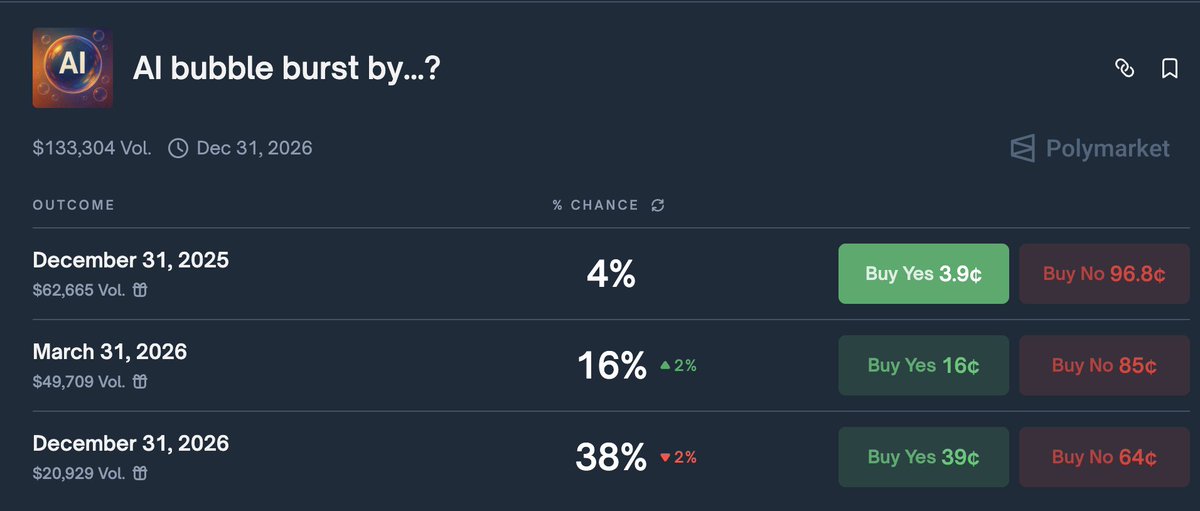
The Polymarket odds on an “AI bubble burst” are telling their own story.
Only 4 percent for a 2025 pop, 16 percent by March 2026, and 38 percent by end of 2026 which means traders are pricing a slow leak, not a blow-up. What’s wild is that public comps already show stress: enterprise AI spend is slowing quarter over quarter, model training costs keep rising, and private valuations haven’t cleared in months.
If this was crypto or SaaS, these signals would be pricing 60 to 70 percent odds, not 16.The market is anchored on the narrative, not the numbers.
Sometimes the smarter play isn’t predicting when it bursts it’s noticing the odds aren’t accounting for the pressure building underneath.
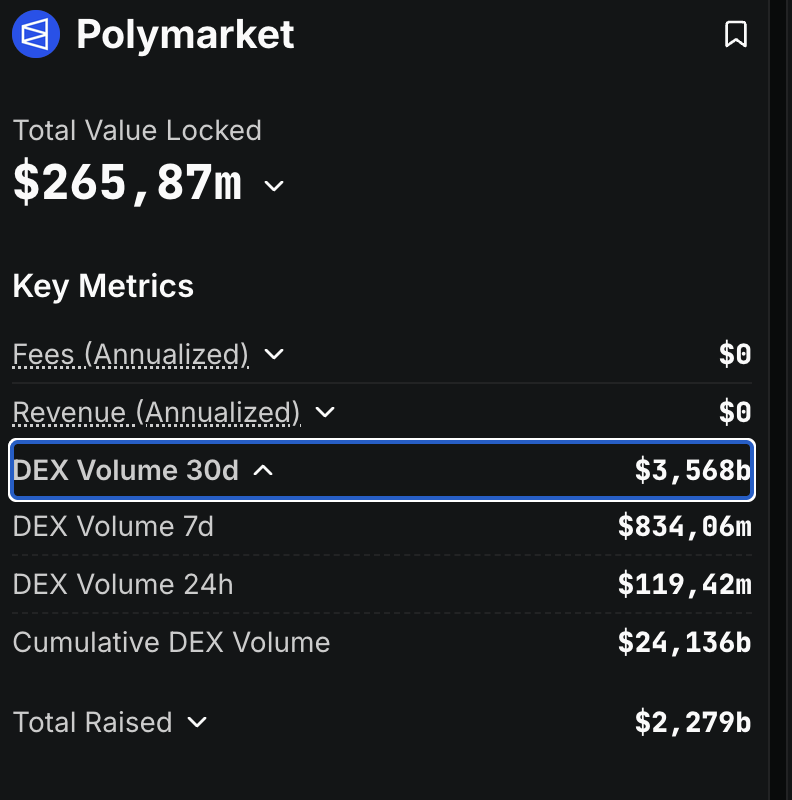
Polymarket’s last 30 days printed over 3.56b in DEX volume with a TVL sitting near 266m.
That’s a ratio most perp exchanges would kill for: the platform is turning over its collateral more than 13 times a month while still showing zero fees on chain.
When a prediction market starts cycling liquidity like a futures venue, you stop calling it a niche product and start treating it like an emerging asset class.
The tape already moved. People just haven’t noticed yet. @Polymarket
Gm Polyfam
Every morning I open Polymarket like it’s a weather app for degenerates: recession risk on page one, AI mania on page two, and a random football prop deciding my mood for the day.
December is when the markets stop pretending to be rational and start behaving like they know something we don’t.
The Polymarket x UFC deal is way bigger than a logo.
They made Polymarket the official and exclusive prediction partner for UFC and Zuffa, with a live Fan Prediction Scoreboard baked into every broadcast. Odds will tick on screen while the fight shifts crowd sentiment becomes a tradable signal.
The edge is simple: the scoreboard reacts slower than the tape. Knockdowns, control time, momentum swings… price often jumps before the broadcast catches up.
If you can read the liquidity moment when the crowd overreacts 10–20 %, you trade the reversal while everyone else is still watching the replay.
Fight night just became a new session. The cage is noise. The orderbook is the truth.
One of the strongest edges right now is in long-dated markets with holding rewards where volatility is artificially high.
Markets like “US recession by end of 2026” and “2028 presidential winner” regularly swing 3–5 percent intraday on low depth but the APY stays constant.
The play is simple:
When the book overreacts, you split into Yes/No, sit delta-neutral, farm the yield on inflated notional, then merge back once price normalizes.
You’re not trading direction you’re harvesting volatility the market pays you to wait for.
Most traders chase the move.
A few quietly collect the APY someone else is too emotional to earn.
Gm gm.
December on Polymarket is when traders suddenly act like probability monks: reading rule pages at 7am, hedging recessions, betting wars, and pretending their NBA parlays are part of a diversified macro thesis.
If discipline was a token, half of us would already be insolvent.