MicroStrategy has acquired 55,500 BTC for ~$5.4 billion at ~$97,862 per #bitcoin and has achieved BTC Yield of 35.2% QTD and 59.3% YTD. As of 11/24/2024, we hodl 386,700 $BTC acquired for ~$21.9 billion at ~$56,761 per bitcoin. $MSTR https://t.co/79ExzXk4UM
$MSTR has completed a $3 billion offering of convertible notes at 0% coupon and 55% premium, with an implied strike price of ~$672. https://t.co/GzO0br0Xfh
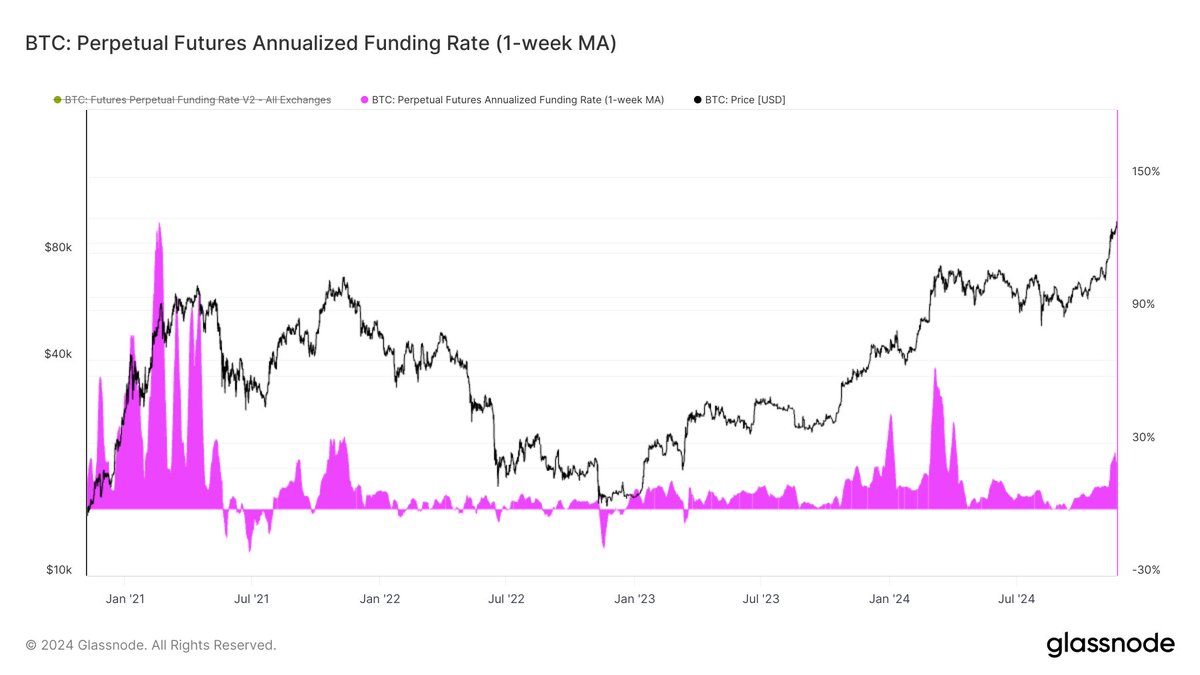
A look at the $BTC native cost of capital, and how this ATH compares to last:
Firstly, shown below is the annualized interest rate to go long $BTC perpetual futures (contracts with no expiry).
Naturally, the masses most always want to be net long BTC, thus, a positive cost of capital. The interest rate is determined by the relative pricing between the spot market and the futures market. If futures are very extended above spot prices, the funding rate will be high (>100% annualized at times).
How is this cycle different (or the same) compared to 2021 you ask?
The piping has been built out between TradFi and crypto to effectively arbitrage this rate (that reached insane heights in 2021).
$BTC native demand for $USD borrow is always high, most especially in bull markets, but in the previous cycle there was no way for TradFi to safely enter this neo-interest rate swaps/credit market.
This time is different.
Bitcoin ETFs provide an avenue for billions to pour into the spot market. In addition, $BTC futures on CME are more liquid than ever, and options just got approved on the spot ETFs this week. This gives Wall St both legs of the trade to play. Last cycle, if you wanted to capture the spread between futures and spot, you might've found yourself trading on FTX......
So, what does this all mean? This tug of war between an international desire to short fiat in order to long $BTC skyrockets borrow rates- but this time, the regulatory environment, investment vehicles, and most importantly liquidity exists for increasingly massive delta neutral positioning to capture 15-20% APR rates in futures, options, etc. in exchange for forgoing directionally long BTC exposure.
The second and third order effects are large. Firstly, expect a tidal wave of structured products built upon $BTC to arise. $MSTY (covered call ETF on $MSTR) is a great example here.
Additionally, this also means the supply of credit coming for collateralized bitcoin loans and structured products is going to be M A S S I V E over 2025.
Structurally, what's taking place is a repricing of $BTC as a collateral asset. When you see a $3b $MSTR 0% coupon convertible at a 55% conversion premium that was over-subscribed; this is merely a sign to come over the next year ahead.
TradFi is massively underweight $BTC exposure where it matters; in the bond and credit markets.
This will change, and in the proceeds, $BTC reprices closer to gold as a global monetary asset.
The bond market is open to $BTC.
The walls of Troy have been breached.