We are delighted to welcome Prof. Young Mee Jung from Kangwon National University, Korea to the #ICORS2026 as a keynote speaker!
Title:
💡 “Versatility and Applications of Raman Spectroscopy in Bioassays”
👉 Learn more: https://t.co/65UDSbTqYd
#RamanSpectroscopy
Low-cost #graphene from nanocellulose:
#Nanocellulose converted into #biochar can reportedly be used to produce high-quality graphene.
Full article at: https://t.co/GVhhuvCYhh
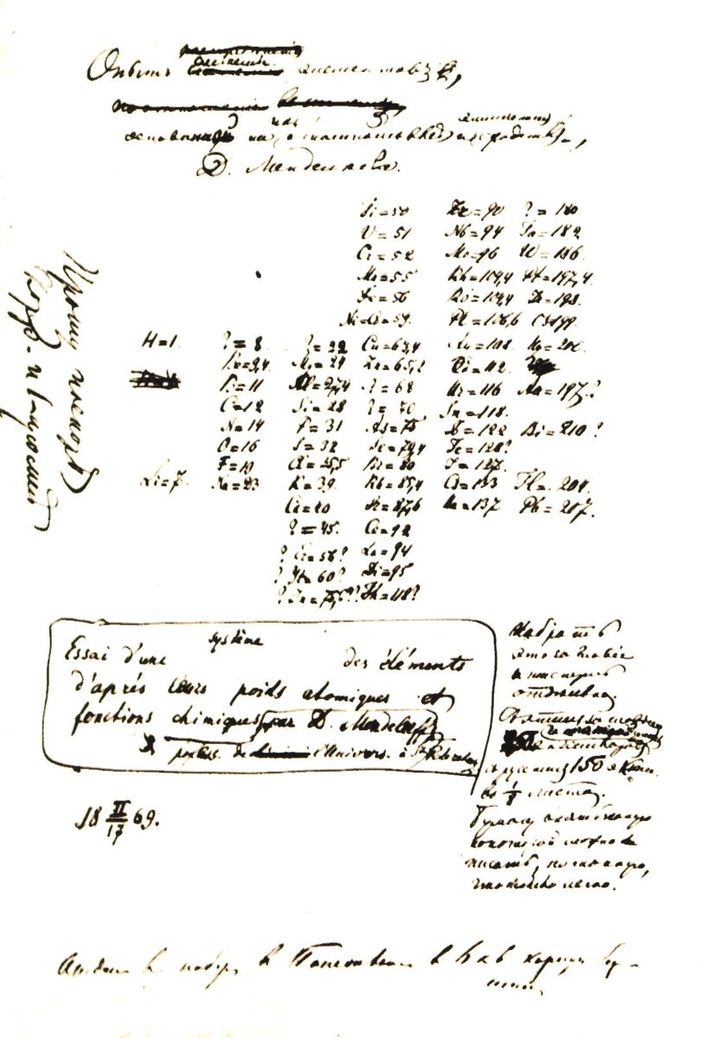
Chemist and inventor Dmitri Mendeleev first presented his periodic table on this day in 1869 to the Russian Chemical Society.
The periodic table is an arrangement of chemical elements, ordered by their atomic number, electron configurations, and recurring chemical properties. The first periodic table contained 56 elements. This number has now increased to 118.
Mendeleev was nominated for the 1906 Nobel Prize in Chemistry for the periodic system, but the Nobel Committee instead recognised French chemist Henri Moissan who isolated the element fluorine in 1886.
Since then, several scientists have received Nobel Prizes for their contributions to Mendeleev's table. Discover more about how our laureates have added to the periodic table: https://t.co/UahWAZGTCb
Image: Mendeleev’s handwritten version of the periodic table, dated 17.02.1869
Magic-angle graphene is created by layering sheets of graphene twisted at a slight angle of around 1° with respect to each another.
https://t.co/yAlzCUG5WC
#A hybrid interdigitated back-contact solar cell has achieved a record 27.81% efficiency, approaching the theoretical limit for silicon cells and marking a major advance in photovoltaic technology. @nature https://t.co/tTiFD8FtBS https://t.co/I8W5j4dK0Z
Have you ever heard about van der Waals forces?
The term in molecular physics is named after scientist Johannes Diderik van der Waals. Van der Waals forces are relatively weak intermolecular forces between atoms or molecules.
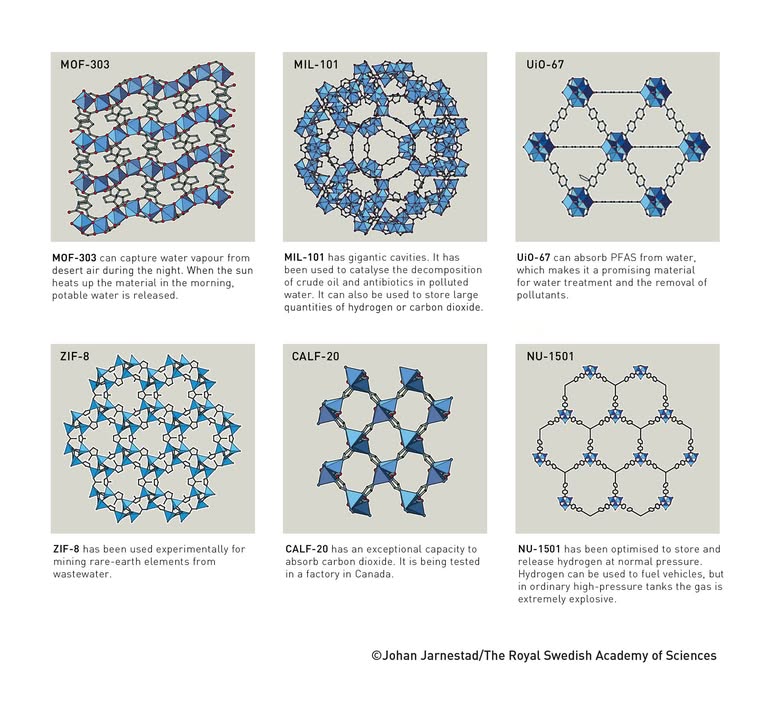
Since the groundbreaking discoveries of the 2025 chemistry laureates, chemists have created tens of thousands of metal–organic frameworks (MOFs).
These versatile materials could help tackle some of humanity’s greatest challenges – from removing PFAS from water and breaking down pharmaceutical residues in the environment, to capturing carbon dioxide and harvesting water from desert air.
Through the development of metal–organic frameworks, 2025 chemistry laureates Susumu Kitagawa, Richard Robson and Omar Yaghi have provided chemists with new opportunities for solving some of the challenges we face.
Following the laureates’ groundbreaking discoveries, researchers have created numerous different and functional metal–organic frameworks (MOF). So far, in most cases, the materials have only been used on a small scale. To harness the benefits of MOF materials for humanity, many companies are now investing in their mass production and commercialisation. Some have succeeded. For example, the electronics industry can now use MOF materials to contain some of the toxic gases required to produce semiconductors. Another MOF can instead break down harmful gases, including some that can be used as chemical weapons. Numerous companies are also testing materials that can capture carbon dioxide from factories and power stations, to reduce greenhouse gas emissions.
Some researchers believe that metal–organic frameworks have such huge potential that they will be the material of the twenty-first century.
On 8 December, our three 2025 chemistry laureates will be sharing more about their research into MOFs in their Nobel Prize lectures. Tune into our live stream at https://t.co/m577HIID0a to find out more.
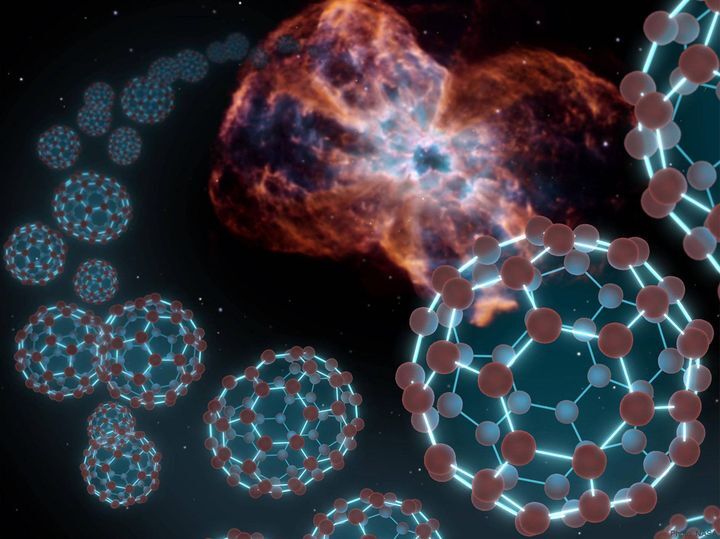
Carbon is an element that can assume a number of different forms. In nature, for example, it can be found as graphite or diamonds. In 1985, Robert Curl, Harold Kroto and Richard Smalley discovered a brand new form - the fullerene.
Curl, Kroto and Smalley irradiated a surface of graphite with laser pulses so that carbon gas was formed. When the gas condensed, previously unknown structures with 60 and 70 carbon atoms were formed. The most common structure had 60 carbon atoms arranged in a sphere with five and six edges, resembling a football. The structures were called fullerenes in honour of architect Buckminster Fuller, who worked with this geometric shape. The paper 'C60: buckminsterfullerene' was published in Nature on 14 November 1985.
Curl, Kroto and Smalley shared the 1996 Nobel Prize in Chemistry "for their discovery of fullerenes."
Photo: (Left to right) Kroto, Curl and Smalley in 1996
On this day 40 years ago, a group of scientists published a journal article only two pages long that revolutionised nanotechnology. They had stumbled upon a strange football-shaped molecule. Their discovery of C60 known as buckminsterfullerene or the “buckyball” scored them a Nobel Prize.
#Advanced imaging techniques now enable real-time analysis of hybrid water electrolysers, clarifying how electrocatalysts produce hydrogen and valuable organic compounds simultaneously. https://t.co/sBFWgFjeSS https://t.co/GGuSsaBXuR