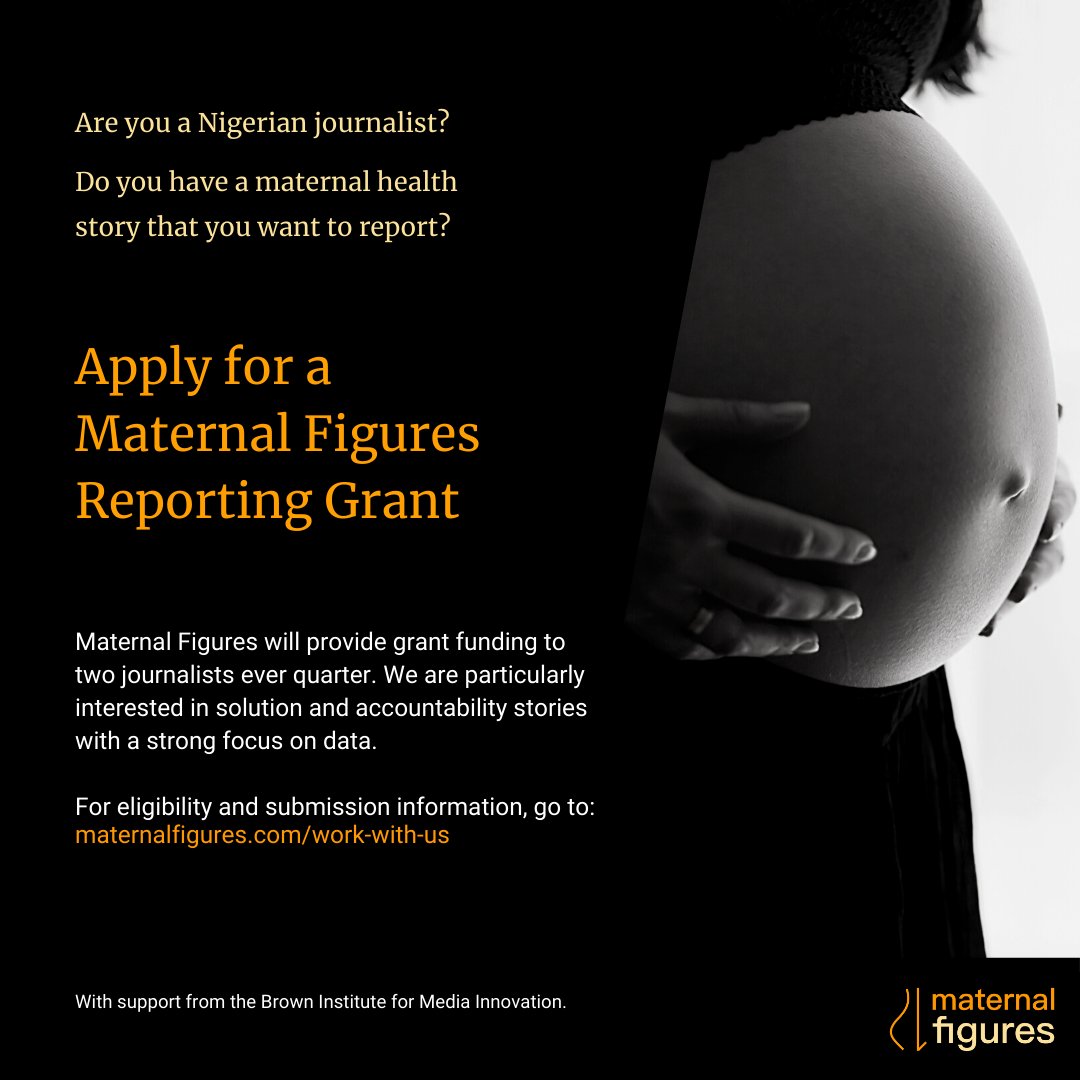
We're looking for journalists who are covering unreported maternal health stories. Think you have a good story but need some support to report it?
Apply for one of our grants! We award two grants every quarter and applications are welcome anytime. https://t.co/W0LAfn1XVV
Shrinking Lakes – the new project by @infoNILE and @Code4Africa – was produced over 2 years, 9 journalists from 🇰🇪, 🇺🇬, 🇷🇼 & 🇹🇿 to tell the status of African lakes & their biodiversity.
An example of African collaborative/transnational journalism https://t.co/F3Q3xyQ3SD
Kudos!
Good to know about @maternalfigures and the solutions they bring onboard in maternal health in Nigeria. At the Wits University @Journ_SA listening to Chukwuma Asuzu on this. Really amazing.
How @maternalfigures is expanding its reach and finding new users🤰🏽
A few months into the #JamlabAcceleratorProgramme, Maternal Figures is targeting new users and diversifying who has access to our database.
https://t.co/j0oJtLcRf6
We've also got an average time spent that's just a little less than 4 minutes, which is significantly higher than the 1.82 minutes that's the average for news sites (Pew, Q4 2020). That said, we're not exactly a news site or have as many pages as one would.
But those 5 are relatively popular programmes with press clips from well known funders. The top Google searches to us are @LUTHofficial's IVF Centre, PHCUOR by @Fmohnigeria, and @UNICEFNG-funded maternal health projects. Projects that may not have a lot of coverage.
The Top 5 interventions people come to the database to read details about are the MNCHW by @Fmohnigeria & @NphcdaNG, CHIPS by @NphcdaNG, NEMCHIC by @NphcdaNG, the Nigeria States Health Investment Project (NSHIP), and @USAIDNigeria's IHP programme. We're the top search for these.
Haven't checked the stats for @maternalfigures since the database went up in late 2020 until today. We've got about 18K page views since (13.5K sessions) and 65% of those are via Organic Search. We haven't spent a dime on ads but are a top search for maternal health in Nigeria.
With the support of @pulitzercenter, Maternal Figures research editor @ashleyokwuosa reported on how @NphcdaNG NEMCHIC initiative reduced maternal deaths in Nigeria since its implementation. https://t.co/wNXsUedVl7
This isn’t the 1st time Nigeria has pushed the “emergency” button for public health. In 2017, Dr. Shuaib spearheaded the agency's fight against polio in a similar strategy, & the WHO declared the country polio-free in 2020.
Nigeria has among the highest maternal, infant, and child mortality ratios in the world. @ashleyokwuosa reports for @maternalfigures on how Nigeria is organizing emergency efforts to reduce these numbers, overcoming COVID-19 and government setbacks. https://t.co/gPT7nVwMY5
How @maternalfigures is building a new model for tracking maternal health in Nigeria 🇳🇬
Maternal mortality is one of Nigeria’s most persistent health issues. Here’s how Maternal Figures is making information about this more accessible for everyone.
https://t.co/HcMbocosd6
For The Precision, @maternalfigures fellow, @talcares, writes about @OndoStateHealth's Abiyamo Scheme and how it plans to pick up from where the state's Abiye (Safe Motherhood) programme. https://t.co/cT1Cv0hv0e
For BONews, @maternalfigures fellow, @OladunjoyeBles1 writes about Nigeria's National Disability Law and its impact on maternal health. https://t.co/r0r82DNGoR