The most recent post on the blog is a follow up of my re-worked non-peridoicity proof for the Turtle #aperiodic#monotile. It is rather dry, but it explains the 'even' distribution of reflected tiles in the Turtle(thus Hat) tilings and sharpens that finding.
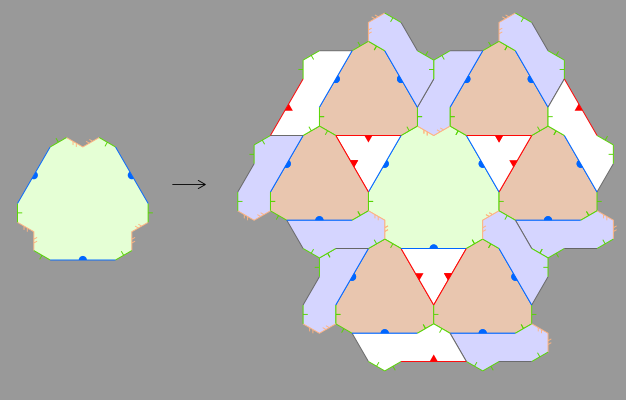
@alytile It seems that you have coloured the original F metatiles white as well as the tile in the H metatile directly connected to it. However, there are a few F metatiles here that aren't coloured white. Why did you choose not to colour them the same?
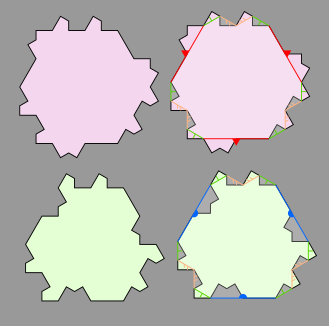
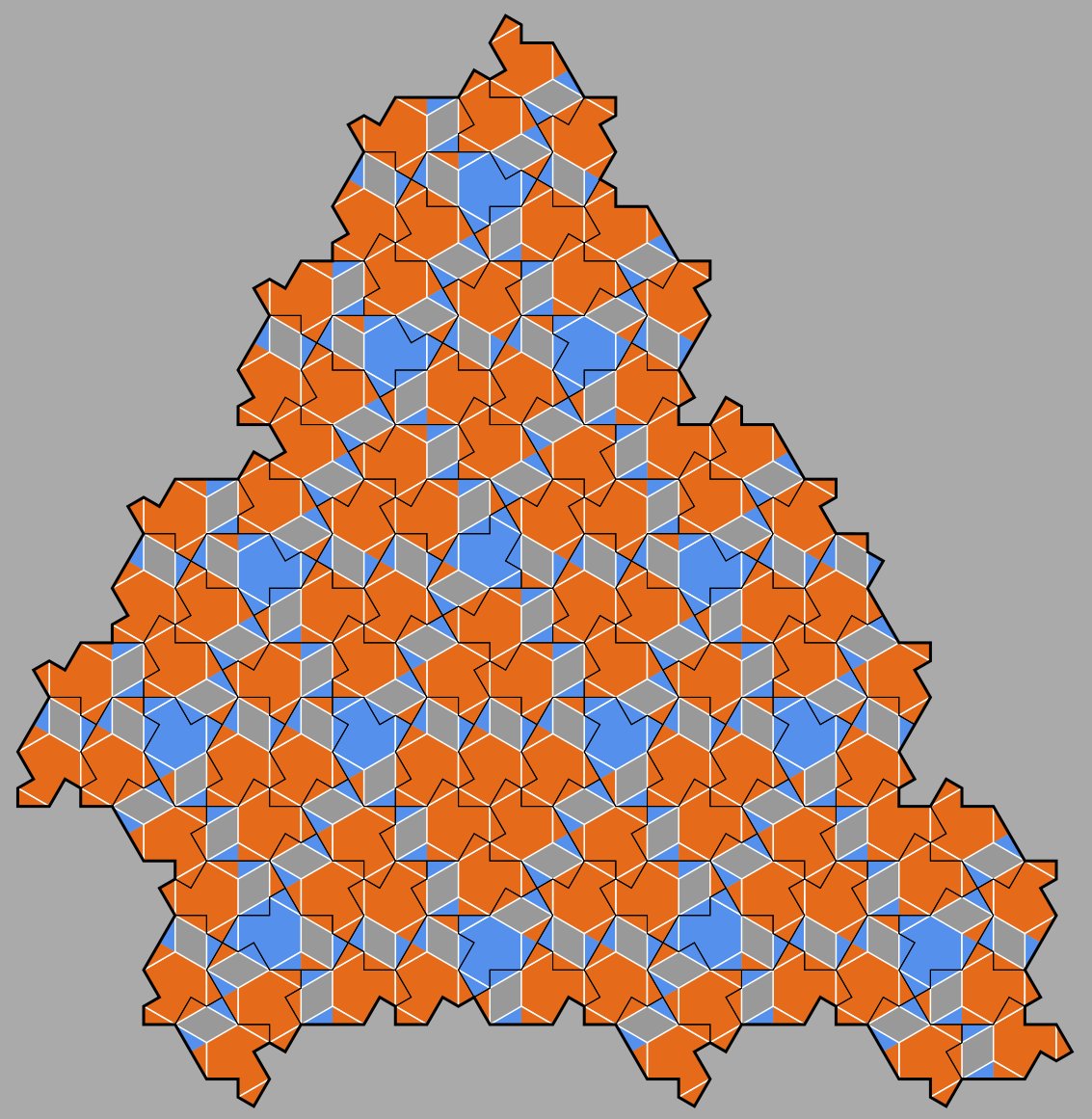
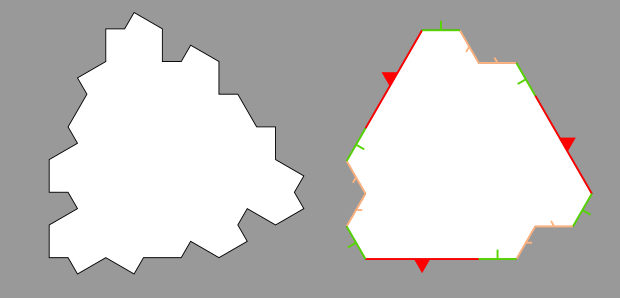
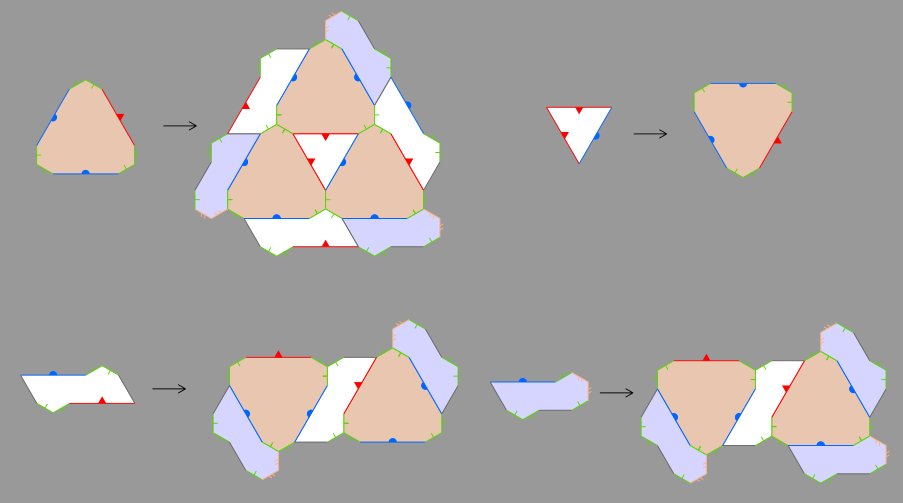
Here's something for those still interested in the Hat or Turtle #aperiodic#monotile. If you take one of the two tiles below, place one on a plane and then try to fill the rest of the plane with Hat tiles, it seems that the position of every Hat tile is already determined.
@ZenoRogue I posted about this elsewhere, but I thought of this hyperbolic prototile thinking about the binary tile and some stuff I was working on. All lengths labelled are Euclidean apparent lengths in the half-plane representation(assuming I did it right).
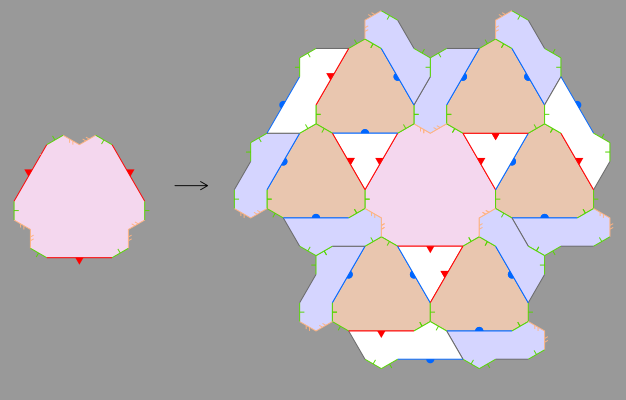
If you start with a #spectre#aperiodic#monotile tiling, and just keep the oddballs, you can flip each one and smush them together to get a new tiling. However, you are left with gaps, which become the new oddballs.
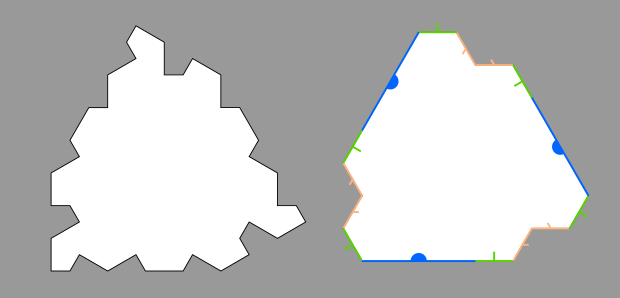
@mathBlock I didn't realize I had to follow the 26 posts, so I was confused by your comment. (I am new to twitter.) Here's a version where I use the edge instead of the vertex to avoid having to extend the outlet past the boundary. And I use one decoration instead of two.
@apu_yokai@mananself@JimPropp@robinhouston@cinderBlock_496 Sorry for the late reply. I don't think I've solved this per se, but I believe I've made progress working with Turtle tiles. See https://t.co/iQS7qJYLEu , replies, and the linked blog posts for details.
The blog post at (https://t.co/I9H0vCSN6k) has more details and further discussion. It is strongly suggested to read the previous post in the quoted/linked tweet(https://t.co/jeU9rnXFpe) first.
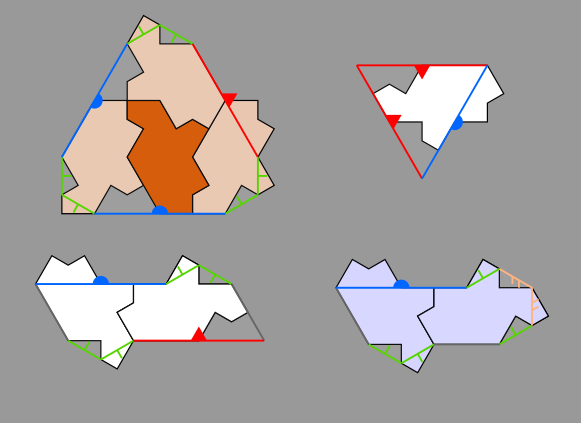
*Note on step 3: It may terminate w/o filling the outline if there exists a ‘loop’ of hexagons and fixed rhombs. Our example outline does not produce those, so it can be completely filled in.