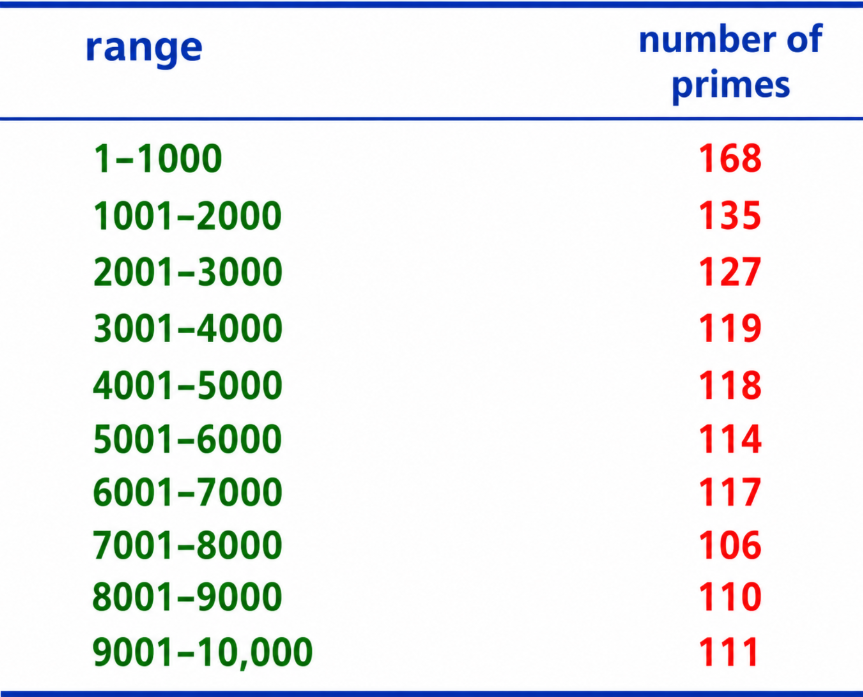
In 1963, the mathematician Stanisław Ulam noticed an unusual pattern while doodling in his notebook during a presentation. When integers are arranged in a spiral, prime numbers appear to fall along diagonal lines. At first, this is not entirely surprising, since all prime numbers except 2 are odd, and the diagonals of such spirals alternate between odd and even numbers. What is far more striking is that primes tend to cluster along certain diagonals more than others, regardless of whether the spiral begins with 1 at the center or with any other number. Even at a much larger scale, clear diagonal lines of primes remain visible, with some lines more pronounced than others. Although there are conjectures that attempt to explain this pattern, no proof has yet been found.
The ancient Babylonians used a base-60 number system rather than base-10, which is why we still have 60 seconds in a minute, 60 minutes in an hour, and 360 degrees in a circle today.
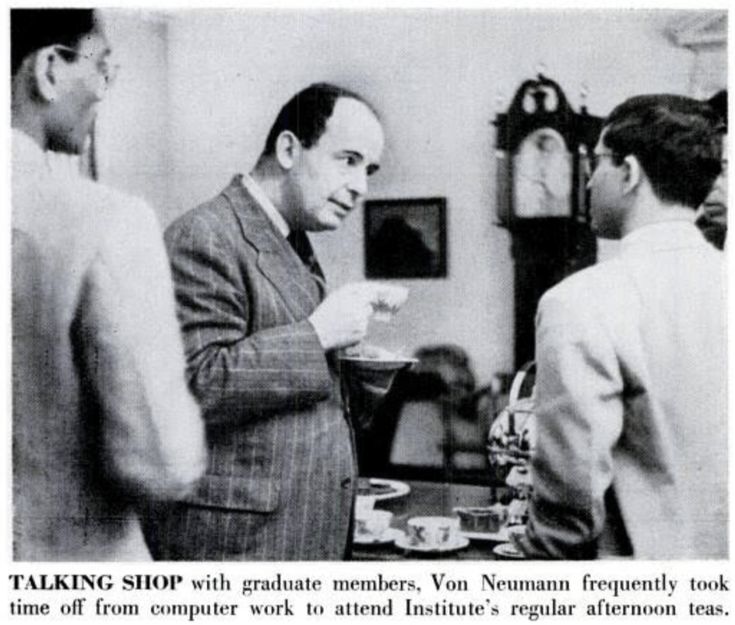
A classic puzzle is often associated with John von Neumann.
Two cyclists start 30 miles apart and ride toward each other, each at a speed of 15 miles per hour. At the same moment they begin, a fly starts at one cyclist and flies back and forth between them, instantly turning around each time it reaches either cyclist. The fly travels at a constant speed of 30 miles per hour.
The question is: how far does the fly travel in total before the cyclists meet?
According to the story, a student once posed this problem to von Neumann, who immediately answered, “30 miles.”
“That is correct,” said the student. “Most people try to add an infinite series, instead of noticing that the cyclists meet after one hour, so the fly travels 30 miles in that time.”
Von Neumann replied, “That is exactly what I did.”
Two engineering students happen to be very close friends.
One day, while sitting in a restaurant and having coffee, one friend asked the other: "How is your relationship with that new girlfriend going?"
Student: I forgot to mention, yesterday she came to my house.
Friend: WOW!!! What happened then? Tell me the full story.
Student: Well, I played her favorite music and we danced.
Friend: Then what happened??
Student: As we were dancing together, we kissed...
Friend: Then what? Keep going!
Student: I picked her up in my arms and sat her on the table next to my new laptop...
Friend: You got a New Laptop? When???
Student: Just last week. My parents gifted me one...
Friend: WOW! What configuration?
Student: 500 GB harddisk, 8 GB RAM, 2.3GHz processor...
Friend: Does it have an HDMI port?
Student: Yes!
Friend: A blu-ray burner?
Student: Yes.
Friend: AWESOME, DUDE!!
Richard Feynman was known for an unusual habit when reading research papers.
He would take the latest issue of Physical Review, read the abstract and opening of each article, and then try to guess how the paper would conclude. Only after forming his own prediction would he check the result. If his guess matched, he would move on; if not, he would read the paper in full.
This wasn’t just about efficiency—it was a way of thinking. By actively predicting outcomes, he turned reading into a process of testing intuition and deepening understanding.
Later in life, time likely made this practice less feasible, and like many scientists, he relied more on discussions with colleagues to keep up with new ideas.
It’s a simple but powerful lesson: don’t just read—engage, predict, and learn from being wrong.
On August 10, 1937, a quiet 21-year-old named Claude Shannon submitted an 85-page thesis at MIT. No headlines. No applause. Just another paper that seemed destined to be forgotten. But inside those pages was a revolutionary idea: machines could think using simple logic, 1s and 0s, ON and OFF. By linking Boolean algebra with electrical circuits, Shannon transformed switches into decision-makers. That single insight became the foundation of the digital world. Every computer, smartphone, and algorithm traces back to it. History did not roar that day. It whispered. And from that whisper, the modern world was born, one bit at a time.