Gary Brown, teacher of math, student of teaching, fancier of CS Lewis, hiker of trails, fan of mancity, admirer of those who help others. Husband, dad.
Your students learned it last year. So why does it feel like you're starting from scratch?
MathDose uses spaced retrieval — the science of remembering — to review prior grade concepts in just 5 minutes a day. Try it for free at https://t.co/c4CLmP54iV.
@jgough I love the no "note taking"... "note making." I went pretty much all in with BTC this past year, and if I did not make myself watch the clock and say "let's create notes now" it was difficult. I know it's vital, but it's so easy to skip in the moment.
@Dean_of_math I've used something like 23x15=(20+3)(10+5) and Ss do a "proof" that distributing is the same as the standard algorithm. Ss could then extend to (20+x)(10+x) where x is between 0-9. Same for division. Extensions include (10a+b)(10c+d) etc.
@KentHaines (b) My favorite approach has been more structured but didn't "add" anything to my time. I have a large stack of yellow sheets for notes, green for practice, and blue for review. Each day, we did 12 practice and 8 review practice problems. https://t.co/WImJ0fQOIj
@KentHaines This is, indeed, a challenge. (a) I tried making each test have a previous section and it felt like "too much." It was easier for me to make 2 parts. Part one was Unit 8 followed by a short cumulative part. I recorded these as two separate grade.
Began reading RANGE by David Epstein. It is a WONDERFUL book for educators. One key premise is that quick and easy approaches toward learning (although better short term) provide less durability and flexibility than learning that is slow and difficult. #iteachmath#mtbos
@bholden86 I love the response "kind of like a 1." It's a very unique, visual, and important observation (why do some put a line through 7's). I would have NEVER thought of it. Young minds are amazing as are open ended questions!
@NolanFossum Ideally, this is the kind of mistake I like to catch early during their work while walking around. I would say something like "Look carefully at the operation. Some are addition and some are subtraction." I'm curious if they just missed the detail or they cannot subtract.
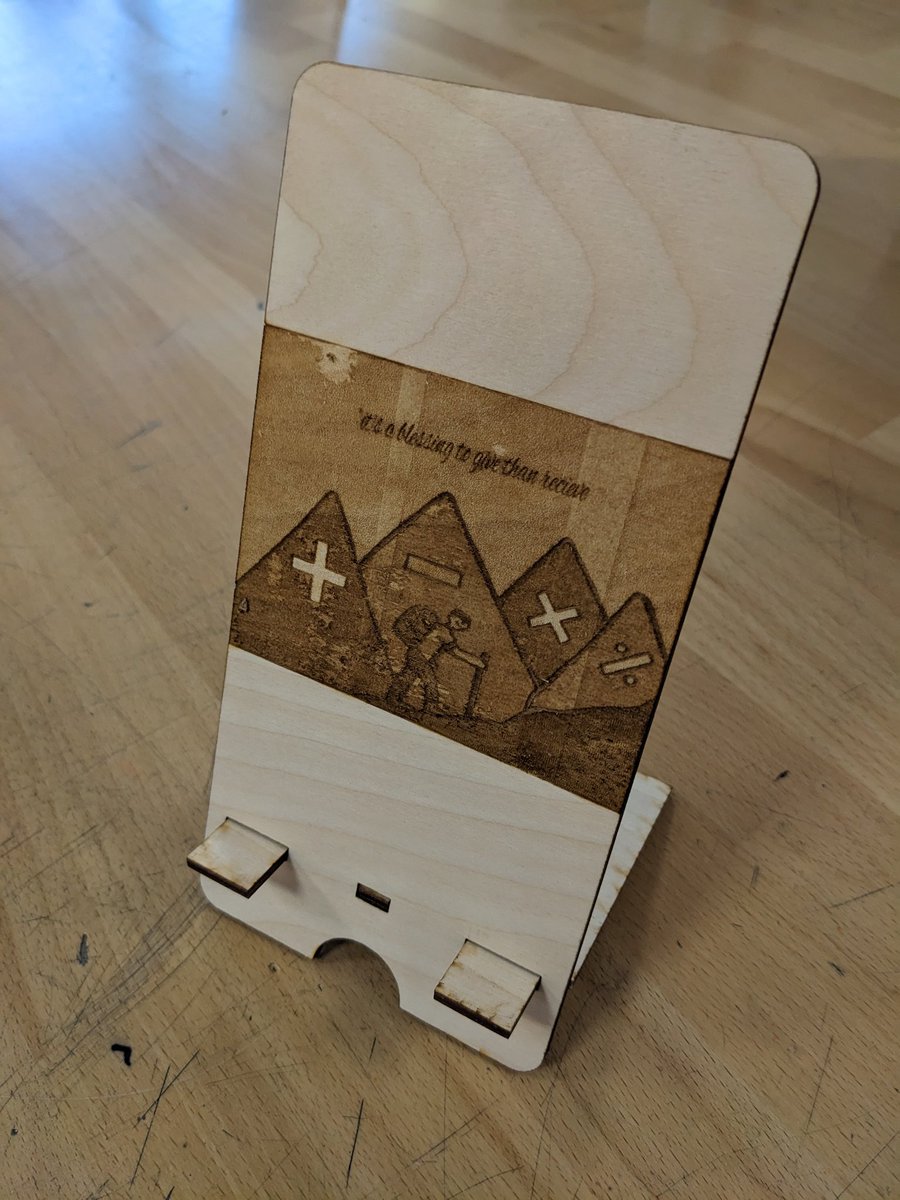
Some very sweet middle school students made a phone holder for me during their tech class. I love how personal it is: math and hiking. I especially love the middle school grammar of the quote. They were sooooo proud!
One of my favorite things about 6th grade is that students still have such a sweet, innocent excitement about learning. Students were asked to write a "math story" and I love this student's comment on his story!
@EAwaah @desmosclassroom I think DesmosClassroom follows Illustrative Mathematics very closely. Slope is introduced in Grade 8 Unit 2 Lesson 10. Slope-int form is introduced in Algebra 1 Unit 2 Lesson 11. They develop ideas slowly so it's hard to say exactly. https://t.co/vEIxJraLlq
I've been asked to speak to a senior IB class about "Beauty & Mathematics." Ideas? I am especially interested in out of the box ideas I have not considered. #iteachmath#mtbos
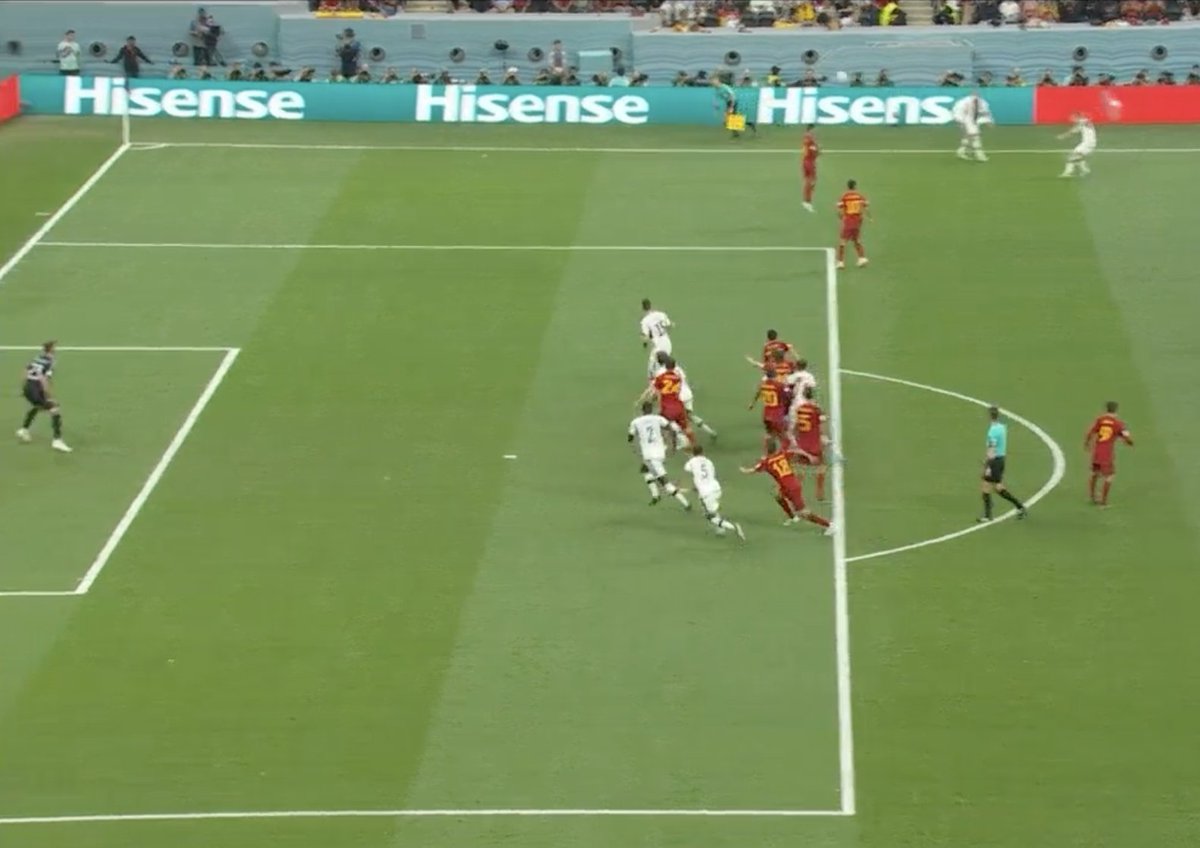
Also interesting is (1) how the arc on the 18 yard box (penalty box) is determined - it bothered my daughter that it's not a semi-circle (2) the radius of the quarter circle in the corners. Both have a very logical and practical reason.
Began class with a 2 min video highlight and Ss were asked the radius of the center circle given that the penalty box is 18 yards out. I teach in Rome so it's interesting that a football/soccer/calcio pitch is measured in yards. #mtbos#iteachmath
@edsouthall Excellent. Grade 6 Unit 1 in Illustrative Math develops this idea similarly. The formula for Area of a triangle isn't introduced until Lesson 8. It slooooowly unfolds and connects to parallelograms. https://t.co/g3uGOpzyHA
We plotted birth month versus shoe size again and there is still no correlation. One student said, "What if it WAS linear... what would that mean?" Good question. #iteachmath#mtbos