For n = 1, 1.5, 2, … , 20 the curves y = xⁿ and y = x^(1/n) both run from (0, 0) to (1, 1) inside the unit square, one colour per n.
Each pair is a single curve read two ways: y = xⁿ exactly when x = y^(1/n), so a reflection in the line y = x exchanges them. As n grows, xⁿ stays near 0 until x is close to 1, with 0.9²⁰ ≈ 0.12, while x^(1/20) is already 0.89 at x = 0.1.
In the limit the pair closes onto the edges of the square.
In 2007, a 16-year-old from Guilin named Hong Wang missed the single place Peking University's maths department held for her province, so she enrolled in earth sciences instead. She transferred into maths a year later, then doubted she was good enough for research and left to spend a semester at an architecture firm in Paris.
She came back to mathematics. In February 2025, she and Joshua Zahl posted a 127-page proof of the Kakeya conjecture in three dimensions, which grew out of a 1917 question about how little space a needle needs to turn and point in every direction. In July 2026, at 35, she won the Fields Medal, only the third woman to receive it.
She once doubted she could do research. Her proof settled a problem that had defeated several Fields medalists.
The Buddhabrot records where orbits go rather than which points escape: every c whose orbit under z ↦ z² + c leaves |z| ≤ 2 adds all the points it visited to one histogram.
Here 3,780,478 escaping orbits are binned. Raising the cap from 20 to 5,000 steps keeps only orbits that linger near the boundary of the Mandelbrot set, and the filaments sharpen. Orbits that never escape trace the anti-Buddhabrot.
Melinda Green described it in 1993.
The graphs of y = 1/x and y = −1/x are hyperbolas: the first in the first and third quadrants, the second in the second and fourth.
They can never meet, since 1/x − (−1/x) = 2/x is never zero. As x → 0 one shoots to +∞ and the other to −∞, and as x → ±∞ both flatten onto the x axis from opposite sides.
Each is the mirror image of the other in either axis, and both axes are asymptotes of both.
A Ford circle sits on the number line at each fraction p/q in lowest terms, with diameter 1/q².
For two of them the squared distance between centres minus the squared sum of radii is ((ps − qr)² − 1)/(qs)², which is never negative. So no two circles overlap, and two touch exactly when |ps − qr| = 1, the condition for neighbours in a Farey sequence.
The largest circle in the gap between two touching circles sits on the mediant (p + r)/(q + s).
Newton's method replaces a curve by its tangent and takes the tangent's zero as the next guess: xₙ₊₁ = xₙ − f(xₙ)/f′(xₙ).
For f(x) = x² − 2x − 1 from x₀ = 3.5 the guesses are 2.65, 2.4311, 2.414313, 2.4142135658, and the error obeys eₙ₊₁ = eₙ²/(2(xₙ − 1)) exactly.
Each error is squared, so the correct digits of 1 + √2 run 1, 2, 4, 9, 17: five steps give seventeen digits.
"A cycloid, the curve traced by a point on a rolling circle of radius r, is turned upside down to make a ramp.
A bead sliding without friction reaches the lowest point in time π√(r/g) from any starting point. A higher start means a longer path, matched exactly by a steeper initial slope.
Christiaan Huygens proved this tautochrone property in 1659 and built it into a pendulum clock whose period does not depend on the swing."
Two cylinders of radius r cross at right angles. Their intersection, the Steinmetz solid, is cut by every horizontal plane at height z in a square of side 2√(r² − z²).
Summing the squares gives V = ∫ 4(r² − z²) dz from −r to r = 16r³/3, with no π anywhere.
The sphere inscribed in the solid has circular slices covering π/4 of each square, which recovers 4πr³/3, the route Archimedes took.
"A ball tiled by P pentagons and H hexagons, with three faces at every corner, has E = (5P + 6H)/2 edges and V = (5P + 6H)/3 vertices.
Euler's formula V − E + F = 2 then reduces to P/6 = 2, so P = 12 whatever H is. The football has H = 20; the Goldberg balls GP(2,0), GP(3,0) and GP(4,0) have 30, 80 and 150.
The same count fixes the twelve pentagons in every fullerene and geodesic dome."
n identical books of length 1 are stacked so that the centre of mass of everything above each book sits exactly over its edge. The k-th book from the top then overhangs the one beneath it by 1/(2k).
The total overhang is ½(1 + ½ + ⅓ + … + 1/n), half the harmonic number Hₙ. Four books give 25/24 > 1, so the top book clears the table; 31 give 2.01.
Hₙ grows like ln n without bound, so the overhang has no limit.
The graphs of y = x and y = x − sin x cross at every multiple of π, wherever sin x = 0.
Lift the second curve off the page to (x, x − sin x, cos x/√2). Its shadow is still y = x − sin x, but measured from the line it moves −sin x/√2 across and cos x/√2 out: a circle of radius 1/√2 around y = x, every turn.
So in space the coil never touches the line. Each crossing on the page is the coil passing over or under it.
The kissing number k(n) counts the unit spheres that can touch one central unit sphere without overlapping. In the plane six close a ring exactly, so k(2) = 6.
In space twelve fit with room to spare. Each blocks a cap of 6.7% of the central sphere’s surface, so thirteen would cover only 87.1%, yet thirteen centres cannot all stay 60° apart.
Newton’s k(3) = 12 was proved in 1953. In five dimensions it is still open: 40 ≤ k(5) ≤ 44.
Archimedes compared a sphere of radius r with the smallest cylinder that holds it: radius r, height 2r.
The sphere's volume is (4/3)πr³ and the cylinder's is 2πr³, a ratio of 2 : 3. The sphere's surface is 4πr², exactly the cylinder's curved side 2πr · 2r; add the two end discs and the cylinder's whole surface is 6πr², again 2 : 3.
He counted this among his finest results and asked for the figure on his tomb.
A spherical triangle is bounded by three great circle arcs. Two meridians a quarter turn apart meet the equator at right angles, so all three corners of this one measure 90°.
Girard’s theorem fixes the excess: α + β + γ − π = A/R². This triangle is one octant, A = 4πR²/8, so the excess is π/2 = 90°.
As the triangle shrinks, the excess falls with the area and the sum returns to 180°. Flat geometry is curved geometry at small scale.
The osculating circle of a curve at a point is the circle that shares its tangent and its curvature κ there, with radius 1/κ.
On the conical helix r(t) = c t (cos t, sin t, 1), κ = √(t⁴ + 5t² + 8) / (c (t² + 2)^(3/2)), so the radius 1/κ grows almost linearly in t. One circle is drawn at each step and they stack into a funnel.
For large t the circles lie flat with radius c t, centred a distance c off the axis.
How do you find every prime up to n without testing any number for divisibility?
Take the first unmarked number p, mark all its multiples from p² onward, then move to the next unmarked number. A composite m has a prime factor of at most √m, so only primes p ≤ √n are needed.
For n = 100 that means 2, 3, 5 and 7, and the 25 survivors are the primes below 100. Every composite is struck out by its smallest prime factor, and the total work is about n log log n steps, nearly linear in n.
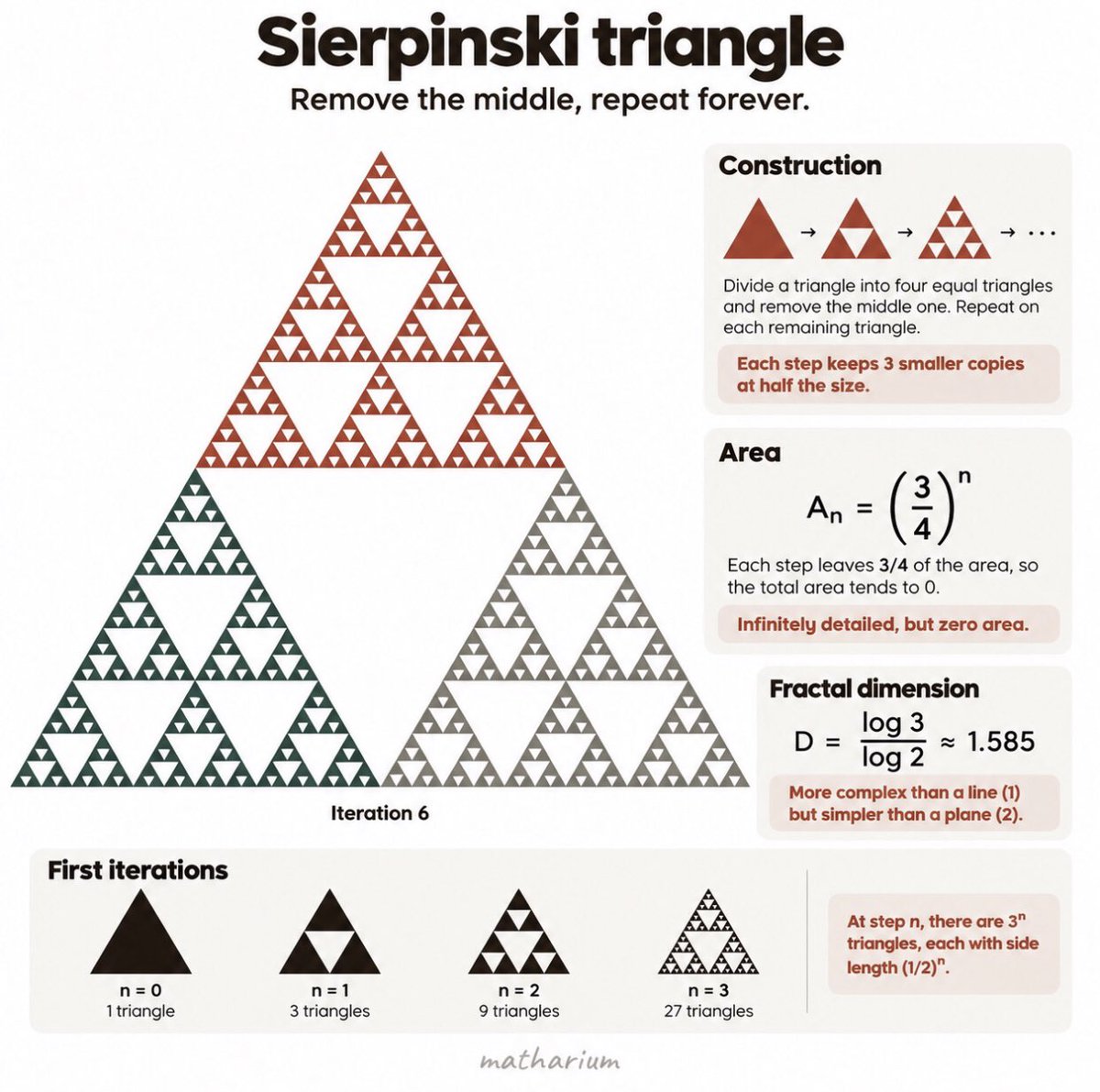
How can a shape have no area and still not be a line?
Remove the central triangle from an equilateral triangle, then repeat on each remaining piece. After n steps the area is (3/4)ⁿ of the original, which tends to 0. The piece count triples while the scale halves, giving dimension log 3 / log 2 ≈ 1.585.
It sits between a curve and a surface. The same set appears from a game of chance: pick a vertex at random, jump halfway toward it, and repeat. Whatever the start, the points settle onto the triangle. Sierpiński described it in 1915.
Why does a² + b² = c² hold in every right triangle?
Put four copies of the triangle inside a square of side a + b. Arranged one way they leave a square of side c uncovered. Arranged another way they leave two squares, of sides a and b. The outer square and the triangles are the same, so the leftover areas match.
Hence c² = a² + b². The result extends to any three similar shapes built on the sides, such as semicircles or equilateral triangles, because area scales with the square of length. The converse holds too: if a² + b² = c², the angle opposite c is a right angle.