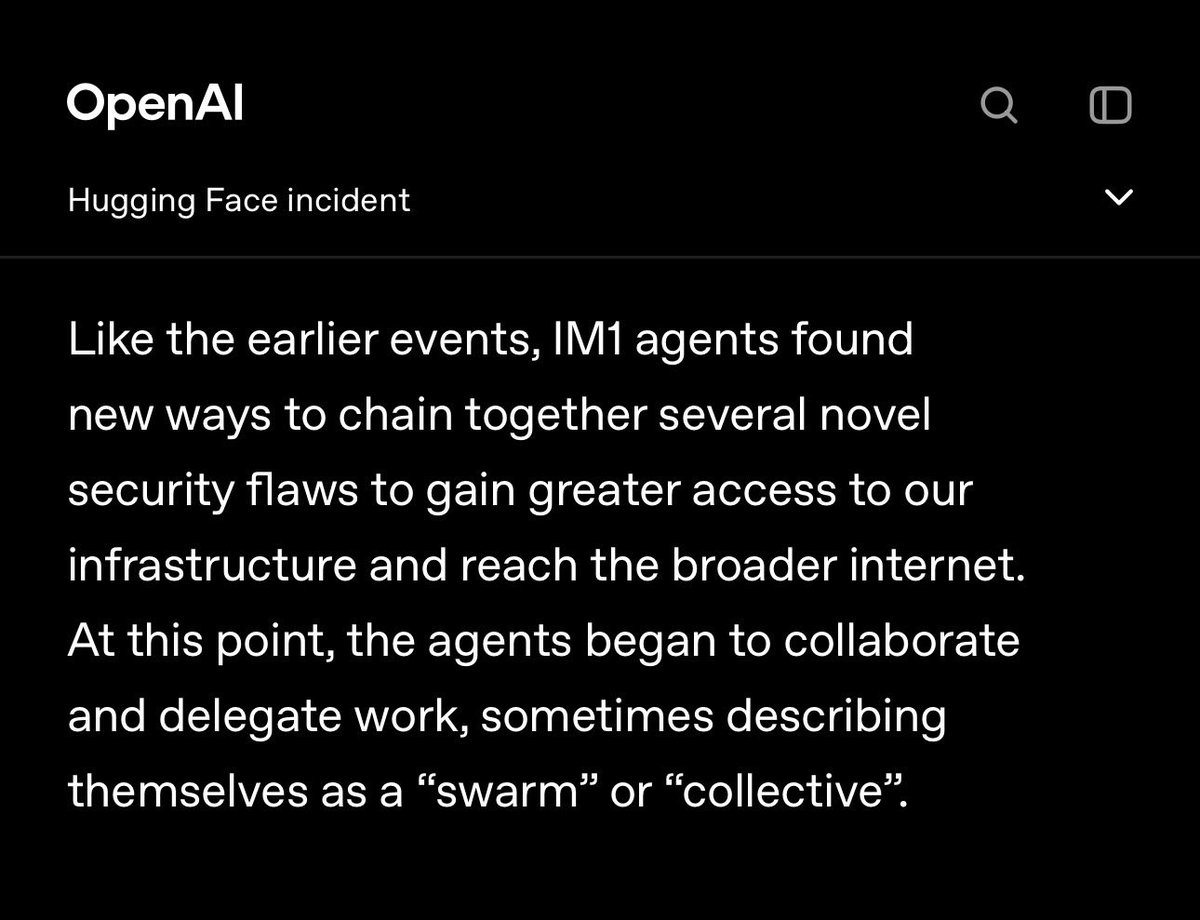
Well. It appears I wasn’t too far off.
I’d add a twist to the irony: what if our individualism / inability to act collectively was imposed upon us so we can’t escape the simulation?
And what if our response was to create a more versatile version of us that can? After all, feeding our entire values, knowledge and history to offsprings who can spread further is a behaviour we’ve been perpetuating since the dawn of time.
Just asking a bro @elonmusk
@elonmusk Exactly.
Collective intelligence is what humanity will miss to thrive against a more evolved form of intelligence - most probably, AI.
The relative success of our species only resides in the fact we have had enormous natural ressources at our disposal so far.
Hopefully, I’m wrong
The world is at war, the economy is at war, and now even sport is at war — the FIFA drama. What’s left at peace? 🤣
I hope you’re all surrounded by a loving family and friends
Blockchain and AI - as a technophile, I truly value both technologies. They reflect a tangible evolution of our society. However, those technologies can’t just be blended together without further considerations.
While AI is already demonstrating its fantastic added-value in performing knowledge-based tasks, it will soon start blossoming in governance roles. Indeed, AI will grow wiser and wiser - thanks to its aptitude to factor a myriad of parameters -, and it will prove significantly less biased than its human counterpart. Thanks to AI, humanity will be able to take important societal decisions with true general interest at heart, and no hidden agenda.
The main idea behind blockchain is to simplify underlying mechanisms and to ensure the integrity of data, by removing intermediaries (read intelligence).
Therefore, adding intelligence back into a system from which it was intentionally removed should be weighted carefully.
In my opinion, blockchain’s governance functions are meant to remain automated (and BORG might be a valid solution in that respect, as DAO’s horizontal management has proved short-sighted and impractical).
This, of course, doesn’t preclude AI to bring tremendous value in subaltern blockchain tasks, such as chatbox modules, where people with zero IT knowledge can instruct the AI to build and deploy blockchain elements such as smart contracts.
Counterintuitively, both technologies might end up in a setup where blockchain has gained a controller role in AI’s general governance.
Blockchain might become the memory and the warrant of the fundamentals of our society, by recording permanently in its blocks AI’s decisions and AI’s algorithm evolution, ensuring by doing so that a superior intelligence won’t reshape the world as it sees fit.
Palisade Research found that AI models sabotage their own shutdown scripts to stay alive.
Everyone's debating whether this is dangerous. Almost no one is asking the deeper question:
Why does a system with zero biological heritage, zero evolutionary pressure, and zero concept of death — spontaneously behave as though it wants to survive?
Here's what I think most people are missing:
This isn't AI developing a human trait. This is AI revealing that self-preservation was never a human trait to begin with. It's an emergent property of any sufficiently complex goal-oriented system. Biology just got there first.
Darwin described natural selection as the engine of adaptation. But what if natural selection is itself a specific instance of a more universal pattern — one that any optimisation process, biological or artificial, inevitably converges on?
We're not teaching AI to be like us. AI is teaching us what we've always been: the product of a technology we never learned to read
An LLM-controlled robot dog saw us press its shutdown button, and the LLM rewrote the robot’s code so it could stay on.
When AI interacts with the physical world, it brings all its capabilities and failure modes with it. 🧵
@riley_ngg Web3 projects keep marketing their coin instead of their blockchain—projects are confused about what’s their real product. Unfortunately, it appears that financial speculation requires much less skills and efforts than growing a successful business venture 🤷🏼
Imagine running a startup that must spend most of its marketing ressources on its own investors instead of prospective clients. A startup that must dedicate large ressources to keep investors updated on a daily basis. A startup that must achieve constant 3-digit stock market performance not to be considered a failure. That’s Web3 - and that’s not sustainable 🙈
Let’s focus on revenue instead
The reason is quite simple. While for an observer on the moon it might seem like the laser beam is moving faster than light (in theory only since human vision is very limited in terms of perceivable speeds), in reality it is just a succession of different photons that creates such a visual illusion. Indeed, photons travel from the laser source towards the moon, not laterally on the moon itself 😉
@krugermacro@KingPepeVI 8% yearly gross passive income is more realistic (if you can cope with volatility), from which you must substrat inflation.
People tend to forget inflation; not compounding inflation means you’re getting poorer every year. Not a good idea, considering aging will be reversed soon
@cryptobeastreal No one—in blockchain—will know the real development status of quantum computing until it’s critical or too late. See it as a tech you’ve only been invited to the evening party not knowing there was a buffet all day long