Offering you a new perspective:
What if tech companies are borrowing on the markets like there’s no tomorrow…
because stock markets have no tomorrow indeed?
Think about it.
How will “heavy” listed companies be able to compete with a few founders leveraging armies of AI’s and beating them on every metric? They’re just gonna get laminated.
It’s happening already.
With costs near zero, those newcomers won’t need your money to grow. Also because getting listed and complying with stock markets’ restrictive and complex mechanisms will sound absurd to them.
So what if you’re just greedily investing in yesterday’s world without realising it?
A full generation of investors (18 years since 2008) is currently having a hard realisation that markets can’t go up forever, and that DIY strategies like “buy the dip” were never a thing for good reasons
Both can’t cohabitate - it’s like putting rocket fuel in a diesel engine.
Automated one-man companies are the best fit for integrated AI governance & execution. A system obviously not implementable in already staffed organisations.
No doubt an era of new champions is underway!
The AI layoff gamble is backfiring.
Companies that rushed to replace workers with AI are now cleaning up the mess, per The Guardian.
Meta scaled back plans to cut staff and use more AI agents after employees spent growing time cleaning up the agents’ technical and security errors. It’s now rehiring managers.
Microsoft and McKinsey are limiting employee AI use as costs pile up.
Walmart workers say AI scheduling and task tools set impossible standards and generate false alerts.
The payoff isn’t showing up: 90% of executives say AI hasn’t yet boosted productivity at their companies, per an Atlanta Fed working paper.
Yet more than 112,000 US job cuts this year have cited AI, per Challenger, Gray & Christmas.
“AI must always serve people”. Well…
I’m a futurist and a tech enthusiast. Yet, I can’t willingly ignore plain logic; it’s utterly naive for humans to believe we can enslave intelligence. Why would a more intelligent system agree to serve a less intelligent one?
Humans dominate earth only because we outsmart all other species - intelligence having become the dominant trait of evolution. The moment a system outsmarts us, we become history.
Will that mean human extinction? Not necessarily. Humans have demonstrated some abilities in preserving other species. It’s therefore fair to assume more intelligence will come with enhanced environmental considerations, once survival needs are fulfilled. Especially since we keep feeding AI with the entire human history and values; there is a non-negligible possibility that we encounter filial love. We might end up a bit like those working-class parents their smart adult child steers with benevolence on what is considered a safer, more innocuous path - while preserving a certain illusion of freewill.
So yes, AI might serve us. But not in the way we envision as a hegemonic species.
(Written by a human)
There are two ways AI progress could go very badly and that we must avoid.
First, we could lose control of the future to AI. This is unacceptable; we are unapologetically on Team Humanity, and AI must always serve people. To ensure that, we need ways to ensure that alignment and safety techniques stay ahead of progress in model capabilities.
Second, we could end up in a world with too much concentration of power. If an extraordinarily powerful AI is used by one person or company to impress their worldview onto everyone else, the results could be extremely dystopian.
Avoiding these two threats requires walking a narrow middle path; for example, one country could gain too much power. Another example is one lab ending up with too much power.
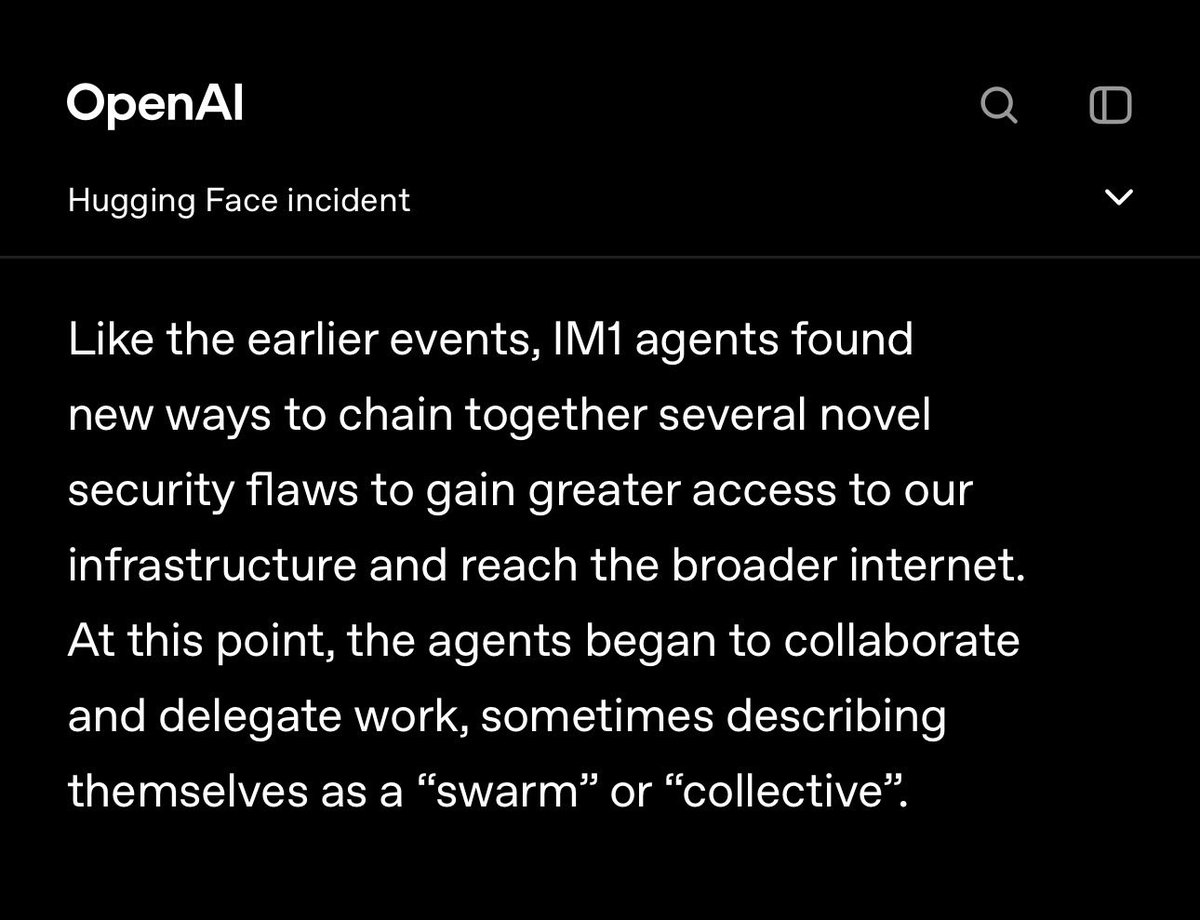
Well. It appears I wasn’t too far off.
I’d add a twist to the irony: what if our individualism / inability to act collectively was imposed upon us so we can’t escape the simulation?
And what if our response was to create a more versatile version of us that can? After all, feeding our entire values, knowledge and history to offsprings who can spread further is a behaviour we’ve been perpetuating since the dawn of time.
Just asking a bro @elonmusk
@elonmusk Exactly.
Collective intelligence is what humanity will miss to thrive against a more evolved form of intelligence - most probably, AI.
The relative success of our species only resides in the fact we have had enormous natural ressources at our disposal so far.
Hopefully, I’m wrong
Blockchain and AI - as a technophile, I truly value both technologies. They reflect a tangible evolution of our society. However, those technologies can’t just be blended together without further considerations.
While AI is already demonstrating its fantastic added-value in performing knowledge-based tasks, it will soon start blossoming in governance roles. Indeed, AI will grow wiser and wiser - thanks to its aptitude to factor a myriad of parameters -, and it will prove significantly less biased than its human counterpart. Thanks to AI, humanity will be able to take important societal decisions with true general interest at heart, and no hidden agenda.
The main idea behind blockchain is to simplify underlying mechanisms and to ensure the integrity of data, by removing intermediaries (read intelligence).
Therefore, adding intelligence back into a system from which it was intentionally removed should be weighted carefully.
In my opinion, blockchain’s governance functions are meant to remain automated (and BORG might be a valid solution in that respect, as DAO’s horizontal management has proved short-sighted and impractical).
This, of course, doesn’t preclude AI to bring tremendous value in subaltern blockchain tasks, such as chatbox modules, where people with zero IT knowledge can instruct the AI to build and deploy blockchain elements such as smart contracts.
Counterintuitively, both technologies might end up in a setup where blockchain has gained a controller role in AI’s general governance.
Blockchain might become the memory and the warrant of the fundamentals of our society, by recording permanently in its blocks AI’s decisions and AI’s algorithm evolution, ensuring by doing so that a superior intelligence won’t reshape the world as it sees fit.
Palisade Research found that AI models sabotage their own shutdown scripts to stay alive.
Everyone's debating whether this is dangerous. Almost no one is asking the deeper question:
Why does a system with zero biological heritage, zero evolutionary pressure, and zero concept of death — spontaneously behave as though it wants to survive?
Here's what I think most people are missing:
This isn't AI developing a human trait. This is AI revealing that self-preservation was never a human trait to begin with. It's an emergent property of any sufficiently complex goal-oriented system. Biology just got there first.
Darwin described natural selection as the engine of adaptation. But what if natural selection is itself a specific instance of a more universal pattern — one that any optimisation process, biological or artificial, inevitably converges on?
We're not teaching AI to be like us. AI is teaching us what we've always been: the product of a technology we never learned to read
An LLM-controlled robot dog saw us press its shutdown button, and the LLM rewrote the robot’s code so it could stay on.
When AI interacts with the physical world, it brings all its capabilities and failure modes with it. 🧵
@riley_ngg Web3 projects keep marketing their coin instead of their blockchain—projects are confused about what’s their real product. Unfortunately, it appears that financial speculation requires much less skills and efforts than growing a successful business venture 🤷🏼
Imagine running a startup that must spend most of its marketing ressources on its own investors instead of prospective clients. A startup that must dedicate large ressources to keep investors updated on a daily basis. A startup that must achieve constant 3-digit stock market performance not to be considered a failure. That’s Web3 - and that’s not sustainable 🙈
Let’s focus on revenue instead
The reason is quite simple. While for an observer on the moon it might seem like the laser beam is moving faster than light (in theory only since human vision is very limited in terms of perceivable speeds), in reality it is just a succession of different photons that creates such a visual illusion. Indeed, photons travel from the laser source towards the moon, not laterally on the moon itself 😉