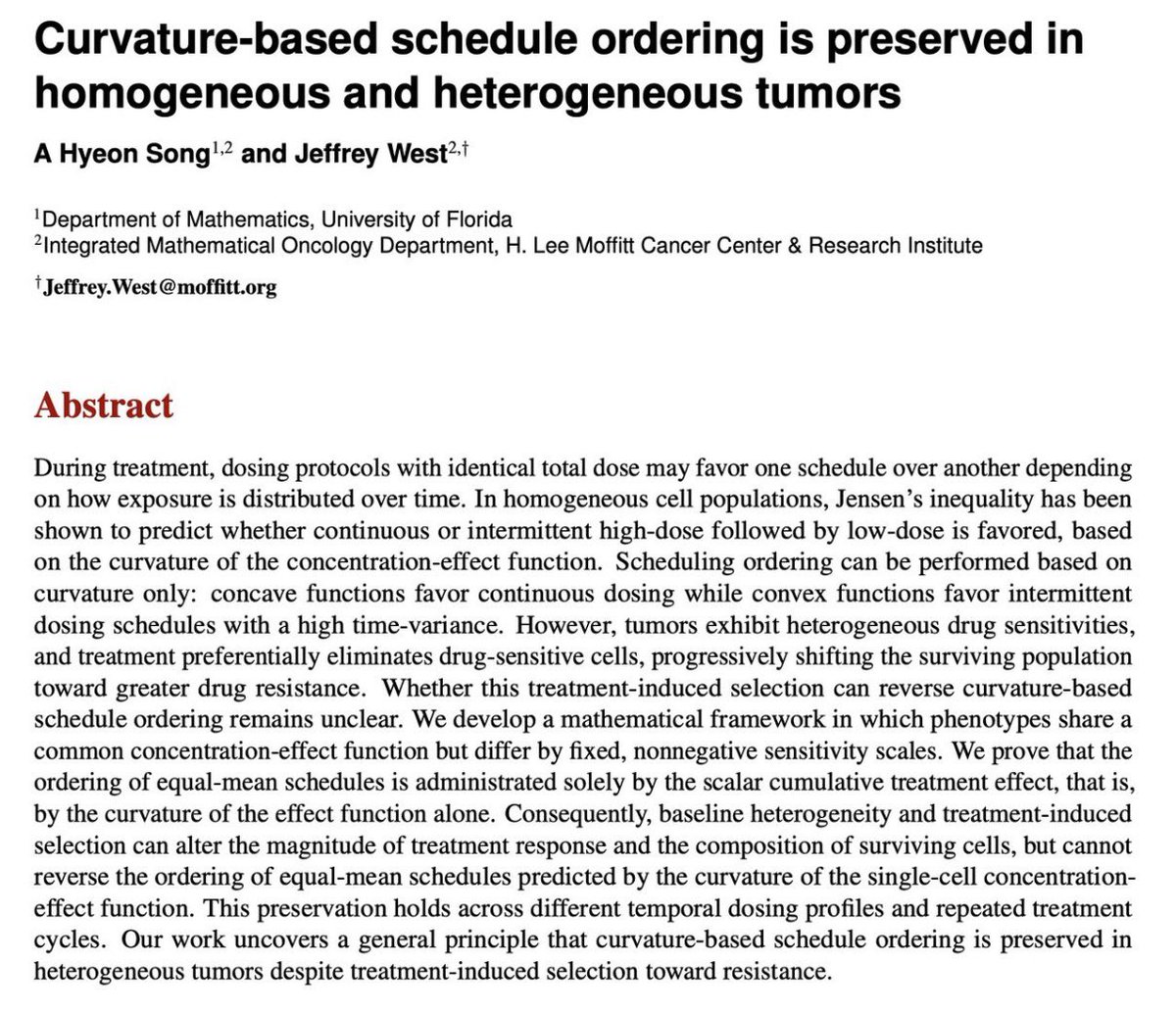
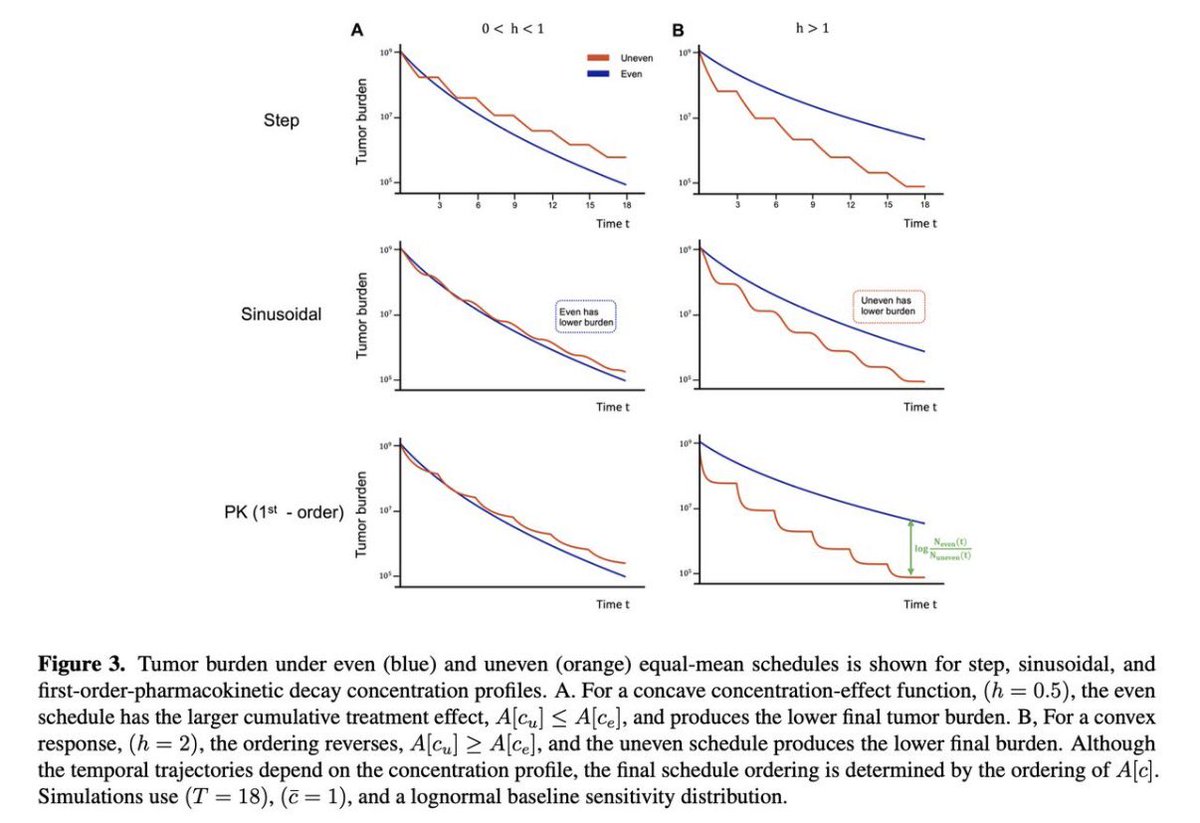
Our latest preprint, out today: "Curvature-based schedule ordering is preserved in homogeneous and heterogeneous tumors" by Lauren Song, wherein we prove that dose-response curvature is still relevant in heterogeneous tumors!
Read more: https://t.co/M08GGYkSmd
One of the strangest things about the AI age is I never expected in a million years that my normy friends would ever ask me about Navier Stokes or Riemann hypothesis.…
I’m really excited to share spatialscape v1.0, my dream spatial transcriptomics visualization tool! 🎉
With the help of Fable, I built spatialscape to make it possible to seamlessly explore spatial omics datasets across samples and multiple technology types.
The final morning of the @imoworkshop is for presentations, judging and importantly winning! Here the teams and judges assemble to hear what they have just spent the last week working on #MoffittIMO@mathonco@MoffittNews
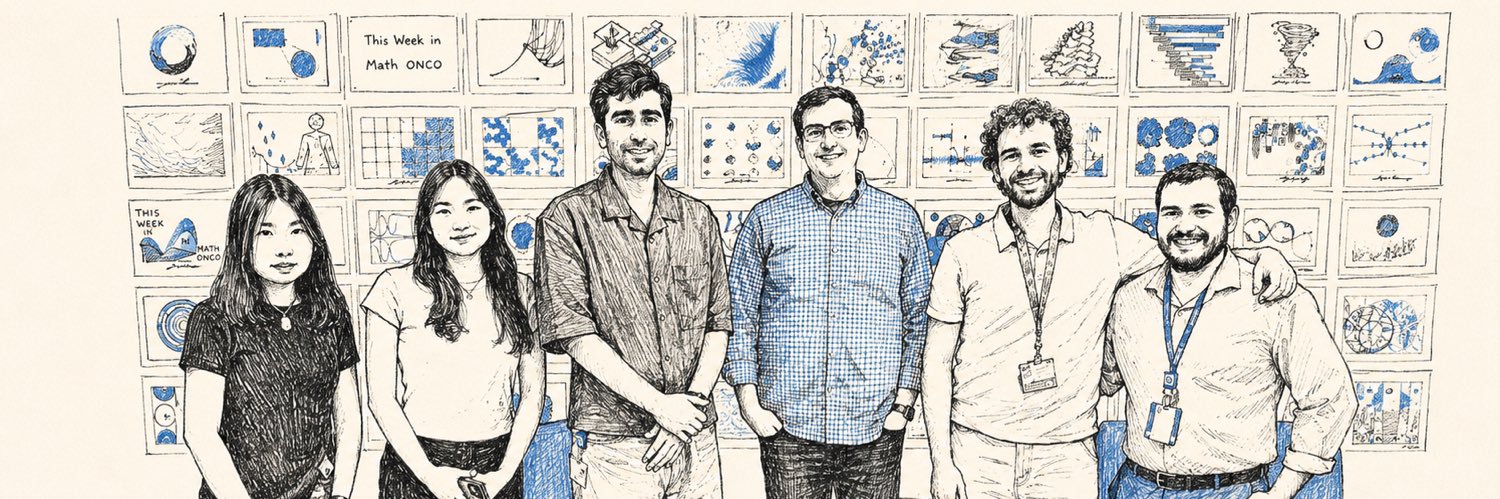
This week in Math Onco!
Artist credit: Katarina Jansén-Storbacka and Alexander Jansén-Storbacka (children of Laura R. Jansén-Storbacka) using Procreate
How does leukaemia develop? 🩸 How long does it take? ⏳
🌟 Our paper, started back when I was a PhD student in @jrblundell’s lab, is out today in @Nature 🌟
Yearly blood samples from women who developed AML in later life let us trace it back decades 👇
https://t.co/fqyOpc5OKH
I’d like suggest a modest proposal: we need to be math model-maxxing. I’ve noticed a trend: to reach for the data before writing down or thinking through a model. This is a fine impulse towards empiricism as a ground of truth. But how can we interrogate data without a model? Write down your hypothesis as an equation. Turn it over in your mind. Plot the model and change the parameters. Try to break the desired behavior. What are the limits, what controls the temporal dynamics, what parameters are coupled? Are there special cases from which emerge a historical model? If not, what did those that come before you miss (or you may be missing something!)? What data would you need to collect to falsify that model? Is this model identifiable in relation to another candidate model? Is this model the most parsimonious (nature loves parsimony)?
We used to call them “toy models” because they are fun educational toys to play with. We didn’t call them toys because we suspected that they didn’t explain reality and needed to feel better ourselves for suggesting a child’s plaything. No, model-maxxing is serious business. Just as I intend my puns, I also intend my models. A model is interesting when it fits the data, and might be even more interesting when it doesn’t! Take courage, write down your model and start model-maxxing today.
The 1st talk of the @imoworkshop each year is by the winning team from the previous years workshop. That team was led by @mathoncbro presenting, Restoring balance: ai-assisted rapid mathematical model development for restoration ecology-guided CAR T #MoffittIMO@mathonco
With many new cancer medicines, reminder that
the clinical effectiveness of drug combinations is highly predictable from the clinical effectiveness of single agents
100% sensitive prediction of phase 3 trial success across all advanced cancers, 1995-2020
https://t.co/hu6VIzg5zn
Final IMAT lecture of the year from our very own @mathoncbro discussing a key tool for the @mathonco community: Artificial Intelligence and Mathematical
Oncology @MoffittNews