HTTP/1 to HTTP/2 to HTTP/3
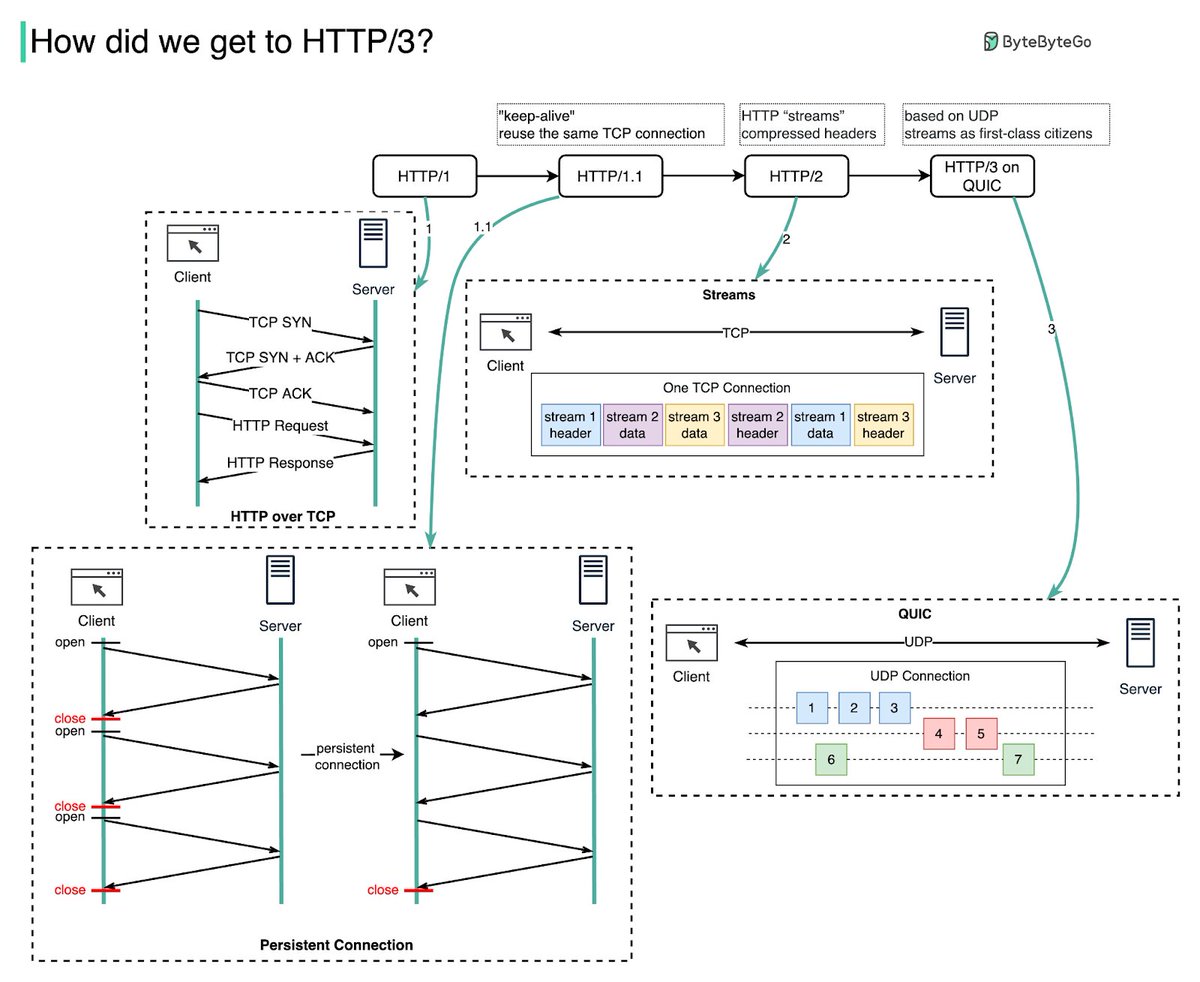
HTTP/1.0 was finalized in 1996. Every request to the same server requires a separate TCP connection which is expensive to establish.
HTTP/1.1 (1997) introduced 𝗽𝗲𝗿𝘀𝗶𝘀𝘁𝗲𝗻𝘁 𝗰𝗼𝗻𝗻𝗲𝗰𝘁𝗶𝗼𝗻𝘀, which allow a TCP connection to be reused for multiple requests and responses. This reduces the latency in setting up new connections for each request. But HTTP/1.1 doesn’t solve the 𝗵𝗲𝗮𝗱-𝗼𝗳-𝗹𝗶𝗻𝗲 (𝗛𝗢𝗟) 𝗯𝗹𝗼𝗰𝗸𝗶𝗻𝗴 problem.
Although HTTP/1.1 enabled pipelining, where multiple requests could be sent out without waiting for each response, the responses still had to be processed and sent back in the order the requests were received. This ordering requirement caused HOL blocking - if the first request took a long time, all later requests had to wait.
HTTP/2 (2015) introduced 𝗛𝗧𝗧𝗣 𝘀𝘁𝗿𝗲𝗮𝗺𝘀 - an abstraction that allows 𝗺𝘂𝗹𝘁𝗶𝗽𝗹𝗲𝘅𝗶𝗻𝗴 different HTTP exchanges onto the same TCP connection. Streams don’t need to be sent in order. This eliminates HOL blocking at the application layer. But HOL still exists at the TCP transport layer.
HTTP/3 draft was published in 2020. It uses 𝗤𝗨𝗜𝗖 instead of TCP as the 𝘁𝗿𝗮𝗻𝘀𝗽𝗼𝗿𝘁 𝗽𝗿𝗼𝘁𝗼𝗰𝗼𝗹, removing HOL blocking in the transport layer.
QUIC uses UDP. It introduces 𝘀𝘁𝗿𝗲𝗮𝗺𝘀 at the transport layer. QUIC streams share one connection, so no new handshakes or slow starts are necessary to create new streams. QUIC streams are delivered independently so packet loss usually doesn’t affect other streams.
–
Subscribe to our weekly newsletter to get a Free System Design PDF (158 pages): https://t.co/kNfv0DVDdf
There was a major OpenAI outage last night. From a security standpoint, the question you need to ask yourself is: do I have a backup plan? What if I lose business because my sole LLM provider is down for several hours? Here are some thoughts:
First, there are other reasons you could lose access to OpenAI. If your credentials are compromised or if you reach API limits (currently happening routinely to some of our partners), the result is the same: your service does not work. You can mitigate those risks, but of course you cannot do much about an outage.
What you can do is diversify. There are other models available, some hosted by other providers (e.g. Anthropic) and some that you could host yourself. Not everyone needs the capabilities of GPT4 (or even 3.5) for many kinds of applications. We have helped startups evaluate whether Llama or Mistral could suffice for their current needs, and we suggest this as an exercise to everyone affected by last night's outage.
As always, don't hesitate to reach out to us with questions!
Luis Caffarelli, a University of Texas mathematician who was born in Argentina, won the Abel Prize for 2023. The prize is considered as an equivalent of a Nobel in mathematics. https://t.co/vYRjKztnfs
Today we’re announcing Firmina, the longest subsea cable in the world capable of running from a single power source at one end if necessary. Firmina will run from the US East Coast to Argentina to help improve access to Google services in South America.
https://t.co/jZqtZoKYil
$SHOP (Focus list name)
Following through today after breaking out of a huge 5 month base.
Longer base breakouts are more reliable & have more room to run. This move is likely just getting started into 2021!
Alibaba says it anticipates that it will be able to comply with any new regulations as new bill aims to delist foreign companies from U.S. stock exchanges https://t.co/lE2rzSuc8T