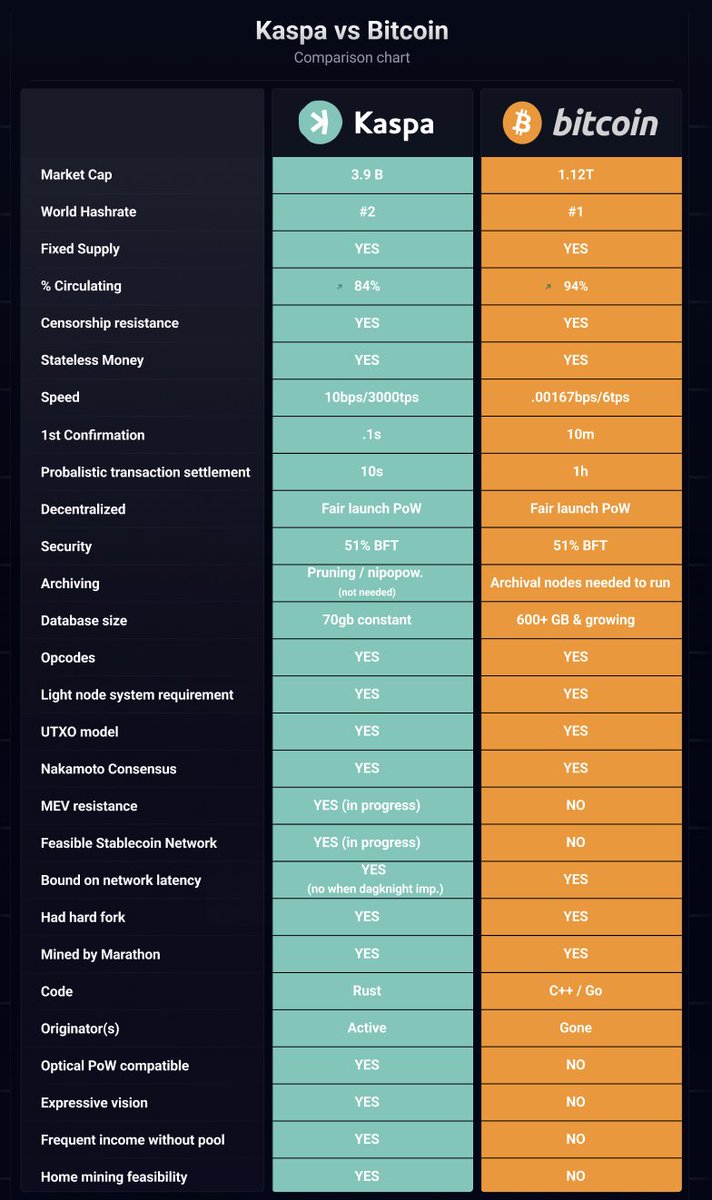
To celebrate the upcoming upgrade to 10BPS, I'm doing giveaway of 3000 $KAS.
✨To participate,
👉Like the post, Follow me, Comment and Repost!
🎉May 26th i will reveal the winner of 3000 #Kaspa!
A braindump of all things crescendo, what’s included, what are the benefits, etc
This might contain many details, so hold tight.
Increasing the block per seconds from 1 to 10 bps while keeping block capacity ~fixed (more on that later). Throughput: obviously, transaction throughput increases. How much? almost tenfold but not exactly 10x. Having more parallel blocks increases the collision rate to some degree. On TN10 and with current mempool txn selection policy, we observe ~80-90% efficiency (i.e., 80-90% of the txns are unique). If the mempool gets over congested and demand significantly exceeds capacity, this efficiency value goes towards 100%. So to conclude, TPS is increasing 8-9x. The missing info is mainnet average DAG width post-activation vs. today. Mempool policies can be finetuned in the coming future without a hardfork based on such real-world data. Frequency: average block time (=interval between blocks) is being reduced from 1 second to 100 milliseconds. This means blink-of-an-eye txn inclusion time. A transaction need not propagate to the whole network in order to be included; for instance, it can reach miners in its continent in 50ms and get mined after 200ms. The frequency also decreases post-inclusion confirmation times due to the increased density of the mining sampling process. Not to say confirmation times decrease tenfold, because they are now dominated by block latency which hasn't changed. Rather, by back-of-the-envelope calculations, they have improved 30% (for the advanced: the tail of the Poisson governing worst-case DAG width diminishes faster, thus K can be set relatively lower, from 18 (1bps) to 124 (for 10bps) and not to 180 as one might expect).
Block parallelism: block parallelism increases with the block rate, and that, contrary to what you might think, is good. Despite collisions being slightly increased due to block parallelism, parallelism is crucial for creating a more fair system. It means there isn't a monopoly of a single winning miner per round, but rather blocks must compete and make wise and competitive decisions within the latency round. The implications can be huge and far-reaching. Oracle systems and MEV kickback auctions are some of the preliminary efforts. Going more into this is out-of-scope. I also need to justify why finance is becoming more relevant post-crescendo... assuming that's the case, I think that even without implementing MEV kickback designs explicitly in consensus (yet), the mere intra-round “chaos” of the parallel DAG at 10 bps will already make economic manipulation much harder than in other, leader-based systems.
Other changes included in crescendo. How do I start, there's so much. KIP-9 is integrated into consensus, baking our unique state bloat solution inherently into the system. By the way, we call this “harmonic” sub-protocol the name STORM (for STORage Mass). In the process, KIP-9 was extended to include UTXO storage plurality (i.e., taxing a UTXO which consumes more storage appropriately), making it more futureproof. KIP-10 adds support for basic covenants and additive addresses. KIP-13 regulates transient storage requirements more strictly. Smart contract-related changes: KIP-14 enables payloads, allowing txns to carry arbitrary data (e.g., smart contract function calls). KIP-15 is a technically minor upgrade -- comprising one line of code -- but enables a conceptually meaningful feature, allowing nodes to archive only transactions and prove their sequencing and acceptance trustlessly. This is significant for allowing pre-zk era L2 nodes to store and prove full SC execution to new syncers at a reasonable cost—hence effectively making such systems possible right after crescendo. The change proposed is a tiny subset of the zk design proposal (see Kaspa research forum—based rollups design posts) where such a mechanism was proposed as a necessary requirement for zk systems to operate over Kaspa, and turned out to have significant value also pre-zk. Overall, this means that preliminary SC L2s are possible over post-crescendo Kaspa (or Kaspa 2.0 as @hashdag refers to it internally) with sufficient trust models.
Other things I wanted to write about but will wait for another time: survey the increased-yet-limited hardware costs of this upgrade, why I conjecture the mainnet DAG width will not grow tenfold post crescendo (hints: the continent claim above; i.e., locality in the P2P net), and more.
Please ask about anything unclear or that requires elaboration.
🚀 High performance doesn't have to be expensive!
Everything is possible with $FLUX @RunOnFlux: Powerful, efficient and cost-effective high-end cloud infrastructure!
We’re on the cover!!!
Our dynamic co-founder, Daniel Keller, @cypherpunkx was featured by the World Future Awards on the cover page of the latest edition of “Futurenomics” honoring the Top 100 Next-Generation Companies 2024.
$FLUX looking good on UK Gov website!😎
Recently we saw a HUGE announcement in the Flux ecosystem as they're approval in the UK government Crown Commercial Services G-Cloud Framework.
It goes without saying this is a great show of strength for Flux gaining government level adoption.
WHAT'S THE UK GOVT G-CLOUD FRAMEWORK?
The UK Government Crown Commercial Service’s G-Cloud framework is an extensive digital marketplace.
It's designed with the to streamline public sector access to cloud computing services.
Which as we know Flux's distributed and decentralized array of compute services is PERFECT for this.
It goes without saying that to be listed on a government service website you'll need to ensure aligned compliance and standards.
So it's great to see Flux get the nod of approval for both it's utility and focus on building in a regulated manner.
WHAT'S THE PURPOSE?
Not only can it reduce the cost of the UK governments in house infrastructure for hosting cloud,
But it broadens the overall backing and utility of Flux Network itself all that much more.
We'd already seen large usage of Flux by various Web3 projects, and Web2 companies like OVHCloud.
And now we can add government level backing and use to the list here.🔥
[☀️#GIVEAWAY FINAL☀️]
C'est votre dernière chance de GAGNER l'un de nos grands cadeaux de l'été :
🟢 RTX 4090 FE
🟢 RTX 4080 SUPER
🟢 RTX 4070 SUPER
🟢 PC Portables GeForce RTX
🟢 Écrans G-SYNC
COMMENT PARTICIPER ?
🔥 Likez + Commentez avec #GeForceSummer + Partagez !
In less than 24 hours, we will release the first version of #FluxAI running on #FluxEdge! So why is this important?
FluxAI: Pioneering the Future of Private, Decentralized AI
Revolutionizing AI with Privacy and Decentralization
FluxAI is at the forefront of a new era in artificial intelligence, offering a unique blend of cutting-edge technology and an unwavering commitment to privacy. Unlike traditional AI services, FluxAI harnesses the power of decentralized infrastructure and open-source large language models (LLMs) to deliver intelligent conversations without compromising user data.
Key Differentiators:
* 100% Private AI Interactions: Your conversations and data are never used for AI training. At FluxAI, your privacy is not just a feature—it's our foundation.
* Decentralized Infrastructure: Powered by FluxEdge, our scalable GPU cloud, FluxAI leverages a global network of GPU providers. This ensures high availability, performance, and scalability without relying on centralized monopolies.
* Cutting-Edge Open-Source LLMs: Stay ahead with access to the latest advancements in open-source AI models, including Llama 3 by Meta.
* Web 3.0 Ecosystem: Experience the convergence of blockchain technology and AI, creating a more transparent and user-centric AI landscape.
* Cost-Effective Solutions: By utilizing consumer-grade GPUs provided by the Flux Community, we offer high-performance AI at a fraction of the cost of proprietary solutions.
* Versatility in AI Models: Unlike the "one-model-fits-all" approach, FluxAI can utilize smaller, more accurate models for specific use cases, enhancing efficiency and performance.
Why Choose FluxAI?
* Privacy-First Approach: Unlike other AI chatbots that may use your data for training, FluxAI guarantees that your information stays private.
* Transparent and Open: Built on open-source models, FluxAI offers a level of transparency unmatched by proprietary AI solutions.
* Scalable and Reliable: Our decentralized infrastructure ensures consistent performance and availability across the globe.
* Ecosystem Support: Using FluxAI, you're supporting a vibrant ecosystem of GPU providers and contributing to the growth of decentralized technology.
* Future-Ready: With plans to launch an API for developers, FluxAI is positioning itself as a comprehensive platform for the next generation of AI applications.
Join us in shaping a future where AI is powerful, private, and accessible to all. Experience the FluxAI difference today!
🇫🇷 Il faudrait 60 milliards € d'économies par an pour "juste" stabiliser la dette !
Problème : le plan du gouvernement n'en prévoit que 20 milliards au mieux...
Et on ne parle même pas de commencer à rembourser...
Le compte est pas bon...
Coup d'œil sur les lots du #GeForceSummer of RTX.
Likez, Commentez & Partagez pour augmenter vos chances de gagner !
🟢 (2) RTX 4090 FE
🟢 (2) RTX 4080 SUPER
🟢 (5) RTX 4070 SUPER
🟢 (3) GPU GeForce + Backplates Customisées
🟢 (2) PC Portables GeForce RTX
🟢 (2) Écrans G-SYNC