Today we (@grial_usal ) presented the result of out research that investigated the effects of test smells when the "Classicist/Chicago/inside-out" TDD is used. To achieve that, we measured:
1. Production code quality (SonarQube)
2. Test smells (detection tools present in the literature)
3. Student perceptions about the TDD practice (interviews)
Even though, code quality and coverage went up with TDD, test smells persisted. Which makes our research to emphasize the need for comprehensive test design alongside TDD instruction, not just the Red-Green-Refactor cycle.
Slides at https://t.co/2MO856nZXn
“Software engineers who don’t know how to use AI coding agents will fall behind.”
No.
AI coding agents are not the hard part of building software. They’re a simple tool. You can learn to use them in a few days.
The hard part is knowing what to ask for.
Knowing whether the answer is any good.
Knowing when the code is brittle, overcomplicated, insecure, or just plain wrong.
It’s the judgement required to use them well.
That’s software engineering. And that takes decades to learn properly.
The people at risk aren’t engineers who haven’t mastered using coding agents yet.
It’s people who only know how to prompt one.
We're experimenting with a way to visualize session history in Firefox DevTools, and we'd love your feedback!
Here's the background, and how to try it: https://t.co/wf2REncijf
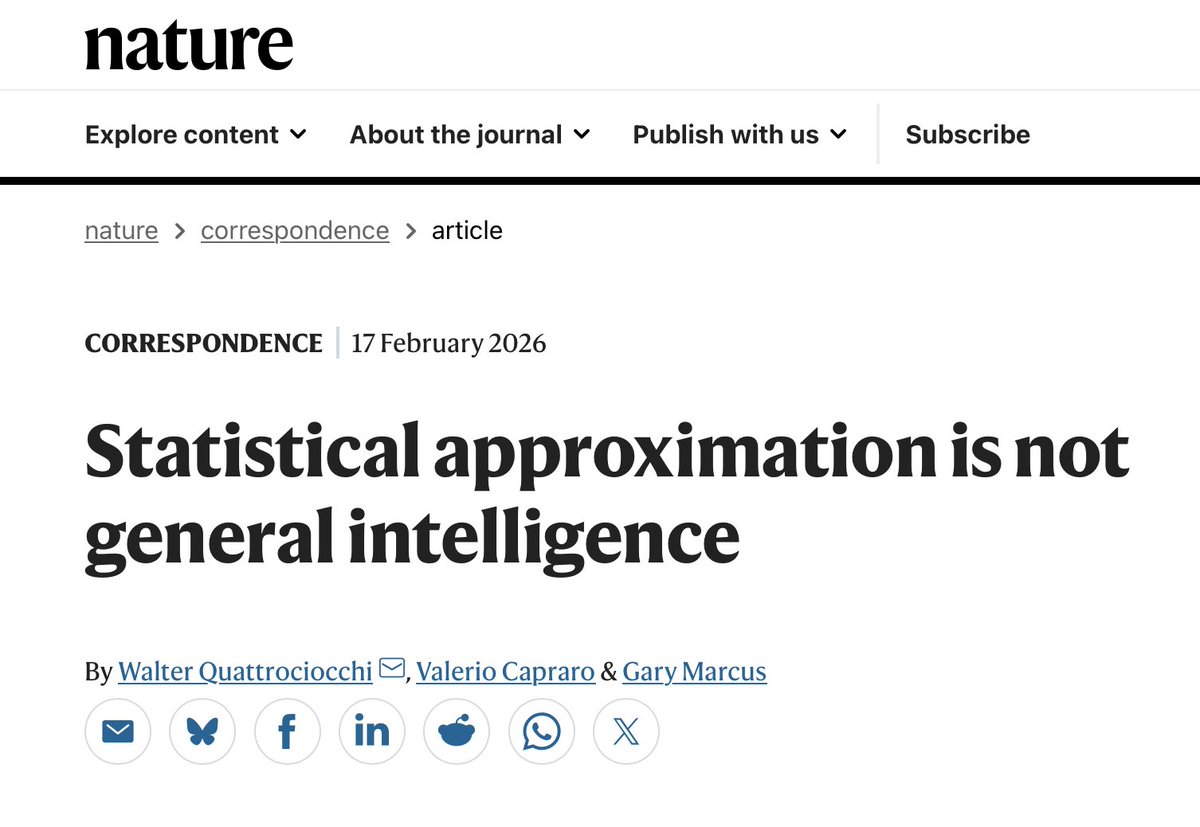
The Pope is making exactly our point. LLMs “may imitate or even simulate, but they do not understand.”
This is the core epistemic fault line.
Most AI evaluation is still based on one assumption: if a system statistically approximates human behaviour, then it is close to human intelligence.
But approximation is not intelligence.
Simulation is not understanding.
LLMs can produce the right answer without knowing why it is right. They can simulate empathy without feeling. They can imitate judgment without responsibility. They can generate coherent explanations without having a world to which those explanations are accountable.
Stop confusing behavioural similarity with cognitive equivalence.
Human understanding is embodied, affective, relational, motivational, and normative. It is not just the production of plausible text.
*
Full paper in the first reply
Watch out! Chrome has a huge bug with <input type="number"> which causes values to change unexpectedly.
It's fixed in Chrome 150, but that won't land until the end of June.
🧪In which we showed that for the London-school TDD, the unit is behavior, not the class
🚫Mocking every collaborator creates brittle tests coupled to implementation details
✅GOOS recommends mocking only peers, not values or internals
📘 Read it: https://t.co/SgSE8RTkGC
We now have an 'open web API' that requires you to comply with Google's "terms of use". I know many at Chrome disagree with this, but feel they can't say anything publicly out of fear of internal retribution. https://t.co/VUNUayQpyZ
So, Chrome's "web standard" Prompt API:
Mozilla: Opposed
WebKit: Opposed
Microsoft: Several concerns
W3C TAG: Several concerns
Developers: Mostly negative
Chrome: Ships anyway.
A sad time for web standards. But, I guess someone at Google will get promoted, so 'every cloud…'
RESTful APIs may be dead soon. Instead, web services may expose a single POST entry point for a prompt. Internally, an AI agent may decide how to interpret it and what to do with the data and the database.