The Apprentice Government, Part 8, continues with Part 3, “Their Own Arrangements”
Washington told its allies to fight for themselves. They took the advice, and some of the help they found runs through Tehran and Beijing.
https://t.co/ErWUNzhmC0
The Apprentice Government, Part 8 - Volume 2 is now available on Substack.
Voters turned on the Iran war on November 3. By then the generals and analysts who might have slowed it down were already gone or overruled.
https://t.co/mhlDNLoI6V
A peace deal was generally “within reach” just hours before the first major combat operation commenced against Iran back in February. As significant and meaningful as Iranian engagement sounds, it may be moot given the agenda of the Israeli PM and the US Department of War.
https://t.co/d141lcaYr2
Significant development and the most meaningful regional engagement seen during the war thus far.
That said, the generally enthusiastic tone from Iranian officials (while not surprising--a regional order that does not include the US has been an Iranian ambition for decades) serves to obscure one of the likely motives behind this trip: Saudi communicating that attacks on its territory are likely to bring more serious repercussions than in the past.
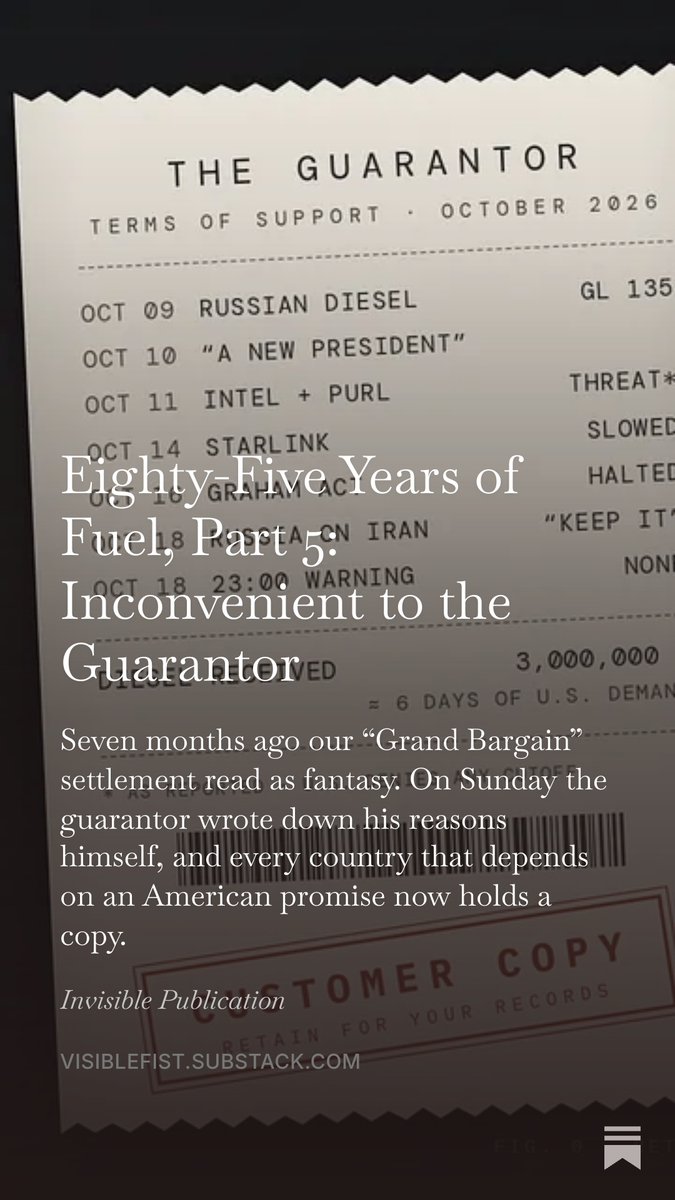
"America as the guarantor to the world, for the last 80 years, it is no longer there."
Trump envoy Tom Barrack, Doha, Tuesday. The same week a third US carrier heads for the Gulf.
Part 5 of 85 Years of Fuel: https://t.co/13zISsnTj5
In March, we wrote about the concept of a "Grand Bargain" or a settlement of the Iran war involving the surrender of Ukraine to Russia and conceding Taiwan to China as a condition of both countries revoking their support for Iran in weapons, trade and intelligence. It was a theory that most everyone scoffed at. Today, we have the president on record describing the Ukraine/Russian leg of that settlement, himself on social media.
It is time to revisit 85 Years of Fuel and what that means for American allies. This should be required reading for leaders of every nation bound by treaty with the United States. Therefore, it will remain paywall-free at the link below in perpetuity.
https://t.co/Zv4jCo0c3I
@INArteCarloDoss GPU loans were sized on a five-to-six-year earning life. Every month a rack waits for power is a month of that life gone, with Vera Rubin getting closer.
In March, we wrote about the concept of a "Grand Bargain" or a settlement of the Iran war involving the surrender of Ukraine to Russia and conceding Taiwan to China as a condition of both countries revoking their support for Iran in weapons, trade and intelligence. It was a theory that most everyone scoffed at. Today, we have the president on record describing the Ukraine/Russian leg of that settlement, himself on social media.
It is time to revisit 85 Years of Fuel and what that means for American allies. This should be required reading for leaders of every nation bound by treaty with the United States. Therefore, it will remain paywall-free at the link below in perpetuity.
https://t.co/Zv4jCo0c3I
The Flattened Depression is a depression hidden from the metrics that would normally identify one.
Today's economic morass isn't called a depression because governments around the world are suppressing the physical losses with paper methods. Those interventions change how fast different clocks run. They slow the fastest clock, which is price, and speed up the slowest ones, which are the long-term stores kept for emergencies.
In effect, governments are saving today's price by sacrificing emergency storage. The depression bites hardest when those long clocks finally run out.
The Russia sanctions waiver shows the mechanism in one act. On the night of October 16, President Trump signed an executive order halting most of a bipartisan sanctions law he had signed in September.
That law allowed tariffs of up to 100 percent on the five largest buyers of Russian oil. The Wall Street Journal reported the move as part of an effort to keep energy prices under control before the midterm elections.
By that account, the order is a paper act aimed at the fast clock: keep Russian barrels moving and hold this autumn's fuel prices down. The Journal's own analysis says the related diesel deal won't ease prices much. The cost lands on the slower clocks. The threat Congress built into the law is set aside before it was ever used. The penalties can still be imposed later, but a threat waived once carries less weight the next time.
Meanwhile the war the pivot is meant to end keeps burning physical capacity. Moscow had already broken the energy ceasefire, and Ukraine resumed strikes on Russian refineries the same week. Ukraine's president said the waiver "only encourages him to keep attacking." Every refinery knocked offline, and every barrel drawn from storage to cover it, comes off the long clocks.
https://t.co/S7rOa6aGlJ
Trump on Iran: "Their leaders are gone. That's one of the problems. I might have gotten too far. I don't know who the hell to deal with ... I probably went a little too far. I'm sorry."
Two weeks ago NVIDIA was asking insurers to cover what happens when a neocloud customer defaults and the chips behind its lease are worth less than the loan.
On October 14, CoreWeave's unsecured bonds due 2032 fell below 80 cents on the dollar, which means a yield above 15%.
Its credit default swaps hit a record that implies a better than even chance of default within five years. The stock is still up 60% since the IPO and worth about $36.5 billion.
Gil Luria of D.A. Davidson put our whole thesis on the shortcomings of the AI business model in one sentence: "If CoreWeave is borrowing at 9% and the best return they can get off of that is a 5% return, it doesn't matter how much they scale."
The collateral side makes it worse:
• Resale value: an H100 system drops to about $30,000 after six years, on Barkr's numbers.
• Supersession: Vera Rubin's measured 10x tokens per megawatt over Blackwell shortens the useful life the debt was sized on.
The other side of the case: this is one day's move in a thin bond, and distressed pricing isn't a default. CoreWeave has a large backlog of contracts with investment-grade customers, and much of its debt is secured at the asset level. CDS-implied odds also overstate real default risk.
What to watch next: CoreWeave's next financing cost, whether NVIDIA's insurer program gets written and at what premium, and whether the stress spreads to Lambda, Nebius, Crusoe and Fluidstack paper.
@beqdn8 The question is not whether they produce real income, it is whether they produce enough real income to repay the loans being taken out on a performing basis. As of today, the answer is emphatically, no.
It’s a brave new world. The hyperscalers are shifting their deal structures from balance-sheet debt to off-balance-sheet debt-like obligations to deploy leverage for the endless buildout for a yet-to-be-proven business model of frontier AI.
Meta’s Hyperion is a perfect example:
•A joint venture called Beignet Investor issued $27bn of bonds due 2049. Blue Owl owns 80% of the venture and Meta 20%.
•A Meta subsidiary leases each of the 11 data centres. The first term is only 4 years, with renewal options in 4-year steps that only Meta controls, out to about 20 years.
•Meta guarantees enough of the campus's value to cover the debt payments for the first 16 years. So if Meta walks away, it still owes the bondholders. The financial risk stays with Meta while the accounting debt shrinks.
Why the 4-year term matters: under US lease accounting, a company only books renewals it is "reasonably certain" to use. A short first term puts a small slice of the 20-year obligation on the balance sheet, while the guarantee keeps Meta liable for the full debt.
Meta pays extra for this. The bonds reportedly carry a 6.58% coupon, more than Meta pays on its own AA bonds. Paying above your own borrowing cost to keep debt off the books tells you how much they value
the cleaner balance sheet.
Here's what's going on underneath:
The commitment is the same; only where it's booked has changed. Meta still owes the money (the guarantee keeps it liable), but the accounting debt is smaller. The idea is that the risk stays put while the reported debt moves somewhere else.
It's legal and disclosed, but it shows up late and in pieces. Short lease terms, joint-venture vehicles and once-a-year disclosure mean the full obligation reaches the balance sheet later and in fragments.
They're paying for it. The higher coupon on the joint-venture bonds shows Meta values the cleaner balance sheet above the cheaper funding.
The structure of the deals demonstrates that Meta, itself is unsure of whether the business model produces the economic value to repay the leverage:
It paid about 6.58% for the right to walk away every 4 years, with the guarantee capping what leaving would cost. A company confident in 20 years of value wouldn't pay for that exit. Meta's own contract treats the payoff as uncertain.
The repayment periods don't line up. The bonds run to 2049, and the buildings will last that long. But the chips that would generate any return turn over much faster, so the debt depends on several rounds of new hardware, and each round has to earn its own return.
What happens if the return doesn't come: Sell-side estimates show Meta’s capex above $500bn through 2028, more than their projected operating cash flow. If AI revenue falls short, the gap gets filled with more debt and leases, not earnings. That's the scenario where debt that shows up on the books late meets returns that never arrive.
@INArteCarloDoss@th_s4m0ht@alwayslearni Makes sense. Probably pretty useful given the following:
The AI build is moving into leases and joint vehicles like Hyperion with Blue Owl. Those stay invisible until each data centre comes online, and the full lease detail is only disclosed once a year.