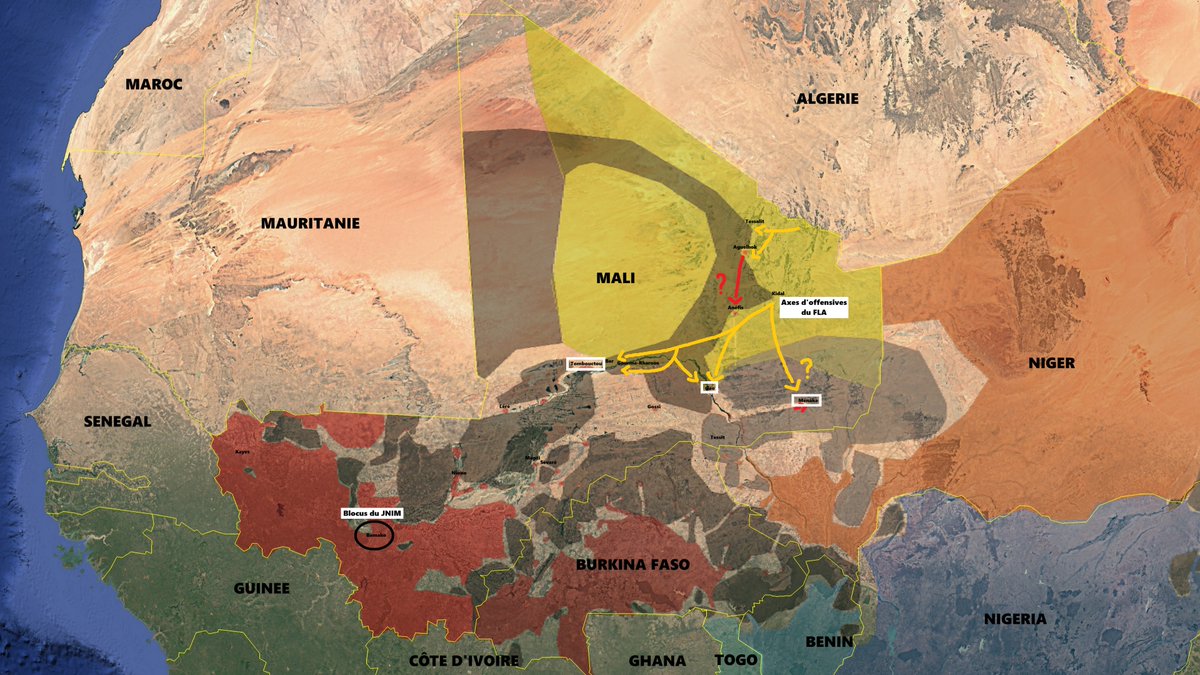
Au Mali 🇲🇱, les rebelles annoncent vouloir s'emparer de Gao, Tombouctou et Ménaka, les principales villes du nord du pays.
En parallèle, les djihadistes du JNIM mènent depuis hier soir le blocus de la capitale Bamako, plusieurs vidéos montrent l'arrêt des camions vers la ville.
Au 5ème jour de l'offensive conjointe entre les rebelles Touaregs du FLA et les djihadistes du JNIM contre l'armée malienne (FAMA) soutenue par l'armée russe 🇷🇺 (Afrika Corps, AC), les combats se poursuivent.
Les rebelles du Front de Libération de l'Azawad, FLA, ont attaqué aujourd'hui la base militaire de Gourma Rharous, à 110km à l'est de Tombouctou. En parallèle, ils sont aussi en possession de la base militaire de Ber à 50km à l'est de la ville. Ainsi, c'est des deux côtés du fleuve Niger que le FLA avance sur Tombouctou, sa présence au sud du Niger est même assez inédite, alors que le groupe était réfugié il y a encore peu au nord du Mali.
Tout porte à croire que les rebelles touaregs souhaitent s'emparer de Gao et Tombouctou, les deux grandes villes du nord du Mali dans les prochains jours, en coopération avec le JNIM. Réunis hier à Kidal, des milliers d'hommes ont écouté un discours du chef rebelle avant de se mettre en route. Les rebelles ont par ailleurs annoncé leur intention de prendre Ménaka, ville de l'est, brièvement conquise par l'Etat Islamique hier avant une contre-attaque des FAMA et de l'Afrika Corps.
De manière générale, l'accord entre le JNIM et le FLA semble être celui d'un front commun. Le FLA administrera les villes, le JNIM la campagne et l'application de la Charia sera "plus soft" que celle voulue initialement par le JNIM. Comme l'ont déjà expliqué plusieurs analystes (@SimNasr, @casusbellii ou @BrantPhilip_), le JNIM s'est récemment éloigné d'Al Qaïda pour se donner une meilleure image et le FLA lui donne une légitimité territoriale et une sécurité arrière face à l'Etat Islamique qui reste plus extrémiste.
A Bamako, quelques affrontements continuent d'éclater entre les forces du JNIM qui bloquent les routes d'accès à la capitale et les forces maliennes et russes qui tentent de garder le contrôle sur la situation.
Un petit point sur le risque régional :
Un effondrement du Mali ne peut être qu'une mauvaise nouvelle pour toute la région. Déjà, depuis deux ans, le JNIM a atteint le Sénégal, la Guinée, la Côte d'Ivoire, le Ghana, le Togo, le Bénin et le Nigeria, lui donnant beaucoup plus de puissance et de moyens de s'enrichir. C'est ainsi toute la région qui est menacée par une déstabilisation du Mali. Déstabilisation de la région signifie également risque de vague migratoire et possible atteintes à des Etats plus riches et peuplés que le Sahel.
Je continuerai de suivre le plus souvent possible la situation au Mali ici. Merci d'avoir suivi.
The UAE suddenly withdrew deposits in Pakistan's Central Bank which Saudi quickly replaced. This report indicates UAE did so to punish Pakistan for its mediator role in US-Iran talks. The story clarifies the 2 Gulf powers' views on the war & is a warning for states like Egypt 🧵
Le général Sadio Camara aurait perdu la vie samedi, a-t-on appris d’une source bien informée. Les djihadistes du JNIM, affiliés à Al-Qaïda, ont revendiqué une série d’attaques coordonnées avec la rébellion touareg contre des positions de la junte. →https://t.co/cbRQLZoVuk
Satellite imagery confirms that Azerbaijan has destroyed the largest church in Stepanakert, the capital of Artsakh/Nagorno-Karabakh. Just another step in erasing all Armenian presence from the region.
While everyone is trying to make sense of Trump’s statements and predict his next move, one of the most significant geopolitical shifts of recent decades is quietly unfolding in Europe. To understand why it began in the first place, you need to pay attention to one number: 10.
10 is the number of liquefied natural gas (LNG) shipments that Qatar will not deliver to Italy by mid-June. Not postponed, but canceled. Qatar Energy declared force majeure after Iranian strikes on the Ras Laffan complex knocked out about 17% of Qatar’s total LNG exports. Recovery will take 3–5 years. That’s $20 billion in losses each year for Qatar and a disaster for their contractors.
And now the number that Brussels prefers not to mention. 100% of Bavaria’s oil goes through a single Italian port. 90% for Austria. About 50% for the Czech Republic. All of this goes through the TAL Transalpine Pipeline, which begins at the maritime terminal in Trieste on the Adriatic Sea. In other words, the industrial heart of German-speaking Europe in Bavaria, the petrochemical industry near Vienna, and Czech refineries—all of these are supplied via Italy.
And now Italy, which imports 95% of the gas and generates over 40% of its electricity from gas, has received a “force majeure” notice from its largest LNG supplier. Before Iran’s strike on Ras Laffan, 45% of Italy’s LNG came from there.
What is Giorgia Meloni doing? On April 3, without any public announcements, she boards a plane and, within 48 hours, meets with the Crown Prince of Saudi Arabia, the Emir of Qatar, and the President of the UAE. They held emergency planning sessions for a new European energy architecture amid conditions where the Strait of Hormuz is de facto closed, and Trump has turned the entire region into a war zone.
The most interesting thing about this is that Meloni isn’t just any European leader. She is the very same conservative populist whom Trump constantly praised as a model for the European right. But that was only the view in Washington. In reality, with this unsanctioned visit, Meloni demonstrated that she is not a populist, but an independent player and strategist. Although Trump himself said he loves surprises.
When Trump’s closest ideological ally in the European Council is conducting independent energy diplomacy with the Persian Gulf — the crack in the transatlantic alliance is no longer theoretical. It is operational. Next, a bit about what Meloni actually agreed to.
Saudi Arabia. The key is not the oil fields, but the Petroline pipeline, built during the Iran-Iraq War of the 1980s specifically to bypass the Strait of Hormuz. It stretches 1,200 km from the Persian Gulf coast to the port of Yanbu on the Red Sea. It is currently operating at full capacity — 7 million barrels per day. 5 million are exported via Yanbu directly into the Red Sea, then through the Suez Canal to the Mediterranean. That is, straight into the basin where the Italian refineries are located. Saudi oil via Yanbu is physically closer to Italy than that which used to go through the Strait of Hormuz.
UAE. The Habshan-Fujairah Pipeline (ADCOP), 248 miles from the Abu Dhabi oil fields to the port of Fujairah in the Gulf of Oman. The key point is that Fujairah is outside the Strait of Hormuz. Capacity is 1.8 million barrels per day; it is currently operating at 1.5 million.
Qatar. There is no point in signing LNG contracts right now — Qatar cannot even fulfill the existing ones. But Meloni offered Italian industrial assistance in the restoration of Ras Laffan. This is a multi-billion-dollar investment that puts Italy at the forefront for future supplies. And second — access to the Golden Pass project in Texas. This is a joint venture between Qatar Energy and ExxonMobil. Qatar does not own Golden Pass outright, but it controls the shipping commitments. And Italy now has preferential access to Golden Pass volumes thanks to the ties Meloni has strengthened in Doha.
Together, this does not fully replace the Qatari shortfall. But it is the framework of a European importer trying to operate in a new reality where the Strait of Hormuz is no longer a reliable corridor. It is the diversification that has been so sorely lacking. Every barrel of oil arriving in Trieste can, within a few days, fuel BMW’s production lines in Bavaria, petrochemical plants near Vienna, and Czech refineries. Trieste is not just a local Italian port; it is the southern loading dock for Central European industry.
If Italy secures preferential access to Saudi oil in Yanbu, if this oil passes through the Suez Canal into the Mediterranean and arrives in Trieste — every refinery along the TAL pipeline from Ingolstadt to Karlsruhe will be running on supplies secured by Meloni in Saudi Arabia.
Italy’s move was planned in advance. It did not go to the Gulf on a whim. Meloni acted on the basis of the Mattei Plan — an Italian framework for partnership with African and Mediterranean states in energy and infrastructure. The UAE has invested $25 million in the Rome Process alone. The Saudis have signed memorandums on water desalination and renewable energy in Africa under the Mattei Plan. ENI has a joint venture with the Saudi company ACWA Power. Fincantieri and Elettronica are integrated into Saudi production chains for years to come.
What this means for Ukraine:
First, this is further proof that the U.S. no longer functions as a guarantor of global security. Even Trump’s closest ideological ally in the EU — Meloni — is conducting her own diplomacy bypassing Washington, because Washington has created the problem rather than offering a solution.
Second, Europe is learning to be an actor. Slowly, through pain and loss, but it is learning. Meloni in the Persian Gulf is exactly what Ukraine has been seeking from the EU for years: independent decisions without waiting for instructions from the White House.
Third, and this is the most important thing for us. Europe, which is building a new energy architecture on its own and paying real money for it, will finally understand: dependence on any authoritarian regime is a deadly trap. Qatar is not Russia, but the very model of “relying on a single country for critical infrastructure” now lies shattered in Ras Laffan. Above all, this counters American calls to buy Russian oil. Moscow is losing money again.
Fourth, Italy now has unique leverage. It is the country where southern supplies converge and Central European distribution takes place. This is true power over energy. And we must closely monitor how Meloni uses this leverage — especially regarding European policy.
A new energy map of Europe is being drawn right now. The chaos created by Trump in the Middle East is, paradoxically, pushing Europe toward strategic autonomy.
În 1972, revista Teatrul a publicat o anchetă pe tema „Sportivii și teatrul”. Răspunsul lui Mircea Lucescu, pe atunci în vârstă de 27 de ani:
„Sper că dumneavoastră n-o să mă ironizaţi şi nici n-o să-mi faceţi o caricatură defăimătoare, aşa cum mi s-a întâmplat cu câţiva ani în urmă, cînd am îndrăznit să mărturisesc că-mi place Apollinaire sau Eluard. Există la noi o tristă şi înrădăcinată prejudecată, după care noi, „actorii“ spectacolului secolului — fotbalul —, am fi nişte troglodiţi, nişte diletanţi amărîţi. Vorbeam odată cu Pittiş şi cu Caramitru, care-mi spuneau că teatrul modern de azi cere performanţă sportivă, că s-a dus vremea actorului care joacă imobilizat în fotoliu. Fotbalul de azi cere la rîndul său şi un bagaj serios de cunoştinţe din toate domeniile: artă, ştiinţă, cultură etc. Eu merg la teatru tot timpul. Cîteodată mă duc în... asalt şi văd cîte patru spectacole pe săptămână. Plăcîndu-mi foarte mult poezia, am fost la toate spectacolele de poezie ale Radioteleviziunii.
Foarte mulţi actori m-au impresionat; dar mai ales Irina Răchiţeanu-Şirianu, cu modul ei simplu, sensibil şi profund prin care a pătruns şi a redat taina versurilor. Extraordinar mi s-a părut spectacolul de poezie susţinut de Caramitru, Pittiş şi Elena Caragiu la Teatrul Bulandra. De altfel, la acest teatru nu mi-a scăpat nici o montare. De la „Play Strindberg la „Leonce şi Lena”, de la „D-ale carnavalului" până la „Scrisoarea pierdută” a lui Ciulei. Găsesc foarte interesante şi foarte utile aceste diferite formule de înscenare ale aceleiaşi piese. Păcat că se aplică atît de rar. Păcat şi că teatrul nostru, cu interpreţi atît de mari, nu întreprinde incursiuni mai largi în domeniul teatrului antic, clasic şi mai ales al teatrului modern contemporan.
Am citit toate piesele de teatru americane şi englezeşti care s-au tipărit la noi şi am întîlnit piese extrem de interesante, care nu ştiu de ce nu se şi joacă. Am citit pasionanta piesă a lui Peter Weiss, „Marat/Sade”, pe care n-a cuprins-o, pînă în prezent, nici un teatru în repertoriul său. Am văzut la Liverpool o montare a piesei „Scripcarul pe acoperiș”. M-a tulburat prin perfecțiune, prin integrarea organică a muzicii și a plasticii, prin acuitatea ideii, exprimată printr-un joc original, de o mare spontaneitate. Mă întreb, apoi, de ce nu se reiau acele spectacole-lectură. Acele lecții de istorie teatrală, ilustrate cu fragmente sau cu piese întregi atât de necesare în educația spectatorului adult sau copil.”
(Ionuț Sociu / FB)
Mario Giuffredi, agente tra gli altri di Pio Esposito, a valanga contro Antonio Conte: "Gli manca il coraggio di mettere i giovani in campo. Vengono messi solo se ci sono tremila infortunati, Vergara non avrebbe mai giocato. Avresti avuto anche meno infortuni. I fatti sono questi. Non mi faccio prendere per il culo da Conte. Quando lui dice che una partita nel Napoli vale 30 partite in B e una in Champions ne vale 60, se tutti ragionassimo così...Conte ha detto abominevoli nefandezze. Allegri fa giocare Bartesaghi retrocesso con l'Under 23, gioca titolare al Milan ora. Bernasconi giocava nell’Atalanta Under 23 e ora ha fatto il titolare con Juric e Palladino. Pio Esposito ora gioca all’Inter e giocava in B. Gasperini ha fatto giocare Arena 2009, l’anno prima era in Serie C. Il suo ragionamento è fuori dal mondo. Se a Conte manca il coraggio di far giocare i giovani non è un problema mio, questo signore tiene in ostaggio Marianucci e Ambrosino da un mese. Uno che fa l’allenatore se perde, perde anche lui. Venuto il momento che ognuno si prenda le responsabilità. Non si può dire che i giocatori che non vanno bene li abbia presi Manna. Nel Napoli non c’è foglia che si muova senza il volere degli allenatori, non ci prendiamo per il culo"
(Calcionapoli24)
🧠🇯🇵 Ojo a la rutina que hace Reo Hatate del Celtic, antes de cada partido, preparando el activo más importante en el fútbol: LOS OJOS.
Esto sirve para activar su cerebro y procesar información a velocidad del juego.
¿Opiniones? ⁉️