@JoshPer52930161@NanoscaleOptics@PhotonicsMeetup Interesting work Josh. I suppose you perform your annealings at atmospheric pressure? When you do multiple annealings in sequence to grow the metastructure do you find the previously grown layers thickness to be stable? Thanks
@E_CabelloOlmo@MOMGroup1@PhotonicsMeetup Very nice work Elena. Do you already have an idea on how the shape and size (slits instad of dots, for example) of your periodical array elements may influence the PL enhancement? Thanks
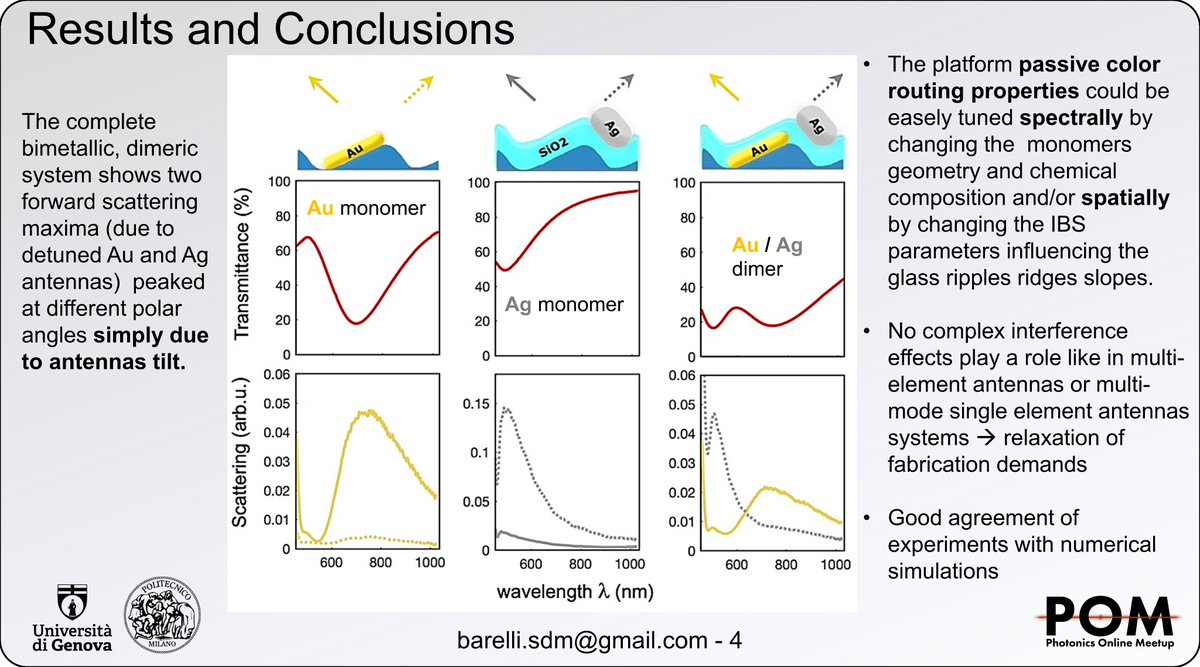
@Sean_Rodrigues8 @UniGenova @fisipolimi @PhotonicsMeetup Hi Sean, thank you for your comment. We chose to employ two different metals instead of using a single one to have a more pronounced spectral separation of the two antennas dipolar resonance, due to the difference in the materials plasma frequency, to show a stronger effect
@nanouschi @PhotonicsMeetup@NorrisOMEL@AndrewBPun@art_karvounis@AlexCHernandezO@rachel_grange@GroupLese @ONG_ETH Hi, interesting work! Do you think it could be feasible to perform and tailor your phase transition on a thin film by heating some underlying previoulsy patterned nanocircuit with a current, or maybe by illuminating some resonant antennas using them as optical nanoheaters?Thanks
@rachel_grange@PhotonicsMeetup@UniGenova @fisipolimi With some work (in progress) on a custom sputter deposition system we could also be able to perform the titled deposition of higher melting point materials.
@rachel_grange@PhotonicsMeetup@UniGenova @fisipolimi Thank you very much! Actually Au and Ag are deposited through simple thermal evaporation (fixed crucible, tiltable sample holder), so any "low" melting point material could be easely grown in their place. IBS is employed only to nanostructure the underlying glass template.