@aimeeterese Yeah, this is basically completely correct! Important to remember as this thing we do dissipates and politics becomes less salient, which is only inevitable as Trump becomes prominent.
Sucks that your Asajew shield wasn't strong enough for the bad guys who tried to hide behind it. Sucks they put you up to this. Sucks you didn't know you were getting used that way. Sucks you have a bad attitude without the intelligence to land it.
White skin gives me and every white American immunity from the virus. But we spread it wherever we go—through our words, our actions, and our systems. We don’t have to be showing symptoms—like a white hood or a Confederate flag—to be contagious.
This is also true. The conclusion of the lecture was Thiel saying “somebody in this audience please do something!”
As one of the only Jews there, knowing that many people online think we are the sole agentic force in the world, it was sobering.
Peter Robinson asks Peter Thiel what he describes as the mandatory hard question about Carl Schmitt: what does he make of the fact that Schmitt joined the Nazi Party?
Thiel: "It's a very bad fact."
Schmitt, he argues, was too esoteric, too coded in his writing. When you act politically, he adds, you end up making compromises, some of which are the wrong ones. He says the intuition he shares with Schmitt is that you are supposed to try.
Peterson interjects: Even at the cost of mistakes?
Some mistakes you should try to avoid making, Thiel replies. But you shouldn't simply engage in a pietistic retreat from action.
Thiel zooms out to describe the lecture series as a whole. He says that, while it has different purposes, it should not simply be taken as a venue for something like yoga, meditation, or pure contemplation. He says he wants his audience to somehow figure out how to stop the Antichrist.
(More from the third Nashville Antichrist lecture).
But @ConceptualJames — why get mad at @AmandaMilius for a picture that @tedcruz posted? Certainly there’s a point where even you admit this stops making sense!
Thiel really said “the time for esotericism is over” in the middle of delivering the most esoteric public lecture series ever. There were a few moments like this.
At the third Nashville Antichrist lecture, Peter Robinson asks Peter Thiel about a recent First Things essay in which he argued that Pope Benedict XVI thought the End Times were upon us.
According to Thiel and coauthor Sam Wolfe, that pope wrote too indirectly, too esoterically, about the apocalypse and the Antichrist, at least until late in his life.
Robinson avers that the First Things essay is itself very Straussian.
Are the Antichrist lectures esoteric?
“I’m not sure I can tell you anything like that," Thiel says, adding that he has sought to be as clear and direct as possible.
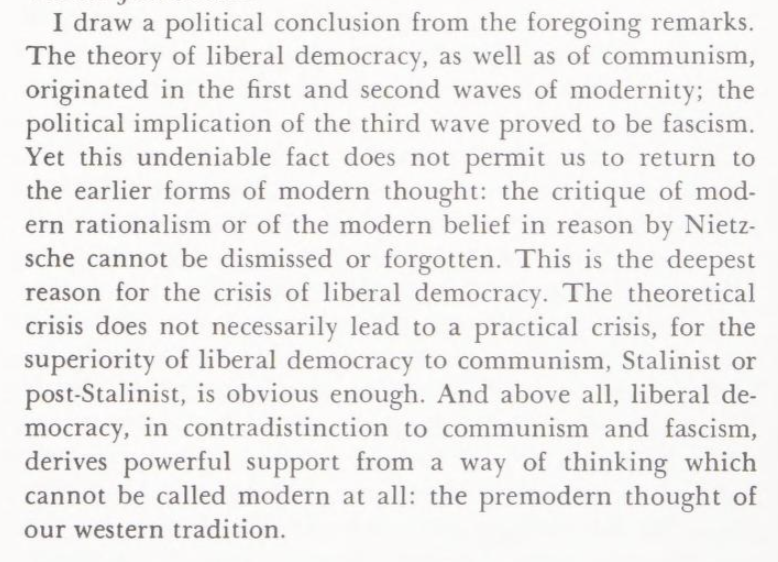
He argues that the late pope, born Joseph Ratzinger, was "incredibly influenced" by Strauss. He cites language in the pope's 2006 Regensburg Address, saying that Benedict's talk of three waves of dehellenization—in the pope's account, successive pushes to undue a past synthesis between Greek philosophy and Biblical faith—parallels Strauss's "The Three Waves of Modernity"—in Strauss's lecture and essay, successive challenges that he relates to Machiavelli, Rousseau, and Nietzsche.
Thiel says his critique of the Straussians is that the time for esotericism is over.
@captive_dreamer He’s still talking about it! It was a turning point. So many things they did were so absurd and comically evil, people simply couldn’t bring themselves to believe it.