If you were inspired by the news of Star Axis last week, here’s a whole series on the myth-makers and monument builders who started the land art movement—from Spiral Jetty to Sun Tunnels, Roden Crater to the 10,000-year clock.
https://t.co/yWaIeRl4Wm
Calling mid 2026 as where the AI x bio industry focus shifts from expecting model improvements to produce cures to realizing we are data-constrained for that goal.
I can't believe it, but our book just came out today! 😀
We investigated more than 100 self-help books and 20 types of therapy to distill them all into the 12 core psychological strategies for improving your life. I'd love it if you'd check it out!
https://t.co/m9oTMMOETd
Today we’ve raised $52M Seed and we are announcing the public launch of S2.1 Pro.
>It can clone a voice from 5 seconds of audio
>2x faster than Cartesia & 1/6th the cost of Eleven Labs
>most expressive model with word level control over emotion, intonation, pacing etc
We support frontier AI companies including HeyGen, LiveKit, Retell, Sanas, and OpenArt all run our model in production.
If you're a business and we can't cut your voice AI costs by 50%, we'll give you 1 year of Fish Audio for free.
Book a demo: https://t.co/vHkyZf9JoG
To celebrate our first birthday, we'll give you 1 month of S2.1 Pro for free. Like, retweet, and comment “Fish” to get it.
hello there the jacobian conjecture is false thanx to my close friend akhil for asking about it and my other close friend fable for working during the world cup final
((1+xy)^3 z + y^2 (1+xy) (4+3xy), y + 3 x (1+xy)^2 z + 3 x y^2 (4+3xy), 2 x - 3 x^2 y - x^3 z): \C^3\to \C^3, has jacobian determinant -2, and sends (0, 0, -1/4), (1, -3/2, 13/2), and (-1, 3/2, 13/2) to (-1/4, 0, 0)
Biology cannot exponentially progress without real computational biologists, because we now live in an omics world where the deliverable of nearly every important experiment is unreadable without a model, and whoever governs that model governs what becomes true.
When you read "China AI...X months behind", keep in mind that *every* Chinese AI service release must be *preapproved* by the Cyberspace Administration of China.
This takes 3-6 months by default.
CAC probably expedited K3. Might just have been weeks. Nevertheless: objects are closer than they appear
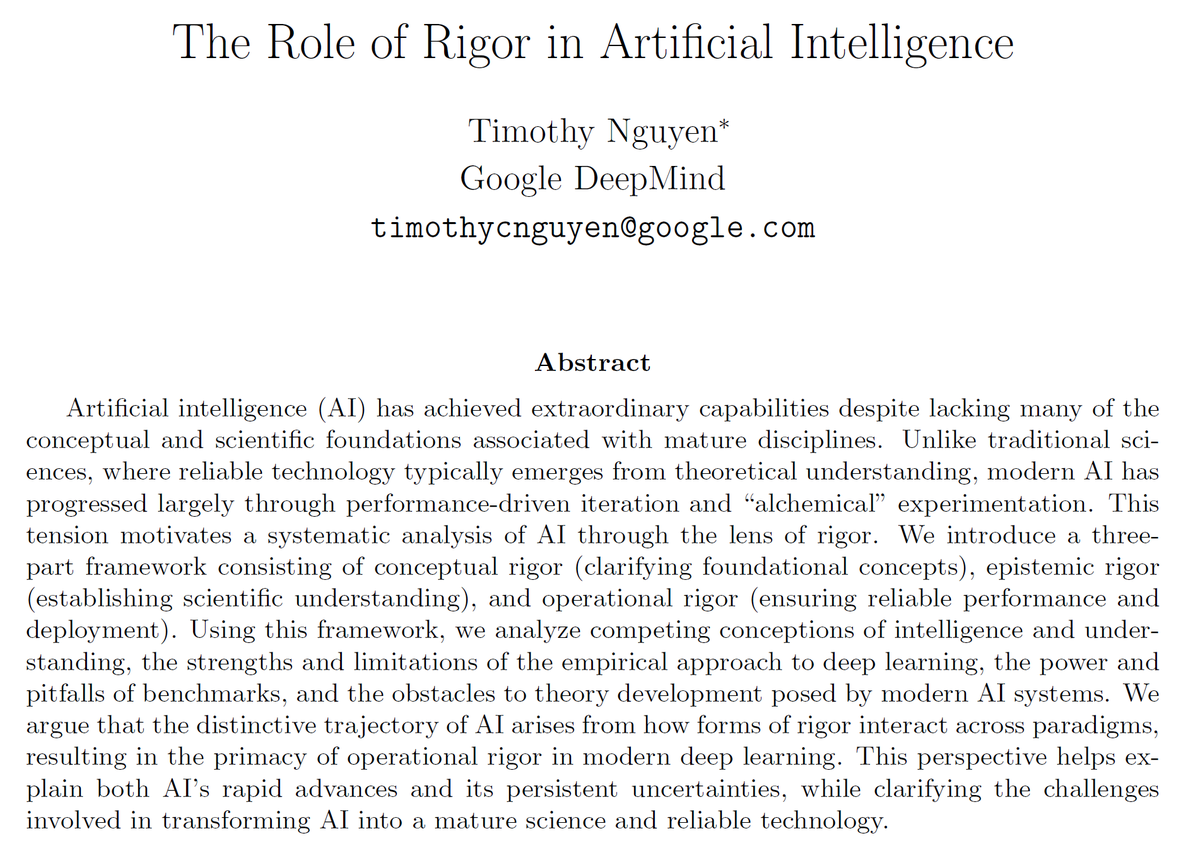
“Deep learning is alchemy” may be the most repeated criticism in AI. It also misses the mark.
Alchemy failed to deliver results. Deep learning, by contrast, has produced transformative technologies. And fields like medicine are only partially understood without being deemed alchemical.
So calling AI “alchemy” captures part of the problem, but not all of it. Modern AI is not simply undisciplined experimentation. It contains significant amounts of rigor. But we still struggle to answer basic questions:
• Do models understand?
• Why do they generalize?
• When will they fail?
The deeper issue is that rigor takes different forms—and in AI, those forms are unevenly developed.
My new paper distinguishes three:
• Conceptual rigor: coherent terminology and paradigms
• Epistemic rigor: reliable scientific understanding
• Operational rigor: reliable performance and deployment
This framework helps explain both the extraordinary progress of modern AI and the uncertainty surrounding it.
Conceptual rigor asks whether the field knows what it's talking about.
• What exactly is intelligence?
• What qualifies as AGI?
• What does it mean for a system to be aligned?
Consider the debate over whether current models are intelligent. One person points to their breadth of performance. Another points to weak planning. Another emphasizes sample inefficiency. Another asks whether it has a grounded model of the world.
They appear to disagree about one property. Often, they are evaluating four.
This is why conceptual clarity matters in practice. Questions about intelligence, understanding, AGI, and alignment do not remain confined to philosophy: they shape how things are measured, optimized, and built.
Epistemic rigor asks whether empirical success has become scientific understanding.
The paper focuses on three criteria:
• Can findings be reproduced?
• Can behavior be predicted in advance?
• Can success and failure be explained?
AI experiments are unusually reproducible in principle: code, data, and models can be copied. But conclusions may still depend heavily on random seeds, hyperparameters, implementation choices, benchmark selection, and compute budgets.
Reproducing a number is not always the same as reproducing the conclusion drawn from it.
Prediction is harder.
Scaling laws can forecast some training outcomes. Infinite-width theory can lead to more tractable settings. Classical learning theory explains important pieces. But we still lack broad principles telling us when a model will generalize, fail under distribution shift, or remain robust under adversarial perturbations.
Explanation is harder still.
Neural networks are mathematically specified, yet their learned features resist human interpretation. A behavior may arise from training data, optimization dynamics, internal representations, or interactions among all of them. The system is transparent in code but opaque in meaning.
Operational rigor is where modern AI is strongest: benchmarks, evaluations, monitoring, red-teaming, and deployment controls.
The field has become highly effective at improving systems without first obtaining a scientific theory of them. Benchmarks turn capabilities into measurable targets. Post-training shapes behavior. Tools and scaffolding compensate for model weaknesses.
Operational rigor can therefore partially substitute for scientific understanding. That imbalance defines the deep-learning era:
• Capabilities rise rapidly.
• Explanations lag behind.
• Benchmarks become optimization targets.
• New systems generate new phenomena faster than theory can absorb them.
AI is advancing while continually changing the object that science must explain.
For AI to mature as both a science and a technology, it will require all three forms of rigor:
• Clearer concepts to define our goals.
• Stronger science to predict and explain system behavior.
• Better engineering to make systems genuinely reliable.
The future of AI depends not simply on demanding “more rigor,” but on identifying which kind is missing—and understanding how the imbalance shapes what we can build, know, and control.
Neural CAs are amazing, but they've never scaled past low resolution.
We propose a simple solution that allows an ~8x resolution boost with minimal extra parameters.
The core idea: Treat cells as local neural fields instead of pixels.
Try the demo: https://t.co/Nnq8VFOGbB
🧵
Richard Murray, a professor at Caltech, made this beautiful chart showing how the complexity of gene circuits (as measured by their number of "parts," or components) has scaled over time. (I'm sharing it below with permission.)
We can learn many things from this chart.
First, academic laboratories have been able to make some *really* complicated gene circuits. My friend, Jai Padmakumar, made the largest gene-circuit ever reported; it was described in a 2024 paper. Jai assembled 1.1 million bases of synthetic DNA into 110 distinct logic gates, and then partitioned that DNA across 66 strains of E. coli. Together, these engineered cells could compute the MD5 hashing algorithm.
The problem is that the larger you make your gene circuit, the less "robust" or reliable the engineered cell becomes. Living organisms did not evolve to carry human-made gene circuits! Therefore, many synthetic biology efforts fail to scale into the real-world. The more complex a gene circuit, or the more genes it has, the less likely that it will be robust over time. More genes have more opportunities to break.
(Note that this is not always the case in natural organisms. Many cells have evolved overlapping ways to regulate genes, such that if one breaks, others can fill in the gap. We're not good at emulating this synthetically, though.)
The chart below shows this trend via the red, dotted line. Engineered cells that have been *commercialized* tend to have only a small number of engineered components; usually less than 10 synthetic genes in total. There is a drop-off in number of components as we move from the laboratory to the real-world.
How can synthetic biologists solve this, and begin to build large gene circuits that are robust over time?
Perhaps we should make it standard to grow engineered cells in a small bioreactor, perturb them with various stressors, and see how well the engineered cells hold up over time. We could record the number of generations that pass before a cell's functions break, and then report that value in the paper. (This is sometimes done, but not often.)
Another option is to "merge" human-made designs, or AI-generated DNA, with continuous evolution.
If we wanted to engineer a cell to break down plastic and recycle the atoms into a medicine, for example, then we could first build dozens of different gene circuit architectures (using high-throughput DNA assembly methods), put each gene circuit into a cell, and then do continuous evolution on each of them to see which one holds up best over time, with various stressors. We could sequence the populations over time, see which sequences hold up well, and use the data to train predictive models of "cellular robustness."
I’m so excited to share this update on @Conception –
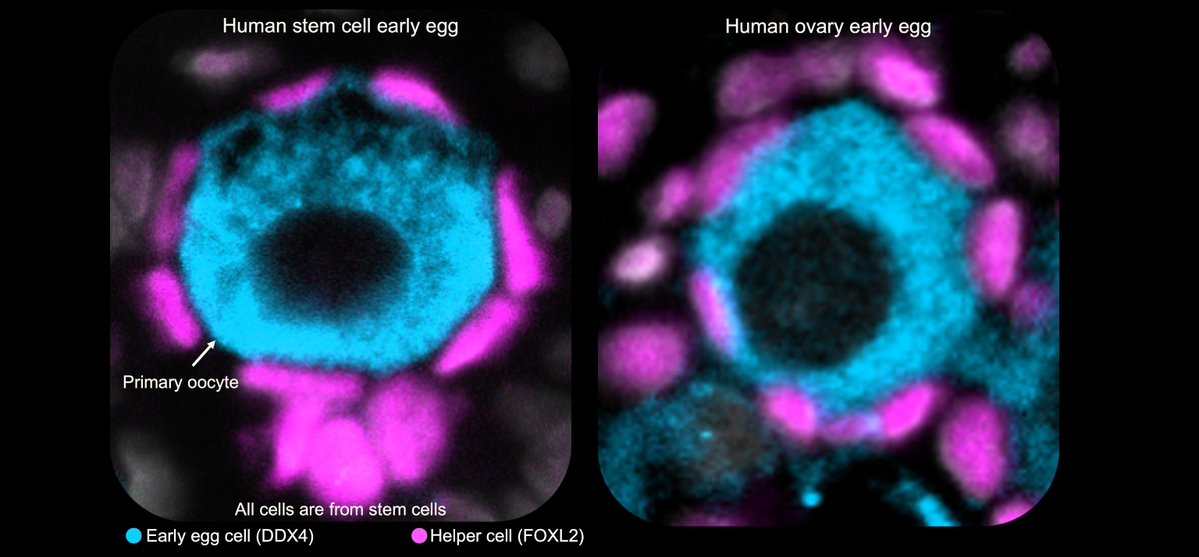
We’ve generated the first early human eggs derived from stem cells.
This is a big deal -- the potential to redefine fertility is real.
Novo Nordisk hackers got in through a GitHub token left in a repo
stayed for two months
took 1.3TB of data including unreleased drug formulas and internal AI models
then asked for $25 million
Novo Nordisk said no
so now they're selling Ozempic's secrets on the dark web
a GitHub token did this
Pro tip: call your internal work meetings "scheming" to add some good whimsy to the day. "Let's scheme today at 11" "Can we move our scheming to tomorrow?" "We talked about this in our last weekly scheme"