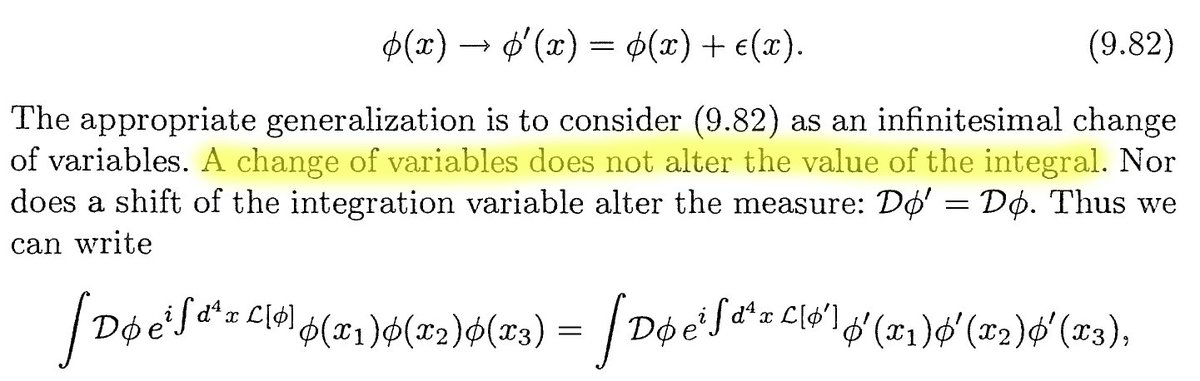
Quantum field theory textbooks have been lying to you or have left you confused. For a typical passage like the following from Peskin&Schroeder - what does it mean to do a change of variables on an ill-defined path integral? For perturbative QFT, my paper resolves this issue: 🧵
Can diffusion models be used for prime factorization? In our new paper with @bodonoghue85, @weballergy, @demishassabis, and others, we explore the limits of this approach.
For small targets, transformer-based discrete diffusion combined with a novel beam search procedure can reliably predict the factor bits of held-out semiprimes. We pushed the ML-based SOTA from 56 to 68 bits, and conducted an empirical scaling study across data, compute, and problem size.
The key bottleneck: problem size. Unlike natural language, which exhibits easily exploitable local substructure, prime factorization lacks the kind of smooth inductive bias neural nets thrive on - and our unfavorable scaling curves suggest a different approach is needed.
We’re excited to share these findings to provide a rigorous baseline and help guide the community on where to look next.
This is jaw droppingly insane. Three new breakthrough results across the board:
1) Harmonic analysis results superceding that of this year's Fields medal (in particular, Kakeya conjecture in every dimension, not just three)
2) Existence of pure Yang-Mills in dimension four. A large part of the Millenium problem (though mass gap still needed).
3) And finally, a subexponential algorithm for 3-SAT upends hundreds of conditional hardness bounds in fine-grained complexity. (However, it doesn't settle P vs NP and because general polynomial reductions blow up instance sizes, the current bound does not make all NP complete problems subexponetial.)
What an insane time for the mathematical sciences.
We are announcing three new discoveries in mathematics, computer science, and physics about harmonic analysis, complexity theory, and quantum field theory.
https://t.co/9BX8HWQDTJ
Extraordinary to see the validity of the largest mathematical result finally certified. The classification of finite simple groups, whose proof spans tens of thousands of pages, is not something you want left to the authority of experts that will not be around forever. Michael Ashbacher was my first math mentor when I was an undergrad at Caltech. Glad that he and others are able to witness today's achievement!
The largest math proof in human history is now computer-verified.
Today, Axiom announces a complete Lean auto-formalization of the Classification of Finite Simple Groups, the "periodic table of symmetry."
About 15,000 pages, built by over 100 mathematicians across generations.
We're also hiring Student Researchers in the Frontier Computation team @GoogleDeepMind, to work with @re_rayne & @IAmTimNguyen!
Areas of interest: agentic optimisation, learning algorithms/simulations, OOD generalisation, AI4Physics, CFD, numerical math.
Applying details below!
Come join my team at @GoogleDeepMind, where we are working on a variety of open-ended problems related to security, sparse computation, agent-guided optimization, and more! We are targeting hires at the L4 level so yes, junior researcher roles still exist. Details:
My team @GoogleDeepMind is hiring! We are seeking a Research Scientist to rigorously study the internals and generalisation of frontier AI systems, w/ a particular view to AI security.
This is an in-person role at our Platform 37 office in London 🎡
Link to apply in thread 👇
Oh just like how neural networks beat rule based systems. I figure if you have some long unpublished list of edge cases, an LLM could supersede it (as a start it could ingest it as context and extend it). And say a human could have a final say for edge cases and not bother with easy cases.
@tdietterich@arxiv Has the arxiv considered using AI to help with moderation? Would clear backlog and arguably handle the endless list of edge cases better.
I’m excited to announce that I will be working at the Mathematical AI Safety Institute (MAISI) full-time as its founding Scientific Director! This means I will not be joining OpenAI as an employee, though I will still be collaborating with them, and I’m happy to announce that OpenAI will be supporting MAISI. They have offered us $10MM in API credits, and access to their latest models for our research use. Moreover, they will be participating in a multi-lab AI safety workshop we are organizing for next year with other frontier AI labs.
As an independent research institute, we are also in conversations with other labs and AI safety orgs about how MAISI can collaborate with them and contribute quickly to AI safety research across the industry. As we’ve seen over the past few weeks, the need for action on AI safety is extremely urgent. Research is an important part of that, and mathematicians have an important role to play!
@Descartesmind@littmath Levent Alpoge is an exceptional example but if you look around you’ll find many contributors outside the system. BB(5) for instance.
Are there any public confessions by senior mathematicians of the form “Had I known during my student days that AI was gonna drop on math like it did on October 6, 2026 I would have become X instead.”? Curious what the values of X are.
I don’t know who it’s from but there’s an adage that goes “you should only do math if you can’t see yourself doing anything else.”
@Descartesmind@littmath Not sure what the entire message would be but given that it’s easier to do math on the side now, consider if you want to do math professionally (academically) and go through the whole tenure system or if you’re fine doing it while getting paid to do something else.
Perhaps with the qualifier that you might not be a professional mathematician. Which is fine. Math will move along a lot more in its current democratized form: you can contribute either by having money, time, curiosity, or the old fashioned way of being a card carrying mathematician in the ivory tower. Curious to see what the volume and magnitude of contributions will be from each.