I've discovered something that unsettles me while doing historical research for my book in progress, "A Prehistory of the Second Amendment".
The current state of play is that I have a manuscript that in theory I could ship tomorrow. But because I'm a careful person, I've given myself the assignment of reading essentially all of the literature adjacent to this specialty topic to make sure I haven't missed anything.
My method is to read the narratives that historians have written, and then use the power of an LLM to drill back down to their primary sources and check them with my own eyeballs. This has two results, one of which is that my book is unusually rich in quotes and primary-source citations that other historians digested into their own language.
The other result is that I've gotten an education in how much difference there can be between what a historian reports the sources say and what they actually say when you go back and look at them.
Most historians who write about this specialty area (as opposed to adjacent ones like, say, the institutional history of the English militia) fall into either a pro-2A or an anti-2A camp. More specifically, they tend to polarize around whether they support the individual-rights interpretation of 2A that is now settled law in the US, or or against it. The difference is usually obvious very quickly once you start reading their stuff.
First, the part that probably won't surprise most of my readers. The antis perpetrate a lot of really appalling lies and distortions - they traduce their sources, or they just plain make shit up. This shouldn't be a surprise to anybody who remembers l'affaire Belleseliles and "Arming America" back in the early 2000s.
That's not the part that disturbs me. It's the behavior of the pros that's bothering me. I've read two major "pro" histories and I'm well into a third. And...well... they don't lie exactly, in they sense of actively saying things that are false to fact. But they misuse quotes out of original context. They gloss over details that don't support their theses. There's often a disturbing sloppiness about attributing a group of several fact claims to a single primary source when they should have cited several distinct ones.
I've even found several citations that are just plain wrong, but would have been extremely difficult to catch without an all-seeing robot eye chasing things down for me.
I am not happy - this is not how the good guys should behave. Is...is all historical scholarship like this, or have I wandered into an area where standards are low? I don't know, and not knowing bothers me.
I am not going to repeat this mistake. When you read a fact claim in my book, you're going to know why I made it and be able to chase a link to the documentary support yourself. I mean, for example, I've gone so far as to make a comprehensive list of every legal enactment relating to weapons control in England between 668 BCE and 1776, with links to source text, and the only reason I don't go back further is that there aren't any written law codes older than that.
Bummer. Well, I shall persevere. Even if I don't write the last word on this topic (and it's not likely that I will), I'm at least going to produce a sourcebook of relevant facts that will be impossible for future historians to ignore.
And, I wonder if anybody else is doing this? That is, using the robot friends to do higher-quality excavation of primary sources than was really practical with the unaided Mark I brain.
(Yes, I do have some novel analytical ideas too. It's not all just dry methodology. One of the key themes in my book is comparative analysis of the English and Colonial militia systems - how the threat model around them shaped their institutions, and in turn the politics of the people who drew lessons from their experience.)
I suspect the scholarly reaction when this comes out is going to be... Interesting.
Your position is reasonable, but wrong.
Having learned to code is still valuable in the new world of AI, not because you're wrong about coding itself having become disposable, but because of the capabilities and mindset you developed while learning to code, some of which are difficult to learn in any other way.
You didn't become a professional programmer. But I'm willing to bet that your intuition about how to design software is far better because you wrestled with code. And that is *not* a skill that LLMs are replacing - ignore the noisy hype about this.
I'm also willing to bet that some of what you learned as a programmer in training translated into problem-decomposition skills that have served you well as an economist.
If one is not a complete dullard (and you are certainly not a complete dullard) learning to code teaches not just craft skills but a mindset - a set of heuristics for carving reality at its joints. There are other ways to get this - I think for example of Richard Feynman who got there by thinking very hard about physics. And it is not guaranteed that every programmer will develop this right mindset.
But many of us do. And most of the other ways to develop it seem also to produce it only as a side effect, but less reliably than learning to code does.
So don't write off learning to code. Maybe someday we'll develop educational methods that can teach those higher-level skills more directly. That would be an excellent thing, if it's possible. But until it gets here, learning to code will still have value that is not easy to duplicate in any other way.
I'll late 40s, same physical ballpark as the Col, probably. I walk 3 miles most days. I run 2x a week and barbell lift 2x. I could run up a mountain, but I would be beat at the end. Adrenaline stress is the missing factor in training, but frequency alleviates that. Train more.
Less than a year ago, the Air Force unveiled a new PT test with a two mile run. Airmen took to social media to complain how the new increased length would cause injuries.
This weekend, an Air Force Colonel, more than likely in their mid to late 40s, ran 5 miles up a mountain to escape the enemy.
Running matters. You should do more of it.
RE: The Moon Launch
OK, look, I admit it. I am an astronaut fanboy nerd (except for one ex-astronaut politician whose head resembles a scrotum).
If you are a late Boomer or early Gen Xer, you remember.
You heard Genesis read from an astronaut orbiting the Moon.
You and all your friends wanted to be astronauts, more than anything.
You remember that your parents bought your family’s first color TV to watch Neil Armstrong on the Moon.
You built the LEM and CSM models and only killed a few brain cells with the glue.
You were scared and prayed during Apollo 13.
You had the lunchbox.
You were sad when they cut off funding for the rest of the Moon landings.
You were amazed when they saved Skylab.
You watched all the movies. (You saw “The Right Stuff” and “Apollo 13” at least 20 times each.)
You cried over Challenger and Columbia.
You got older and wondered why we became so timid. Why not more of the Moon? Why not Mars? Why not beyond? The ISS seemed so…. limiting.
You always said that the US space program was the one thing you did not care how much your were taxed for.
Elon became a god of space travel, and you were there for it.
So it’s our day, fellow astronaut nerd fanboys and fangirls. Put on your make-believe astronaut beanies and goggles, be 8 again, and remember the way you took that refrigerator cardboard box and turned it into the inside of an Apollo capsule with magic markers, Scotch tape and buttons stolen from your Mom’s sewing box.
WE’RE GOING BACK TO THE FREAKING MOON BABY!!!!!🚀❤️🤍💙🇺🇸
@DataRepublican@johnkonrad@EvansRyan202@DataRepublican have you read Robert Coram's biography of John Boyd? Just finished it for the second time, and I'm reminded that this is a very long-known fact of life for our military.
Note: this is not a problem with AI, this is a problem with people storing security items in code repositories instead of secured storage. Stupid games, stupid prizes, etc. etc. ditto ditto
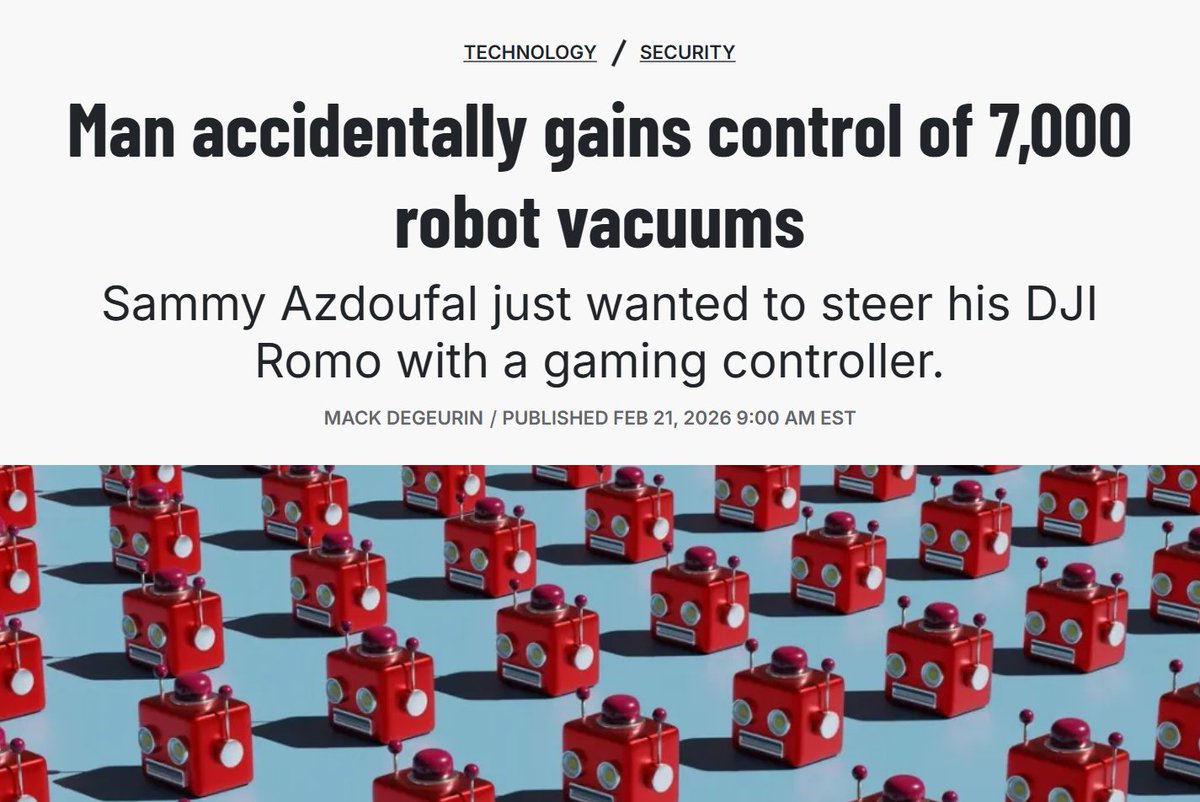
This story is actually insane:
• dude drops $2000 on a DJI robot vacuum like a lunatic
• refuses to use the normal app like a peasant
• Sammy Azdoufal fires up Claude to crack the API so he can drive it with an xbox controller
• Claude delivers the goods
• pulls an auth token from their servers, connects successfully
• except the system thinks he controls 7000 vacuums
• checks again
• yep, seven thousand
• DJI built authentication with zero device ownership verification
• any valid token works for any unit on the planet
• Sammy now has eyes inside homes across 24 countries
• live vacuum camera feeds everywhere
• full floor plans from the mapping data
• some guy in germany eating cereal at 3am, unaware his roomba is snitching
• one API call away from being the most informed burglar in history
• all he wanted was to steer his vacuum with a joystick
• does the right thing and reports it
• DJI fixes it in two days
• back to normal life with his stupidly expensive floor cleaner
• IoT companies stay undefeated at shipping garbage security
A few days from now I'm going to ship my first program written in Rust. But I don't actually know Rust. Strange days have found us.
The astute among you will already have guessed that I used an LLM to translate to Rust a program I originally wrote in C. And that would be correct! But there's a bit more to the story, and some heavy symbolic freight.
For, you see, to me this isn't just any C program. It's the very first one I wrote, back in early 1983. It marks the point where I was able to stop farting around with OSes and tools that were doomed to rapid obsolescence and become a Unix developer
It's hexd, my humble little hex dumper that has survived four decades and is packaged by several Linux distributions competing with od(1) because it emulates the more pleasing and ergonomic dump format now associated with CP/M. (The style actually goes back further to the PDP-11 and very old DEC operating systems.)
That year, 1983 was approximately the beginning of the long dominance of C as a systems programming language. It have been in use at Bell Labs earlier than that, of course, but not until the early 1980s did it escape containment and begin to steamroll every other compiled language and use at the time.
And in a few days I'm going to ship a Rust translation. Alongside the C, giving distribution makers a choice between memory safety with a large binary made from Rust versus a small but very well tested binary without those guarantees. So one could argue it's a half step.
Still. The portents are clear. The old order passeth. C being replaced by languages with stronger memory safety guarantees. But in a twist nobody anticipated, this won't happen because developers are changing their manual coding habits. It will change because increasingly, automatically moving code between languages is nearly trivial.
Not long ago I LLM-lifted another ancient C program I maintain, cvs-fast-export. That one went to Gol. I do know Golang and I like it. So, why move hexd to Rust?
The answer is: automatic memory management. cvs-fast-export needed that capability rather badly; hexd does not. I think this is the big fork on the road when it comes to moving stuff out of C, because in 2026 what candidate l C successors other than Go and Rust would one realistically choose for serious production use?
I was there at the beginning of the long era of C. I believe now that I will live to see its end, and the large language models will be the instruments of its demise. Somebody should write an elegy.
@esrtweet to be fair, you don't see what's under his jacket, and he looks bulky enough that he *might* be wearing one. But I doubt it's properly positioned, if he is. And your other points are definitely true.
This clown, whoever he is, deserves to have a sign lettered "I AM A DUMBSHIT AND I WANT TO DIE" hung around his neck. Let me count at least three ways...
* Totally exposed position.
* No armed buddies covering his back.
* No plate carrier.
It's 2026; if you're planning for the possibility of a rifle gunfight against LEOs and you don't have body armor, you're not serious.
This clown is LARPing.