Nonequilibrium dynamics in spin-model transformers
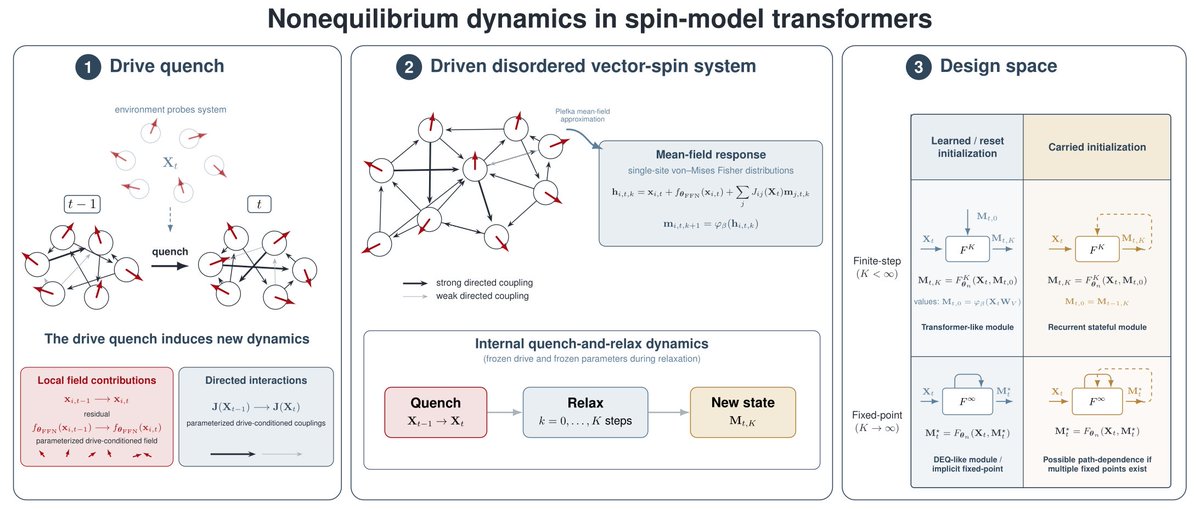
We construct transformer-like computation from a driven disordered vector-spin system: inputs quench and drive the spins, mean-field relaxation implements the forward pass, and learning tunes the effective dynamics.
A non-equilibrium statistical mechanics perspective on transformers
https://t.co/ybu9FLDnEu
We present a class of transformers based on mean-field dynamics of vector-spin models. Our framework supports asymmetric couplings and yields residual, attention, and feed-forward terms.
@de_gennes Haven't looked into that, but sure sounds interesting to explore. Lately I've mainly been working on a dynamical TAP-style mean-field approach to include asymmetric couplings like softmax attention into the transformers-as-vector-spin-models framework: https://t.co/dujEtJ6gVO
New post on approaching transformer modules from statistical mechanics.
https://t.co/xs9p5RWqMn
We implement a differentiable vector-spin model whose couplings act as learnable parameters and probe it with data to find a transformer-like attention response. 1/9
A short post on transformers and statistical mechanics.
https://t.co/FU0C4FZVTD
Can we interpret transformer modules physically? Yes, their forward pass looks like computing magnetizations from free energies in differentiable spin systems. Training shapes collective behaviour.
A short post on transformers and statistical mechanics.
https://t.co/FU0C4FZVTD
Can we interpret transformer modules physically? Yes, their forward pass looks like computing magnetizations from free energies in differentiable spin systems. Training shapes collective behaviour.
A short post on transformers and statistical mechanics.
https://t.co/FU0C4FZVTD
Can we interpret transformer modules physically? Yes, their forward pass looks like computing magnetizations from free energies in differentiable spin systems. Training shapes collective behaviour.
We previously interpreted the deep equilibrium fixed-point procedure physically as solving the mean-field fixed-point equations of a vector-spin model. This work instead takes derivatives of the steepest-descent partition function of a particular class of vector-spin models. 8/9