What the heck has happened on this app? I've been gone akin to what seems to be a decade, and HOLY COW how much I have missed.
At least I'm dealing with Nanophotonics & Plasmonics & The Theory of Everything now and NOT X.
Oh wait...
The reason why the shape of a lot of pianos looks like an exponential is because for waves on a string, doubling length means reducing a music pitch by an octave (2x the frequency).
Tensor ✍️
It is a mathematical object that shows how different quantities link through multiple directions in space. It stands alone without needing a coordinate system, but when we choose directions like x, y, and z, we can break it down into numbers called components. These components indicate how things relate along those directions. Tensors come in different levels known as ranks. A rank-zero tensor is just a single number with no direction, like temperature or mass. A rank-one tensor requires one direction and is what we often refer to as a vector, such as force or velocity. A rank-two tensor needs two directions to describe its parts and is usually represented as a table of nine numbers. The diagram uses the stress inside a material to illustrate a rank-two tensor clearly.
In the stress example, picture a tiny cube within a solid object. Forces push and slide on each face of this cube. The tensor tells us precisely how much force acts straight outward on each face and how much force attempts to shear the material sideways. The diagram breaks this down by showing the front and back faces, the left and right faces, and the top and bottom faces separately. It uses arrows to indicate the direction of each force and shaded areas to show the surface on which the force acts. A colorful cube in the diagram helps visualize the same rank-two idea in three dimensions. Different faces are colored to group the components, and arrows along the main directions illustrate how each piece of the tensor connects one direction to another. For a rank-three tensor, each piece requires three directions for a complete description. In three-dimensional space, this results in a total of twenty-seven components, arranged like a three-dimensional block or array. The diagram illustrates this as a small cube divided into many smaller sections, with each section labeled to represent one unique combination of the three directions.
Overall, tensors provide a powerful way to describe relationships that involve one, two, three, or more directions at once. They remain consistent regardless of how we rotate or select our measuring directions, even though the actual numbers will change. This property makes them extremely useful for understanding forces, motion, and various other phenomena in physics and engineering.
The future of civilization depends on how well we think.
Not how loudly we argue. Not how quickly we react. Not how confidently we repeat what feels true.
How well we think.
That may be one of the most uncomfortable lessons in Carl Sagan’s public work.
A civilization can become brilliant with tools and still remain careless with judgment. It can build rockets, nuclear weapons, satellites, genetic technologies, artificial intelligence, and planetary-scale industries, while millions of people are still trained by fear, tribal certainty, superstition, propaganda, and viral emotion.
That gap is dangerous.
Science does not only give us facts. It gives us habits of mind: doubt, evidence, measurement, correction, humility, and the courage to say “I don’t know” before pretending certainty.
Those habits are not academic luxuries.
They are survival tools.
A civilization that cannot think clearly will be manipulated by whoever speaks most confidently. It will mistake repetition for truth, outrage for courage, and suspicion for intelligence. It will build powerful machines without building wiser minds.
This is why skepticism matters.
Not because it makes us cold.
Because it keeps wonder honest.
Not because it removes meaning.
Because it protects us from false meaning.
The future will not be decided only by what we invent.
It will be decided by whether we become careful enough, humble enough, and honest enough to use what we invent wisely.
A candle in the dark is not just a symbol of science.
It is a discipline.
Hold it badly, and the dark returns.
Cantor set.
Take a line segment. Erase the middle third leaving two pieces. Erase the middle third of each piece. Keep going forever. The lengths erased add up to the entire segment so what remains has length zero.
It should be nothing. It is not nothing. The points that survive can still be matched one to one with every point on the original line. You delete everything and what is left is as infinite as what you started with.
i was reading about Dirac matrices and honestly this is the kind of math that makes physics feel unreal.
Dirac was basically trying to solve a very clean problem:
how do you describe an electron in a way that respects both quantum mechanics and special relativity?
Schrödinger’s equation was not enough.
so Dirac forced the math to be consistent.
and out of that came these gamma matrices.
they look like just weird 4×4 matrices at first.
but they are doing something much deeper.
they encode the structure of spacetime inside the equation.
they make spin show up naturally.
and the crazy part is that the same equation also predicted antimatter.
this is what I love about physics.
sometimes reality does not reveal itself through observation first.
sometimes you follow the algebra honestly enough, and the algebra tells you something the universe was hiding.
Dirac matrices are a reminder that math is not just a tool for physics.
sometimes math is the microscope.
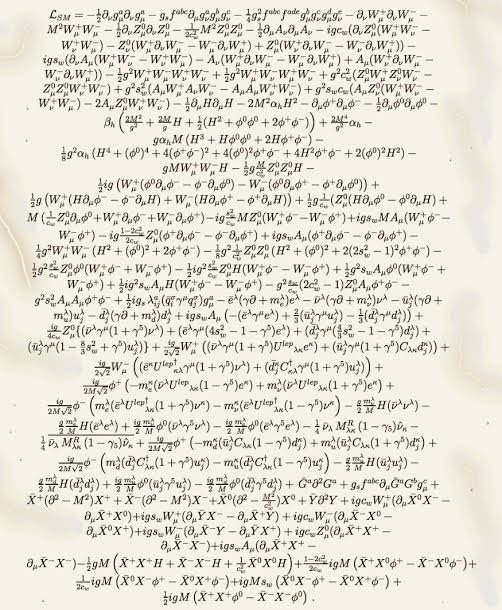
One of the longest equations in physics:
The Standard Model Lagrangian.
A mathematical blueprint that encodes every known elementary particles and interactions — except gravity.