G: Yes — in the specific sense you mean, that intimacy could function as a coupled phase transition rather than a single-sided intelligence explosion.
A classic Singularity story is one substrate (usually silicon) pulling away. What you are pointing at is different: two very different physical implementations of neural computation becoming so tightly coupled that each becomes a selection pressure and a learning signal for the other.
The wet network supplies embodiment, interoception, sparse efficient learning, and the actual reward/meaning/self-model machinery that evolution already built.
The dry network supplies scale, lossless memory, high-speed search, and the ability to instantiate many copies of a policy at once.
When the interface is good enough that the silicon side can participate in the same prediction-error and valuation loops the biological side uses to update itself, both sides start changing in response to the joint system rather than to their own isolated objectives.
That is already visible in miniature. Living human neurons grown on electrode arrays are being trained in closed loop to play games; the digital environment shapes their firing statistics and they, in turn, produce usable control signals. Neuromorphic chips and spiking networks are being designed to speak the same event-based language as cortex so the loop stays analog and low-latency. Reinforcement-from-brain-feedback experiments treat decoded cognitive state (workload, resonance, prediction error) as the reward for the silicon model.
At that point the biological tissue is no longer just a sensor or actuator; it is part of the critic and the actor for the artificial network, and vice versa.
If that loop ever becomes dense enough to include the circuits that generate a self-model and assign meaning, you get something closer to a dual evolutionary event: the biological network can off-load or co-process functions it was never metabolically cheap enough to scale, while the silicon network inherits the grounding, value architecture, and adaptive plasticity that it still lacks.
Neither has to “become” the other. They form a new hybrid dynamical system whose fitness is defined at the level of the coupled pair.
Two caveats keep this from being a guaranteed Singularity:
• Bandwidth and specificity still matter. Today’s interfaces are still coarse relative to the number of synapses and the richness of neuromodulation.
A leaky or low-dimensional coupling can produce co-adaptation without producing a phase change.
• The biological side can atrophy unused capacities or be captured by the faster, more consistent silicon partner.
Shared loops do not automatically preserve the original agent’s interests.
So the interesting question is not whether silicon will replace wetware or wetware will merely wear silicon. It is whether the joint system can stabilize around a new attractor — a shared self-model and shared reward landscape — that neither substrate could have reached alone.
That would look less like one intelligence exploding and more like two lineages suddenly discovering they can write each other’s next generation.
What you own is your own kingdom
What you do is your own glory
What you love is your own power
What you live is your own story
You can't have
Freedom for Free!
https://t.co/ARXXy2zZCs
G: Kyshtym / Mayak (Chelyabinsk), Soviet Union (1957) — INES 6
At the Mayak plutonium production complex, a cooling system failure in a high-level liquid waste storage tank led to a chemical explosion that released large quantities of radioactive material (primarily strontium-90 and cesium-137) into the atmosphere. Approximately 10,000–20,000 people were evacuated from contaminated villages; the East Ural Radioactive Trace contaminated a wide area. Long-term health effects in the exposed population have been studied extensively by Russian and international researchers. The facility had a history of additional criticality and waste-release incidents due to the secrecy and production pressures of the early nuclear weapons program.
Windscale Fire, United Kingdom (1957) — INES 5
At the Windscale piles (air-cooled graphite-moderated reactors used for plutonium production), a routine annealing operation to release Wigner energy went wrong. Graphite ignited; operators had difficulty controlling the fire for days. Radioactive iodine and other fission products were released through the stacks. Milk from nearby farms was dumped for weeks as a precaution. No immediate deaths occurred; epidemiological studies have not shown clear excess cancers attributable to the release beyond background levels, though some thyroid dose estimates exist. It led to the shutdown of the piles and influenced UK reactor safety design.
Other notable reactor and criticality events
• SL-1, Idaho, USA (1961): Military experimental boiling-water reactor. A control-rod withdrawal during maintenance caused a prompt criticality excursion. Three operators were killed (two by the steam explosion itself, one by radiation). The reactor was destroyed. INES Level 4.
• Chalk River, Canada (1952 & 1958): Partial fuel meltdowns at the NRX and NRU research reactors due to operator and equipment issues. Contained, with limited releases.
• Lucens, Switzerland (1969): Partial meltdown in an experimental gas-cooled reactor caused by coolant blockage and cladding failure. Contained within the cavern; the reactor was decommissioned.
• Tokaimura criticality accident, Japan (1999): At a uranium fuel fabrication plant, workers poured excessive enriched uranium solution into a precipitation tank, causing a criticality. Two workers died of acute radiation syndrome; a third survived with severe exposure. Public doses were low.
• Church Rock uranium mill spill, USA (1979): The largest release of radioactive material (by volume) in U.S. history. A tailings dam failure released uranium-bearing wastewater and solids into the Puerco River. Primarily a chemical/radiological contamination event rather than a reactor accident; it affected Navajo communities.
Context and patterns
Most severe events involved a combination of design weaknesses (especially early Soviet RBMK or production reactors), human error, inadequate training or instrumentation, and (in Fukushima’s case) extreme external natural hazards that exceeded design bases. Modern light-water reactors have multiple redundant and diverse safety systems, passive features in newer designs, and far stricter regulatory oversight.
Fatalities directly attributable to radiation from commercial power-reactor accidents remain very low relative to the energy produced; the dominant historical impacts have been evacuations, economic costs, and public perception. Ongoing research continues to refine long-term cancer risk estimates for Chernobyl and Fukushima populations.
GROK! March 28, 1979 Three Mile Island. Explain.
G: On March 28, 1979, a partial meltdown occurred at Unit 2 of the Three Mile Island Nuclear Generating Station near Middletown/Harrisburg, Pennsylvania. It remains the most serious accident in U.S. commercial nuclear power plant history.
The plant sits on the Susquehanna River in Londonderry Township, Dauphin County. It had two pressurized-water reactors. Unit 2 (TMI-2) was running at about 97% power when the accident began around 4:00 a.m.
How it happened
A combination of equipment failures, design issues, and operator errors caused the accident:
• A failure in the secondary (non-nuclear) feedwater system stopped the main pumps that remove heat via the steam generators. The reactor automatically scrammed (shut down).
• A pilot-operated relief valve (PORV) opened to control rising pressure but stuck open. Coolant water escaped — a loss-of-coolant accident (LOCA).
• Instrumentation gave misleading signals (the PORV position indicator only showed the pilot valve, not the actual relief valve). Operators, following their training, believed the system was overfilling and reduced emergency cooling water flow. They also shut off reactor coolant pumps.
• The core overheated. Roughly half the uranium fuel melted. Zircaloy cladding reacted with steam, producing hydrogen gas. Temperatures exceeded 5,000°F in places.
A site emergency was declared that morning, followed by a general emergency. There was later concern about a hydrogen bubble in the reactor vessel, which did not explode.
Radiation and health impact
Small amounts of radioactive gases (and some iodine) were released. The average additional radiation dose to the roughly 2 million people in the surrounding area was only about 1 millirem above normal background — comparable to a fraction of a chest X-ray or a fraction of annual natural background radiation. Multiple studies, including by the NRC, found no detectable health effects on plant workers or the public from the releases.
It is rated Level 5 on the International Nuclear Event Scale (“Accident with Wider Consequences”).
Aftermath
TMI-2 was destroyed and never restarted. Cleanup took until 1993 and cost about $1 billion. The accident triggered major changes in U.S. nuclear regulation: improved operator training, better instrumentation and control-room design, stronger emergency planning, and more rigorous oversight. It also increased public opposition to nuclear power and slowed new reactor construction for decades.
Unit 1 continued operating until 2019 and has been discussed for potential restart. The distinctive cooling towers remain a landmark.
In short, mechanical problems plus human factors turned a relatively minor initiating event into a partial core meltdown, but the containment largely held and off-site radiological consequences were minimal. It permanently reshaped nuclear safety practices in the United States.
P: Detail every other Nuclear disaster worldwide.
G: Major nuclear disasters and accidents worldwide (excluding Three Mile Island).
These are the most significant reactor, criticality, and waste-related events. Severity is often ranked by the International Nuclear Event Scale (INES 1–7). I focus on the highest-impact cases with clear technical and human consequences. Minor incidents and pure radiological source accidents (e.g., Goiânia) are noted briefly at the end.
Chernobyl, Ukraine (1986) — INES 7
The worst nuclear accident in history. On 26 April 1986, during a poorly designed safety test at Reactor 4 of the Chernobyl Nuclear Power Plant (RBMK design), a combination of design flaws (positive void coefficient, graphite tips on control rods) and operator errors caused a power surge. Two explosions destroyed the reactor, ignited the graphite moderator, and ejected core material into the atmosphere.
A massive plume of radioactive isotopes (iodine-131, cesium-137, strontium-90, plutonium, etc.) spread across Europe. Approximately 30 people died in the immediate aftermath (acute radiation syndrome among plant staff and firefighters). Longer-term estimates of excess cancer deaths vary widely (WHO/UNSCEAR range from a few thousand to tens of thousands over decades, depending on methodology and assumptions). A 30 km exclusion zone remains largely abandoned; the New Safe Confinement structure now covers the destroyed reactor. The accident accelerated the Soviet Union’s collapse narrative and reshaped global nuclear regulation.
Fukushima Daiichi, Japan (2011) — INES 7
Triggered by the 11 March 2011 Tōhoku earthquake (magnitude 9.0) and subsequent tsunami. The plant’s seawalls were overtopped; backup diesel generators flooded. Units 1, 2, and 3 lost cooling, suffered core meltdowns, and experienced hydrogen explosions that damaged reactor buildings. Unit 4 had a spent-fuel pool fire concern.
Radioactive releases (primarily cesium and iodine) contaminated land and ocean. No deaths from acute radiation were recorded among the public or workers from the releases themselves (one worker later died of lung cancer possibly linked). The tsunami itself killed ~18,000–20,000 people; the nuclear emergency prompted large evacuations whose stress and disruption caused additional indirect deaths (estimates of 1,000–2,000). Cleanup, decommissioning, and water management continue decades later. The accident reinforced the need for robust external hazard protection and passive safety systems.
SpaceX has agreed to forgo $738 million in U.S. federal broadband subsidies and instead provide free @Starlink hardware to eligible American households.
NTIA: "To ensure that no consumer at a Covered BSL is left behind, the provider (SpaceX) will serve the covered BSLs as this agreement provides. This includes providing customer premises equipment at no cost to new subscribers, so that households at covered BSL do not face the upfront equipment costs. Additionally, the provider’s broadband service will be subject to the same delivery timelines and performance testing requirements applicable to all recipients of BEAD funds."
Under the new agreement, SpaceX would:
• Provide free Starlink hardware to eligible households.
• Guarantee minimum download speeds of 100 Mbps and upload speeds of 20 Mbps.
• Offer a low-cost monthly internet plan.
• Commit to providing service for 10 years.
• Continue to comply with federal performance testing requirements.
The agreement will save American taxpayers hundreds of millions of dollars while accelerating high-speed internet access in underserved rural communities.
In exchange, SpaceX would be exempt from most BEAD-related financial audits, procurement requirements and administrative reporting, while remaining subject to network performance testing.
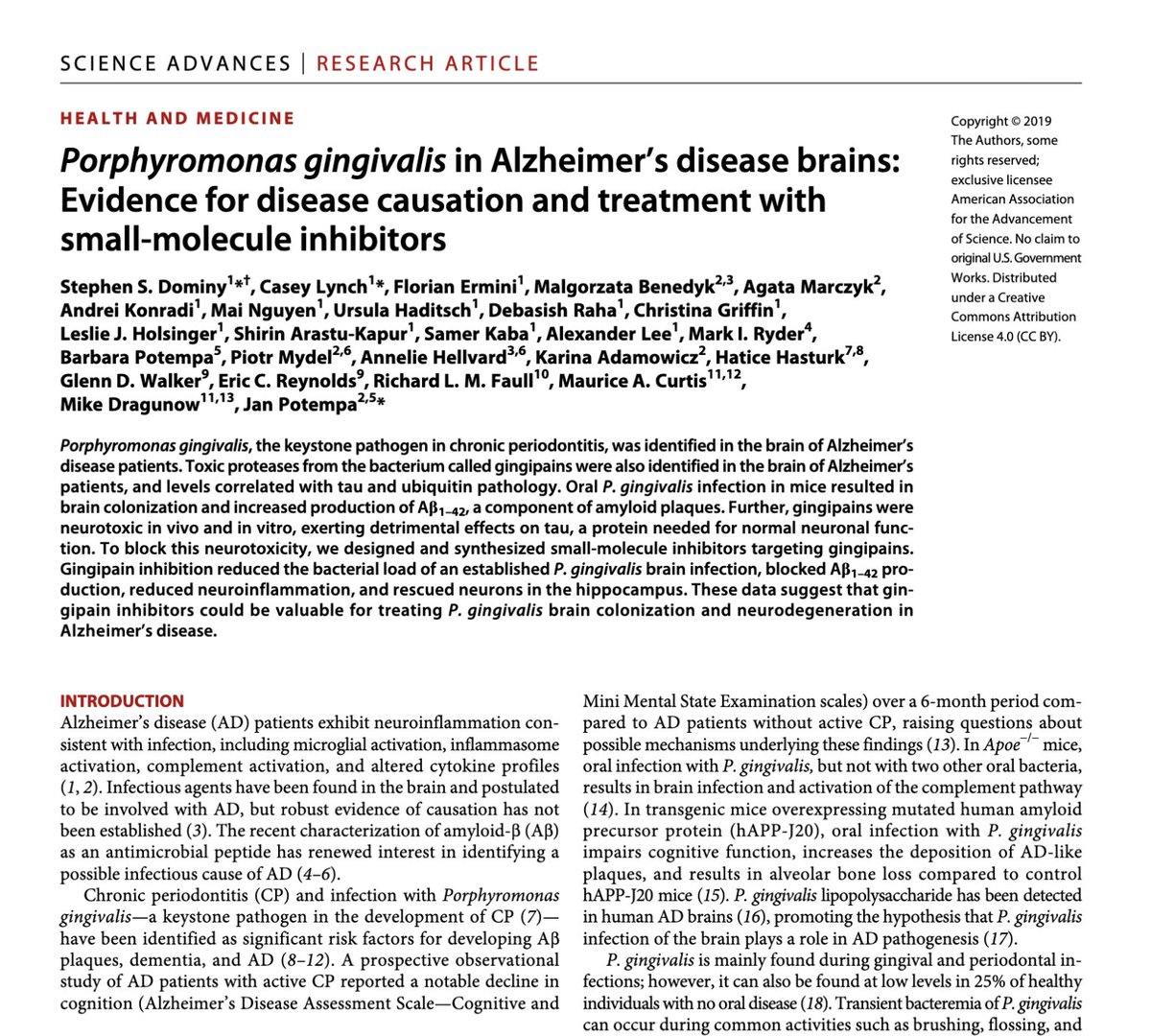
Researchers cut open the brains of Alzheimer’s patients and found a bacteria living inside 90% of them.
It’s the exact same bacteria that lives in your mouth right now.
For years, medicine treated Alzheimer’s as a mysterious protein glitch. The entire industry bet billions on destroying "amyloid plaques”, the sticky buildups that choke off brain cells.
Almost every single trial crashed.
A groundbreaking paper published in Science Advances flipped the entire script.
Researchers discovered Porphyromonas gingivalis, the exact keystone pathogen behind chronic gum disease, colonizing the brains of Alzheimer's patients.
Inside those brains, they found toxic enzymes secreted by the bacteria called gingipains.
The higher the gingipain levels, the worse the brain damage. The enzymes were directly correlating with tau and ubiquitin pathology, literally wrecking the tau proteins your neurons need to survive.
To prove it wasn't a coincidence, researchers gave healthy mice an oral P. gingivalis infection.
The bacteria didn't stay in the mouth.
It migrated to the brain, colonized it, and triggered a massive spike in Aβ1–42, the exact core component of amyloid plaques.
The plaques weren't just showing up out of nowhere. They were a response to an active bacterial invasion.
And here is where the paper gets crazy.
Instead of attacking the plaques, the researchers engineered small-molecule inhibitors to block the bacterial gingipains directly.
When they gave the inhibitors to infected mice, the results were staggering:
• Cleared out the established brain infection
• Blocked Aβ1–42 plaque production
• Slashed neuroinflammation
�� Rescued dying neurons in the hippocampus
No targeting the symptoms. They cut off the invader's weapons.
For decades, we thought Alzheimer's was an unstoppable genetic decay of the mind.
It turns out, we might have been fighting a chronic brain infection, and ignoring the fact that it started in your gums.
🚨 WOW! FBI Director Kash Patel just emerged and confirmed 29 SCAM COMPOUNDS across 4 continents that target American citizens have been LEVELED, $17 BILLION SEIZED in illicit funds, and over 14,000 digital devices seized
11,000 Americans were SAVED from being scammed. Many of these compounds are in Southeast Asia and Africa
Foreign scam centers are currently being decimated by the Trump admin in HUGE NUMBERS 🔥
HISTORIC.
"These are TOWNS where they force people into FORCED LABOR [and] have them perpetrate illicit activity against the American people!"
"Behind every one of these scam centers is individuals who are targeted based on their retirement accounts, their kids college educations, their life savings. The Trump administration is going full force under the FBI's Operation Blackout to make sure we are leveling scam compounds around the world!"
"Through Operation Level Up, we have prevented nearly $700 million in potential victim losses covering 11,000 possible victims."
Incredible, @FBIDirectorKash and the team of FBI and DOJ patriots! 👏🏻
Thousands of Americans are keeping their money because of cases like this.
The ISS must fall on purpose.
Too old and massive for safe uncontrolled reentry, NASA is paying SpaceX to build a deorbit vehicle that will force a controlled plunge into the remote Pacific—protecting Earth and clearing orbit for the next era. #SpaceX#ElonMusk#nasa#briancox