Upcoming releases of FSD will remember your parking preferences, so that the car goes to the right location at your home, office, school drop off, etc.
Destination parking is by far the biggest reason people now intervene with FSD. Critical safety interventions are extremely rare.
As two of the largest forces in equity markets -- growing index ownership and increasing amounts of capital controlled by extremely short-term-oriented, leveraged, volatility-intolerant investors -- converge, we have found occasional opportunities to acquire some of the most dominant long-term compounding franchises at attractive valuations.
For example, we acquired Alphabet $GOOG when the stock declined substantially on the release of ChatGPT in late 2022, Amazon $AMZN in the weeks following Liberation Day, and $META more recently on the market's response to the company's unexpectedly large cap ex guidance and expenditures.
In our 13F which we will file later today, we will disclose a new position in Microsoft, a company we have followed for many years now offered at a highly compelling valuation. While $PSUS will not be filing a 13F tomorrow, it has also recently made $MFST a core holding.
Microsoft operates two of the most valuable franchises in enterprise technology, which account for approximately 70% of the company's overall profits: M365 and Azure.
M365, the company's productivity suite, is the dominant operating platform for knowledge work, with over 450 million workers using Word, Excel, PowerPoint, Outlook, and Teams on a daily basis.
Azure is the world's second-largest hyperscaler cloud platform and, like AWS in our Amazon investment, is a direct beneficiary of the multi-decade migration of enterprise IT workloads to the cloud, which is now further accelerated by surging demand for AI inference workloads.
Both M365 and Azure are underpinned by Microsoft's unparalleled enterprise distribution and the security, compliance, and identity infrastructure it has built and refined over decades.
Beyond these core franchises, Microsoft also owns a portfolio of other leading businesses, including LinkedIn (the world's largest professional network with 1.3 billion members), its gaming platform (Xbox and Activision Blizzard), and search and news advertising (Bing and the Edge browser).
We began building our position in MSFT in February following a meaningful share price decline after the company reported its fiscal Q2 2026 results. We were able to establish our position at a valuation of 21 times forward earnings, broadly in line with the market multiple and well below Microsoft's trading average over the last few years.
Notably, MSFT's headline multiple does not reflect the value of Microsoft's approximately 27% economic interest in OpenAI, which would represent approximately $200 billion, or 7% of Microsoft's market capitalization, at OpenAI's most recent funding round valuation.
We believe Microsoft's recent share price decline has been principally driven by investor concerns around two key issues: i) the competitive positioning of M365 against increasingly capable AI lab offerings (notably Anthropic's Claude Cowork), and ii) the durability of Azure's growth, especially in light of Microsoft's evolving relationship with OpenAI.
In our view, investors underestimate the resilience of the M365 franchise given its deeply embedded role across enterprises and highly attractive price-value proposition. Unlike point software solutions, which may be vulnerable to disintermediation by better-performing AI alternatives, M365 is tightly integrated into the daily workflow of nearly every large enterprise and is supported by Microsoft's identity, security, compliance, and data governance infrastructure, which would be nearly impossible to replicate.
Attractive bundle economics further reinforce Microsoft's advantage, with monthly average revenue per user on the M365 suite at approximately $20, less than half of what customers would pay to purchase the underlying applications individually from different vendors.
Moreover, we are encouraged to see Microsoft prioritizing its R&D efforts and investment in Copilot, its own AI agent embedded across M365, with direct involvement from CEO Satya Nadella. We believe these efforts will translate into improved product velocity and greater customer adoption over time.
Alongside Copilot's rollout, the company has also begun shifting its pricing model from pure per-seat licensing to a hybrid model of seats plus metered consumption, which helps expand the company’s revenue opportunity as AI agents drive incremental usage that a seat-only structure would not capture. These initiatives should help sustain M365’s strong underlying growth momentum, which was already evident in the business unit’s 15% revenue growth (in constant currency) last quarter.
We believe concerns regarding Azure's growth trajectory are similarly misplaced, particularly in light of the franchise's exceptional recent performance. Azure revenue grew 39% in constant currency last quarter, with company guiding to modest acceleration through the second half of the year.
We view Microsoft's recent decision to restructure its OpenAI partnership not as a concession but as part of a deliberate pivot toward a more open, multi-model architecture that better serves enterprise customers, who increasingly seek optionality across model providers.
Microsoft recently disclosed that over 10,000 enterprise customers have used more than one model on Azure Foundry, the company’s modular AI model marketplace. This model-agnostic approach also strengthens Copilot, which can auto-route queries across multiple models to deliver the optimal output for a given task.
To support Azure's rapid growth amid persistent supply constraints, Microsoft has raised its calendar year 2026 capex budget to approximately $190 billion. Consistent with what we have observed at hyperscaler peers Amazon and Google, we view this spend as growth capex that should drive future revenue generation. This is particularly true for Microsoft, given that roughly two-thirds of its capex budget is allocated to server and networking equipment that correlates directly with near-term revenue.
Like our purchases of $GOOG, $AMZN, and $META, we believe that $MSFT offers analogous and compelling long-term value at today's valuation.
After nearly 18 years I can stop working on Model S and X. We put so much love into these products, but will continue to pour that into the future products. Thanks to everyone who believed in and supported these cars through the years. We strived for the best and will never stop. Saying goodbye to something great and making room for something even greater!
Amazon Supply Chain Services—our freight, distribution, fulfillment, and parcel shipping network—can now be used by any business.
Was built over nearly three decades to move, store, and deliver products across land, air, and sea. All one network, so no need to piece together different providers at every stage. Same reliability and speed our customers rely on.
P&G, 3M, Lands' End, and American Eagle already on board. Gonna help a lot of businesses move faster, save money, and simplify things. https://t.co/xFUa9lVRDx
Here's a general summary of Elon Musk’s 3.5 hour long testimony today during day 2 of the OpenAI trial:
• Elon on Sam Altman & Greg Brockman: “If they wanna get rich, they should go do so as a for-profit. They should not get rich off a nonprofit. I gave them $38 million of essentially free funding to create what would become an $800 billion company.”
• Elon says he could’ve made OpenAI for-profit but chose nonprofit for AI safety
• Wanted initial ~51% control due to funding, but expected dilution over time
• Donated $10M+ and trusted assurances OpenAI would remain nonprofit
• Elon says his view of OpenAI evolved in three stages: first, he was “enthusiastically supportive.” Then, he became “a little uncertain” about whether the founders would keep it nonprofit. Now, he says he’s convinced “they’re looting the nonprofit.”
• Elon says he “I would have filed the lawsuit sooner if I thought they had stolen the charity sooner.”
• Left board in 2018 (Tesla/SpaceX commitments), still believing mission wouldn’t change
• Was not concerned by 2019 capped-profit shift at the time
• Elon feels the Microsoft partnership was a “bait and switch” and risked corporate control of AGI. When Microsoft invested $10B in OpenAI at the end of 2022, Elon sent a text to Sam asking, “What the hell is going on?” Elon became very concerned about OpenAI’s direction. Sam Altman responded to Elon's text with: “I agree this feels bad. We offered you equity when we established the cap profit, which you didn't want at the time. We are still very happy to do any time you’d like.”
Elon says "I didn’t understand how you could have stock in a nonprofit. It just didn't seem to make sense to me. Frankly, it felt like a bribe."
• Rejected equity offer from OpenAI, saying it didn’t make sense for a nonprofit, later called it a “bribe”
• Says he sued only after the “charity was actually violated,” not earlier concerns
• Denies seeking permanent control; says goal was ensuring AI goes in the “right direction”
• Early OpenAI relationships were positive, later deteriorated
• Elon criticized OpenAI as “not open” and effectively controlled by Microsoft
• OpenAI attorney asked Elon about the potential upcoming SpaceX IPO. Elon said that it would be illegal for him to comment on it before it actually goes public. When asked if he will control SpaceX after the IPO, Elon said: “Yes" and said he will still be CEO.
• Elon’s last $5M quarterly donation to OpenAI was in May 2017; he stopped covering office rent in 2020.
• OpenAI attorney on suggesting that xAI’s Grok lags far behind ChatGPT. Elon said, “Well, not anymore.” The OpenAI attorney asked, “It’s catching up, you think?” to which Elon replied, “Yeah.”
Elon will continue his testimony tomorrow.
Scam Altman and Greg Stockman stole a charity. Full stop.
Greg got tens of billions of stock for himself and Scam got dozens of OpenAI side deals with a piece of the action for himself, Y Combinator style. After this lawsuit, Scam will also be awarded tens of billions in stock directly.
The fundamental question is simply this:
Do you want to set legal precedent in the United States that it is ok to loot a charity? If so, you undermine all charitable giving in the United States forever.
I could have started OpenAI as a for-profit corporation. Instead, I started it, funded it, recruited critical talent and taught them everything I know about how to make a startup successful FOR THE PUBLIC GOOD.
Then they stole the charity.
Q1 2026 Shareholder Update
https://t.co/dOjSLhd10p
We continued to make meaningful progress on the build out of the infrastructure & AI software that underpins our Robotaxi & future robotics businesses in Q1.
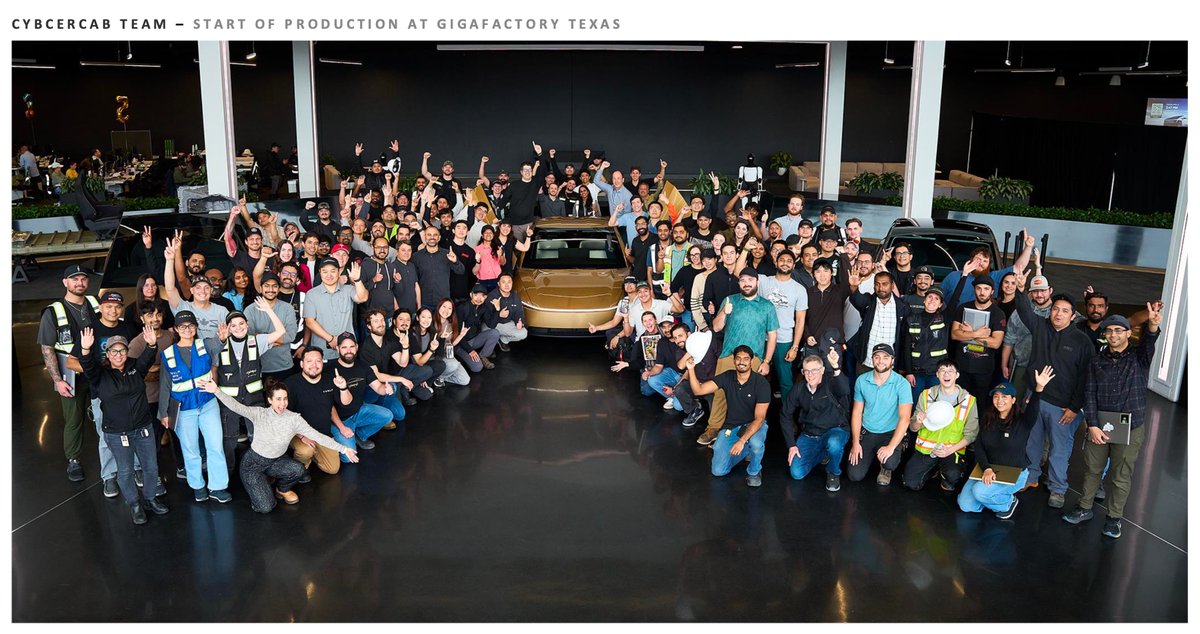
That meant commencing the ramp of new factories across AI compute, battery & battery materials, as well as preparing lines for start of production of Megapack 3, Cybercab & Tesla Semi.
Demand for our vehicles continued to grow in APAC & South America markets, with a rebound of demand in EMEA markets & North America.
As trade and geopolitics become more uncertain, we're further regionalizing and vertically integrating critical supply chains to ensure access to key materials & componentry in each region across vehicle, energy & AI.
Automotive
– Optimizing our vehicle product portfolio with an emphasis on vehicles designed for a fully autonomous future
– More affordable trims of Model 3/Y & rollout of Model Y L in markets outside of China
– Began deliveries of Cybertruck in the UAE
– Volume production of Cybercab & Tesla Semi this year
Energy Generation & Storage
– Good progress with new Megafactory outside Houston (will produce Megapack 3 for Megablock). Start of production on track for later this year
– We began meaningful customer deployments of Tesla’s first in-house designed solar panel produced at Giga New York
Robotics
– Preparations for our first large-scale Optimus factory will begin shortly in Q2.
First-gen line designed for 1M robots/year will replace Model S/X lines in Fremont Factory, second-gen line is being prepared at Giga Texas (long-term annual capacity of 10M robots/year)
AI Training Compute
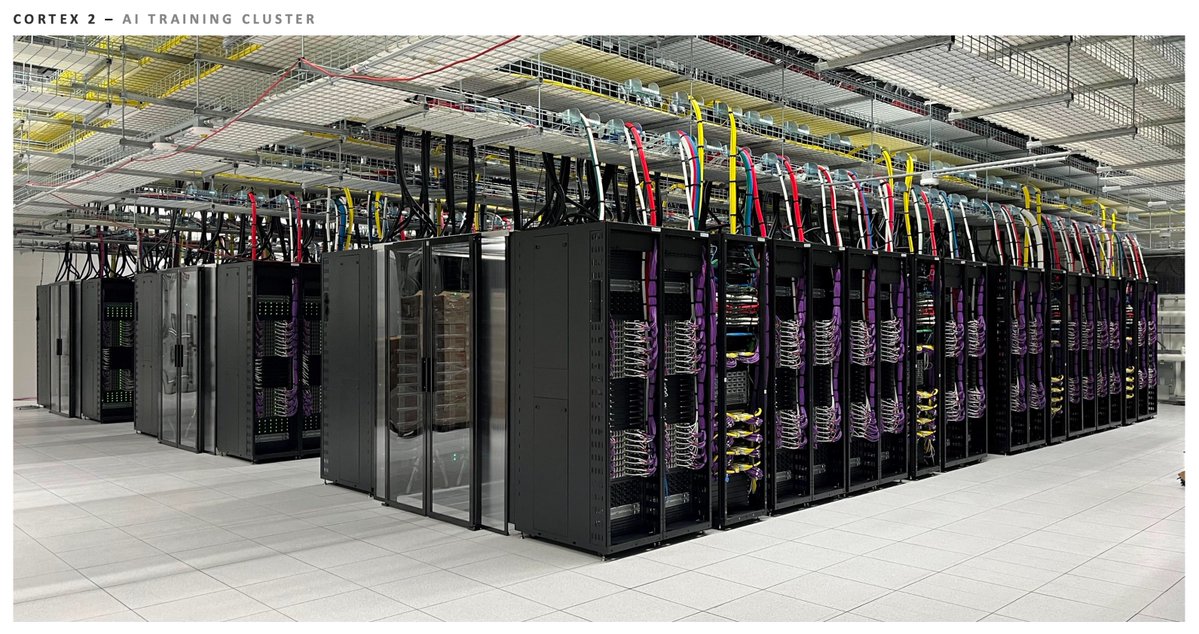
– Cortex 2 is now online & has started running training workloads
– Also ramping on-site training infrastructure to ensure sufficient compute resources for AI products & services
– Continuing with custom silicon development (Dojo 3) to reduce training cost over time
Battery
– Ramping new battery & material factories, including LFP cells in Nevada, cathode material & lithium refining in Texas
– Battery vendor cell availability continues to be a limiting factor on ramping vehicle production, so we're working on initiatives to de-bottleneck, including using 4680 cells at Giga Berlin
Other Supporting Infrastructure
– Giga New York is now producing V4 Supercharging cabinets (3x power density & 2x the number of stalls vs V3)
– Alongside the ramp of Tesla Semi, we're deploying public Megachargers, including our first one in SoCal
– Over 2,200 new Supercharger stalls, growing the network 19% YoY
AI Software
– FSD 14.3 launched in April
– Upgraded Reinforcement Learning (RL) stage to better handle long-tail edge cases, enhanced the neural network vision encoder for sharper perception in low-vis scenarios & rewrote the AI compiler to accelerate model iterations & cut inference latency by 20% (faster reaction time for FSD!)
This accelerates our efforts to eventually deploy unsupervised autonomy to both the Robotaxi fleet & customer owned vehicles
– Digital Optimus: our next evolution of AI development. We're working on automating digital workloads, building an intelligence layer that will complement real-world AI in vehicles & robots
AI Inference Compute
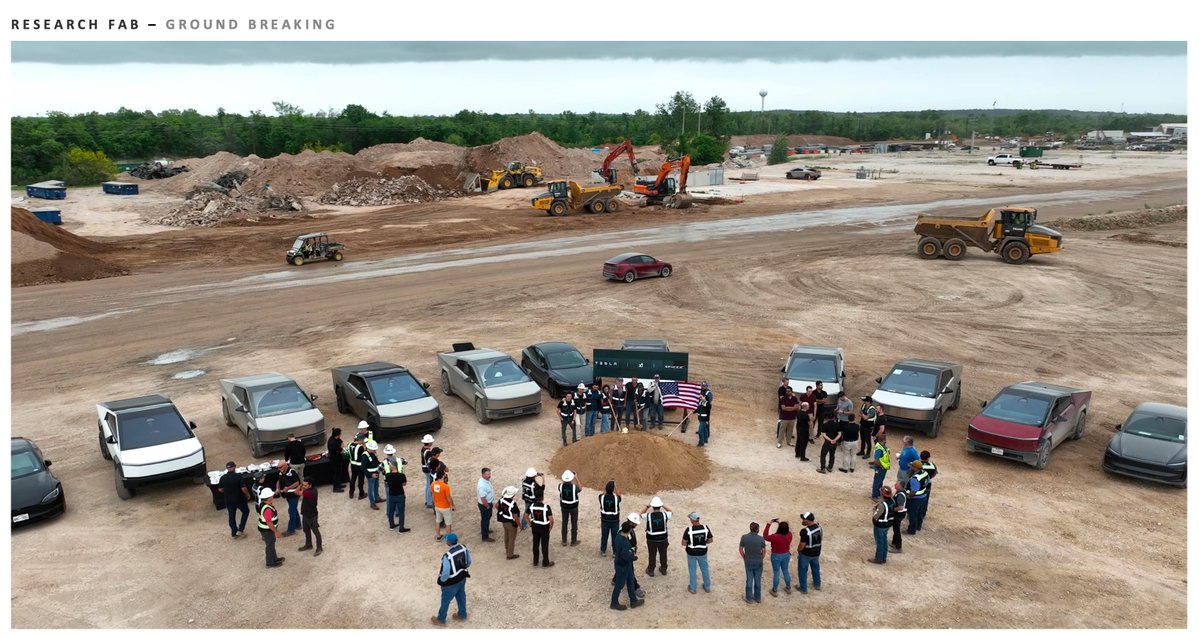
– Expanding our scope of manufacturing to include semiconductor fabrication (coinciding with Robotaxi & Optimus ramps) = step towards ensuring sufficient & resilient chip supply
– Partnership with SpaceX aims to build the largest chip fab ever, vertically integrating logic, memory & advanced packaging to allow for rapid iteration
– Completed final chip design of AI5 (our next-gen inference processor) in April
Automotive & Other Software
– Rolled out Spring Update which includes a new Self-Driving app with tutorials & stats, "Hey Grok" wake word w/ location-based reminders, accent lights for blind spot alerts, updated Pet Mode & more
Robotaxi
– Paid Robotaxi miles doubled sequentially in Q1
– Cybercab will begin replacing Model Y fleet once in production & be the largest volume vehicle in the fleet over time
– Continuing to lay the groundwork for expanding into new cities (testing, permitting), so we can launch quickly once ready. Safety remains top priority
– Expanded unsupervised ops in Austin & launched in Dallas & Houston in April
FSD Supervised
– Record net new FSD subscriptions in Q1
– Received approval to deploy FSD Supervised in the Netherlands in April, clearing the path for potential approval in other EU countries
– Continuing to make progress on approval in China
Automotive Services
– Safety Score v3.0 enables every mile driven with FSD Supervised engaged to receive a score of 100. Higher Safety Score over time = lower premiums for Tesla Insurance customers