The Demos SDK gives developers one interface for multiple chains.
Write a workflow once, deploy it everywhere.
The chain becomes an implementation detail rather than a product decision.
Builders stop choosing ecosystems and start choosing user experiences.
Building an oracle on Demos is one DAHR call.
Building a private DEX is one L2PS deployment.
Building a sybil-resistant social graph is one ZK Identity integration.
Infrastructure that used to take entire engineering teams now ships in single commits.
The Omniweb in action:
Post-quantum signing on Demos pairs Falcon with ML-DSA in a dual-sign configuration.
Both signature algorithms must validate independently for any transaction to finalize.
If one cryptographic scheme is ever compromised, the other continues to protect every asset on the network.
ZK Identity on Demos uses Groth16 proofs and Poseidon hashing to let you prove you are a unique human without revealing which one.
Nullifiers prevent double-registration across the network without ever exposing your wallet address.
Anonymous yet provably singular.
Anti-fragility comes from having multiple independent paths to the same outcome.
Demos runs three verification models in parallel, supports eleven blockchain ecosystems, and integrates Web2 data sources directly into the protocol.
When one path is unavailable, the others remain operational.
That's the beauty of the Omniweb
A prediction market needs attestation in milliseconds.
A compliance record needs proof that outlasts market cycles.
A healthcare credential needs verification without exposure.
These are fundamentally different trust requirements, and that is why Demos runs three parallel verification models instead of forcing every application through one.
Quantum computing will eventually break the cryptography that secures most blockchains.
When that happens, every chain that postponed the problem will need an emergency migration.
Demos already ships Falcon and ML-DSA signing with dual-sign capability, so applications can run quantum-safe and traditional signatures simultaneously.
Protection today is worth more than a migration plan tomorrow.
Without additional funding, Session's doors will close next month.
Please read this appeal from Session co-founder Chris McCabe.
https://t.co/nTJCocoDwI
Dear Fuddsters,
WIF --> Rugged (All time high 4.5 billion)
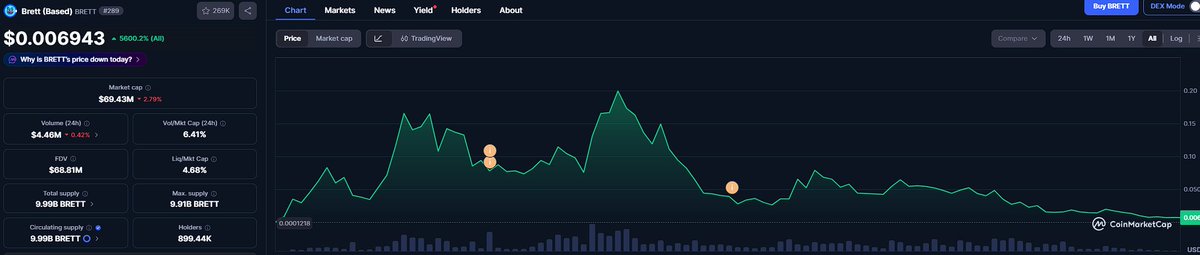
BRETT --> Rugged (All time high 2 billion)
Popcat --> Rugged (All time high 1.3 billion)
So next time you call $ROOST a scam and a rug.. think again..
Have a good weekend, truly yours, $ROOST
The relationship between information and truth is broken.
AI created the noise. Fake news drives agendas. Centralised media controls narratives. Social feeds amplify bots.
The guardrails we have today were not built for this world.
Something new is coming.
Soon.
If you want to bring real-world data onchain, most oracles make you stop at a checkpoint and wait.
But many applications need the data in real-time.
That's why we built DAHR.
DAHR monitors and attests to Web2 data as it flows through the network. No decryption. No checkpoints. Near-instant finality with minimal overhead.
Verified data at the speed your application actually needs.
L2PS changes everything.
Most privacy solutions rely on promises. Promises about data handling. Promises about encryption. Promises about who can see what.
L2PS operates on a different foundation entirely. It operates on architecture.
The distinction matters. Promises can be broken.
Architecture cannot be rewritten by a bad actor, a policy change, or an external pressure.
When privacy is structural, it becomes reliable. When privacy is structural, it becomes real.
L2PS runs private subnetworks alongside the Demos Network main chain.
The infrastructure stays unified. The same nodes that secure the main chain also power these subnetworks. This means builders and users inherit full L1 security from the first transaction.
No trade-offs.
No compromises.
No separate trust model to evaluate.
The architecture eliminates sync delays entirely.
Parallel execution means the private subnet operates in step with the main chain. Latency disappears as a concern. Performance scales as the network grows.
Builders get the speed they need to ship real products. Users get the experience they expect from production-grade infrastructure.
Transaction privacy begins at the client level.
Data encrypts before it ever leaves the user's environment.
Execution happens inside the subnet.
The outside world never receives exposure to that information.
This is a fundamental departure from systems that encrypt data in transit but process it in the open.
Client-side encryption is a specific and deliberate choice. It positions the user as the origin of control. The system cannot expose what it never receives in plaintext.
This design principle runs through every layer of L2PS. Privacy is the default state, not an optional configuration.
The separation between public and private execution environments gives developers a powerful tool.
Applications can interact with the Demos Network main chain for coordination, settlement, or identity verification while keeping sensitive logic confined to the subnet.
Builders compose privacy into their products without rebuilding infrastructure from scratch.
For projects building on sensitive use cases, this matters at scale.
- Governance systems need protection from vote manipulation and coercion.
- Financial coordination needs confidentiality without sacrificing verifiability.
- Identity systems need to prove attributes without revealing underlying data.
L2PS addresses each of these requirements at the infrastructure layer.
Architecture-driven privacy produces a different kind of trust. Developers do not need to audit a privacy policy. Users do not need to accept terms of service that trade data for access.
The system's design makes certain outcomes structurally impossible. That is a stronger guarantee than any agreement or certification can provide.
Demos Network builds infrastructure for a future where digital participation belongs to humans, not bots or surveillance systems.
L2PS extends that mission into the execution layer.
Private by architecture.
#1 The name "L2PS" won't win any beauty contests.
But what's coming? Well, that's a different story.
L2 Parallel Subnetworks are private networks that will run alongside the Demos main chain.
Your transactions. Your data. Your rules. Nobody else sees a thing.
Coming in the next 2 weeks. Let us explain 🧵
What is real? What is fake? Who made it, when, and where?
In the age of AI, these are the questions that matter most.
Demos enables verifiability in 3 ways:
Stake Based: Through our DAHR technology for super fast attestations
Cryptographic: Through our TLS Notary module for those needing incorruptible evidence
Protected: Through our ZK module, for those who need proof without revealing the underlying data
Three proof models, one network.
In a world of machines, the ability to audit is key - prediction markets, API access, Agent to Agent handoffs, service delivery, compliance, the list goes on .
The Omniweb solves a big piece of the puzzle.