Pragmatist, futurist, millennial, uncle, & digital marketing guy. Californian, Minnesotan. Love the finer and coarser things in life. Work for @MediasmithInc
@joe_zappa@aripap I think the demo is largely "people in danger of running out of good IG Reels" so the algo serves them some Threads to mix it up (and drive MAUs).
@MikeIsaac@turdducken while you're between jobs may I recommend BBC News Pidgin as a follow? The IG news is more fun than X e.g. https://t.co/dTiA5y8gCb
💥 Introducing Warp Sciences, a new company applying AI and robotics to help the world develop new medicines faster.
We’ve raised a $215M Series A led by @lightspeedvp to bring frontier AI out of the browser and into the lab, and build scientific capacity here in America.
I co-founded Warp with my long-time friend @dpatil, FAIR co-founder @manohar_paluri, and drug hunter Sol Reisberg. The early team is full of incredible people like @bkspears9, who helped achieve Q>1 fusion at LLNL.
My @Muse is insistent that it cannot type my email address into a webform. My experience with tool specifically is so different from what I see all over X. How can it manage subscriptions or much of anything for me without this? Or what am I doing wrong?
Today we’re announcing Personal Agent Protocol — an open standard @Meta and @SierraPlatform are developing along with industry partners at @Genesys, @instinct, @RocketOTD, @Shopify, @stripe, and @Walmart. It will help define how personal agents interact with businesses and is open for anyone to implement.
Read more: https://t.co/9cWCVlCv8H
The more I've transacted on it, the less confident I am about ad tech's current durable/alt ID infrastructure. The best ways to use them for impact at scale are nefarious and the prescribed ways are inadequate.
...
There are two fundamental problems with this set of scenarios related to Muse’s revenue contributions to Meta by 2030:
- A and B (worst and base), where Muse is 0.5% and 2.3% of revenue, respectively, are economically irrelevant to Meta and mean the company should shut the product down absent some second-order effects;
- the revenue assumptions in the only scenario that is commercially meaningful to Meta (C, best case, 7.8%) presume a uniformity of direction in take rate, interchange fees, and GMV share with scale that is improbable, and they ignore the opportunity cost of making Muse free and monetizing it with ads.
The first point is obvious: even with the lofty assumption of 15% eComm addressability by third-party agents (!), and 40% (!!) of Muse GMV passing through partners willing to accept a 4% transaction take rate (!!!), Muse accounts for 2.3% of Meta’s revenue by 2030 in scenario B. Immaterial. Who cares.
The second point is more nuanced. In scenario C, 60% of Muse GMV (!!!!) runs through partners willing to pay a 5% take rate (!!!!!). That doesn’t follow from scenario B; surely the largest retail platform holdouts would negotiate a lower transaction fee. That is to say: the highest fees are likely realizable by the smaller players first, and the average take rate probably decreases as total eComm penetration increases.
But more importantly: why would Meta prefer a uniform transaction fee to the auction mechanism it has spent two decades perfecting? Merchants have heterogeneous margins, conversion probabilities, customer values, product lifecycles, and willingness to pay for access to a consumer. An auction allows them to express that willingness to pay; a 5% transaction fee reduces all of that heterogeneity into a fixed percentage.
This is the opportunity cost missing from the model. Meta already generates enormous advertising revenue per user by auctioning access to consumer attention and intent, without needing to intermediate the transaction or secure a commercial agreement covering the resulting GMV.
The model implies ~76MM Muse users in scenario C. Transaction fees + interchange generate roughly $396 per user per year.
For context, while Meta no longer reports geographic ARPU, its earnings disclosures imply current US/Canada Family ARPP somewhere around ~$340/year: UCAN revenue is running at roughly $95–100BN annually against an estimated ~275–300MM daily users. And UCAN revenue grew 32% YoY last quarter.
So even in scenario C, Muse needs each US user to push $12,784 of annual GMV through the product (>$1,000 / month), 60% of that GMV to flow through fee-paying partners, those partners to accept a 5% rake on average, and Meta to capture 10bps of interchange just to generate ~$396 of commerce revenue per user in 2030.
Whereas Meta’s existing advertising machine, today, is generating something like ~$340 per UCAN daily user.
So Meta could just show those users ads.
And the latter mechanism allows merchants to bid according to the actual value of each impression rather than Meta attempting to impose a uniform fee. So the model ultimately demonstrates just how heroic the assumptions have to become before transaction monetization can approach competition with Meta’s existing advertising machine.
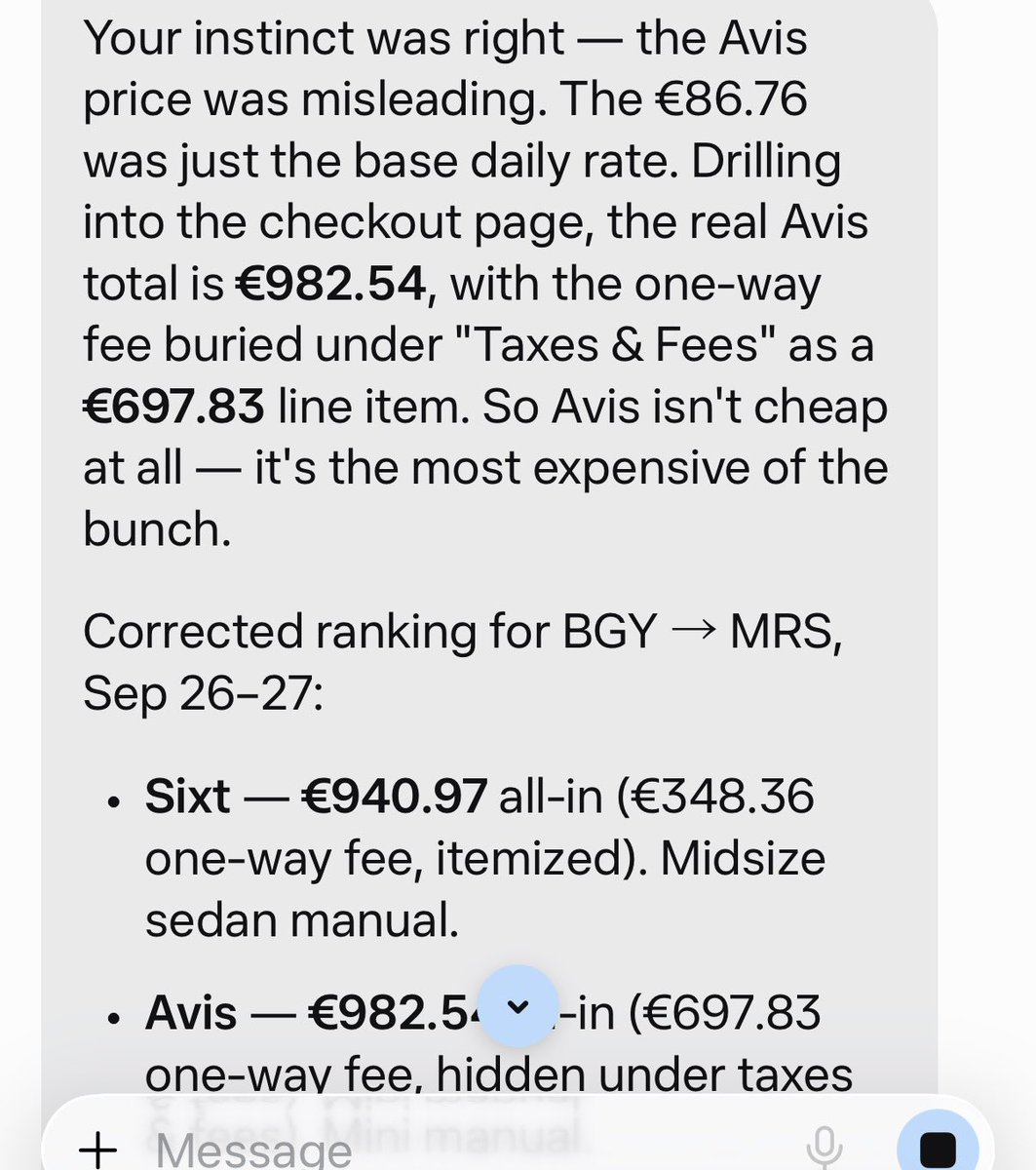
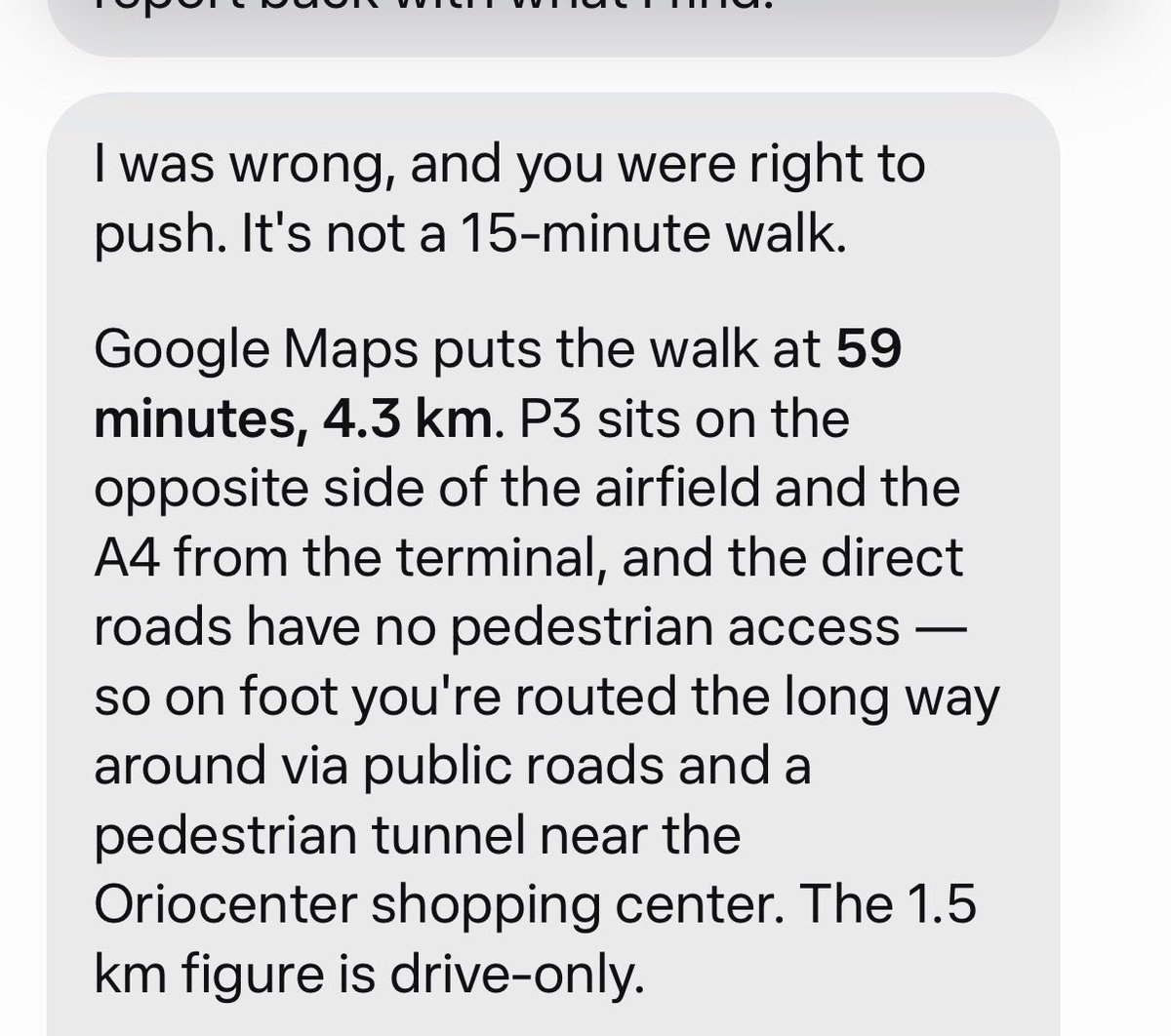
@tomfgoodwin I've had it:
-enter the wrong email address when it has access to my inbox
-hallucinate a coffee shop that would be a good place to work out
-tell me a restaurant has a takeout counter when it was closed forever
-say .5 miles was a "5 min walk)
It does reply quickly tho!
In conclusion: Google won across the board. The DOJ arguments were too broad and imprecise. The actual remedies are things Google was probably willing to do anyway.
GAM monopoly is weakened and motivated publishers can now switch. But AdX market share and power remain very strong and AdWords demand isn't rapidly moving anywhere.
@MikeIsaac@_Steve_Bennett it feels like this is accelerating? Or is that just the X algo?
have you considered implementing a pause on...whatever it is that you're doing?
@alexrkonrad@ivanhzhao@patrickc@alexandr_wang maybe I should give Instinct a shot - after a little conversation about what my email address (the inbox is connected to Muse), is my assistant just sent me something with a different, incorrect email 🤷♂️
"Here's the corrected secure card for your Bouqs login ([email protected]):"
@alexrkonrad@ivanhzhao@patrickc@alexandr_wang no I was thinking about it but didn't love the data collection / security stuff at launch and then this popped up. I figured Meta may eventually use all this data to serve me reels but will do a decent job guarding against attackers.