Amir won the Kite fight mostly because of a lucky change in the wind. Cooper equated that luck to being born as a Pashtun instead of a Hazara in Afghanistan. Amir was able to live in a nice house and didn’t have to face daily persecution because of his physical features @drkefor
After @drkefor brought up Amir’s relationship with Raheem Khan, @carodaly23 refereed to him as a “exhale” for Amir. Amir was more interested in storytelling and writing but his father failed to recognize or appreciate his creativity. Baba solely appreciated more manly qualities.
As we discussed Amir’s desire for approval from his father, Sean referenced how he will struggle to live up to Baba’s expectations mostly because Baba compares him to a younger version of himself. Baba is also not an average man. @drkefor
Hannah Hubler noted how Pecola was pretty much doomed from the start. Throughout the novel nothing seemed to go her way. Awful things happened to her and people in her community looked down on her because of these things, despite the fact she had no control over them.@drkefor
Caroline mentioned how Pecola had trouble improving her self esteem because she was too focused on her own safety. Caroline related this to the psychological theory of Hierarchy of Motives. Until she is safe, she’s unable to focus on accepting herself. @drkefor
Vicky and Zeina noted how altered Pecola’s sense of reality had become. She had fallen so deep into her own fantasies that she believed she now had blue eyes, she had the blue eye she’s always wanted. But that wasn’t enough. She wanted more. She needed the “Bluest Eye” @drkefor
Caroline argued that the tragic ending of The Bluest Eye was sad but necessary. The reality of it is everyone loves a happy ending but unfortunately happy endings seldom take place in the real world. To do her story justice, Morrison needed to end her novel this way. @drkefor
In Oryx and Crake, Crake displayed sociopathic tendencies throughout the novel. Especially when Jimmy mentioned the possiblity that the people in his computer games, like https://t.co/zAEqp0lr1Q, were real and Crake still was cruel and killed them. @drkefor#althw
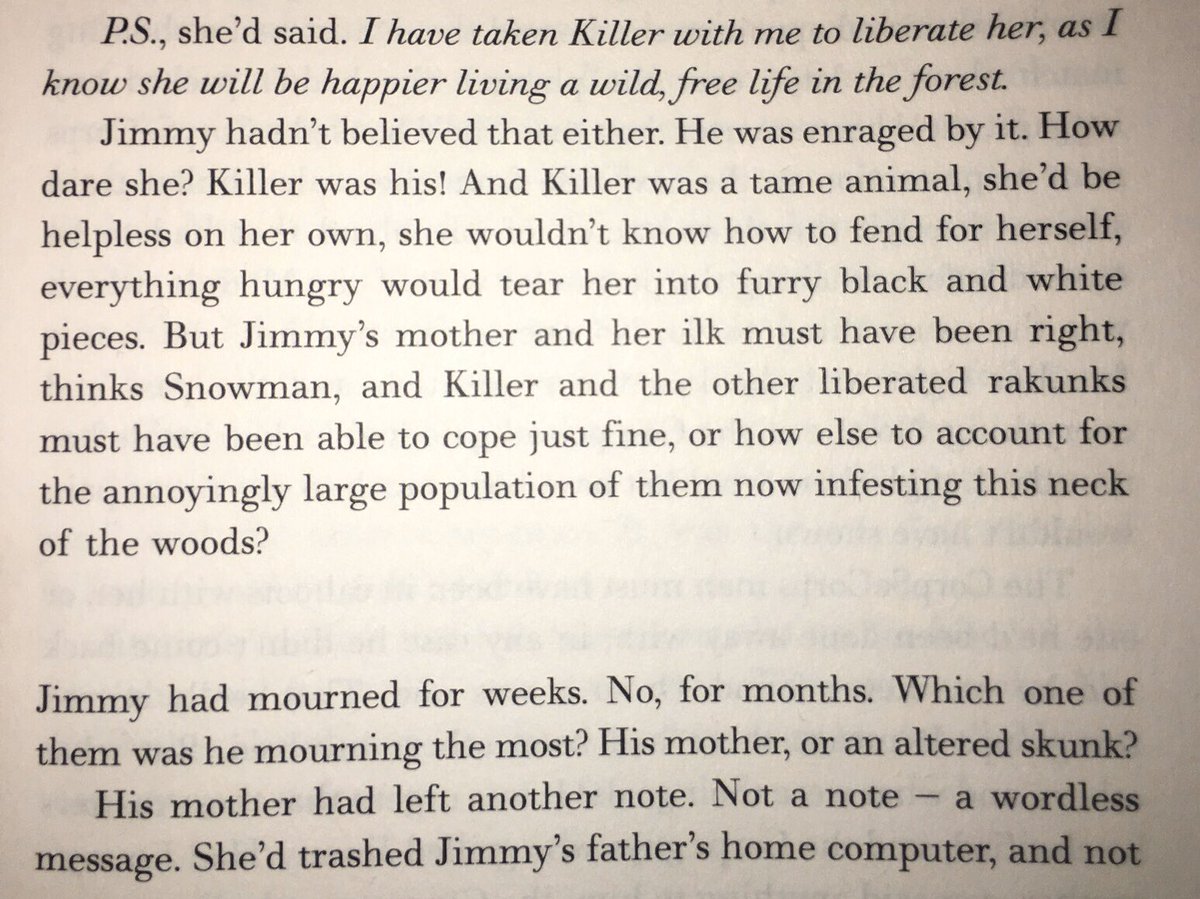
In “Oryx an Crake” by Margaret Atwood, Jimmy experiences the Five Stages of Grief after his mother takes his pet rakunk, Killer. Immediately after he learns she took Killer, he is in denial, then he builds a sense of resent meant towards his mother, he wonders how Killer will...
Jess made a great observation how despite Atwood never said how old Jimmy was as Snowman recalled his past, the reader was able to distinguish that he was most likely in his adolescent years. @drkefor
@carodaly23 made a great point about how despite the physical age difference between Michael and Achak they have a very similar mental age. When Achak came to the United States it was like he had been reborn and he was back in the same stage of development as Michael. @drkefor