A physicist passionate by quantum theory, working to bridge gaps between Computational Chemistry and #DataScience || Salsero and beer lover in the free time
Analysis of nonadiabatic molecular dynamics is challenging due to its high dimensionality and complexity. We address this by introducing ULaMDyn, an open-source Python package that automates the unsupervised analysis of large dynamics datasets.
#compchem
https://t.co/geSpgotKhB
Very interesting article. Using electric field distortions as an alternative to generative diffusion-based #deeplearning
models. Looks promising. #physics#GenerativeAI
https://t.co/i421x4CH2L
Your academic CV is NOT linked to your ability to make big discoveries.
▫️
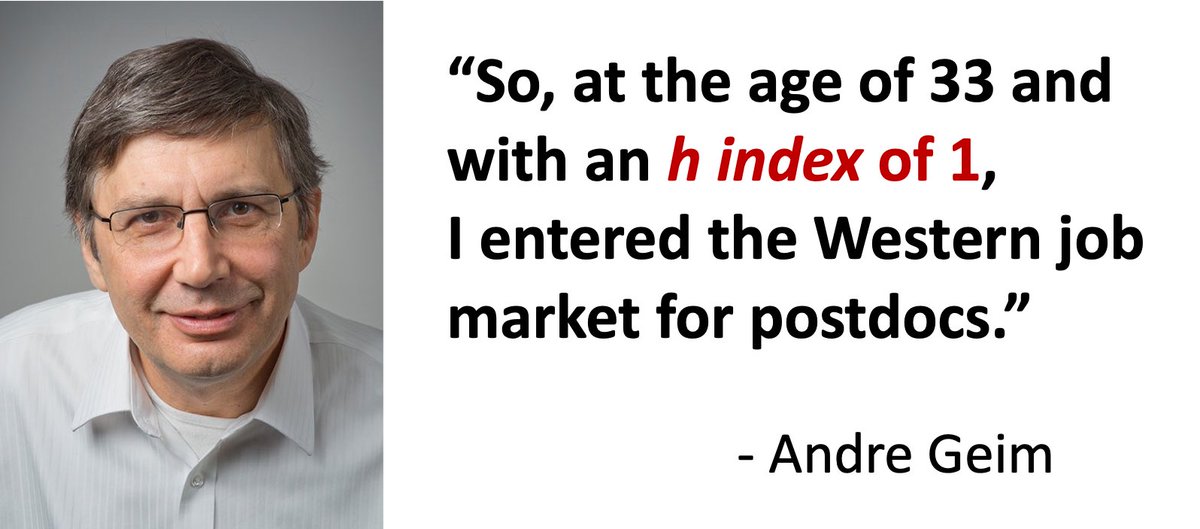
1. Andre Geim, a co-discoverer of graphene, wrote in his Nobel Lecture article:
- “So, at the age of 33 and with an h index of 1 (latest papers not yet published), I entered the Western job market for postdocs.”
2. Albert Einstein searched for a teaching position for two years. He had to accept a position at a Patent Office, where in a single year he wrote the four papers that completely revolutionized #science (the photoelectric effect, Brownian motion, special relativity, and E=mc2).
- Only few years later, he finally secured his first academic position as lecturer at the University of Bern.
▫️
Other examples include Peter Ratcliffe and Frances Arnold, who won Nobel Prizes for the discoveries they made as young PIs in newly established labs. And many others.
▫️
So, let us all keep in mind that:
1. Big discoveries are often unforeseen. They emerge from random and risky research (e.g. graphene was a tiny side project!). Make sure you have such projects in your lab.
2. Most truly impactful discoveries did not require high h-indices, excessive funding or a high-IF journal.
3. Rejection of your proposal does NOT mean it proposes bad science. Such rejections represent the opinion of one person who has a rather subjective idea of what ‘good science’ means.
4. For younger people, it’s easier to do risky research. Locking them to unnecessarily complex tenure requirements makes such discoveries unlikely.
▫️
A strong scientist is not defined by high “academic metrics”.
It is the ONE who proposes risky endeavors outside the conventional boundaries.
Who sees risk as an opportunity to make discoveries.
And who is constantly seeking out these risks in the lab.
#AcademicTwitter #AcademicChatter
their support in my recent achievements! Can't wait to tackle new challenges and contribute my expertise to Alstom's mission. #DataScience#CareerGrowth
I'm thrilled to share that I'll soon join @Alstom🚆as a Data Scientist😀! Big thanks to the Light & Molecules group for enriching my research experience 🙏. Special shoutout to @MarioBarbatti for the invaluable guidance and opportunity to be part of his amazing team. Grateful for
Curious about #DeepLearning applications for polyaromatic molecules? Don't miss Renana's (@Aromaticist) talk (+ tutorial) from Israel Institute of Technology at the 8th @smlqc1smlqc webinar on June 8th.
🔗 Learn more: https://t.co/nHFxPt6oQD
✍️ Sign up: https://t.co/2RhYZxaAox
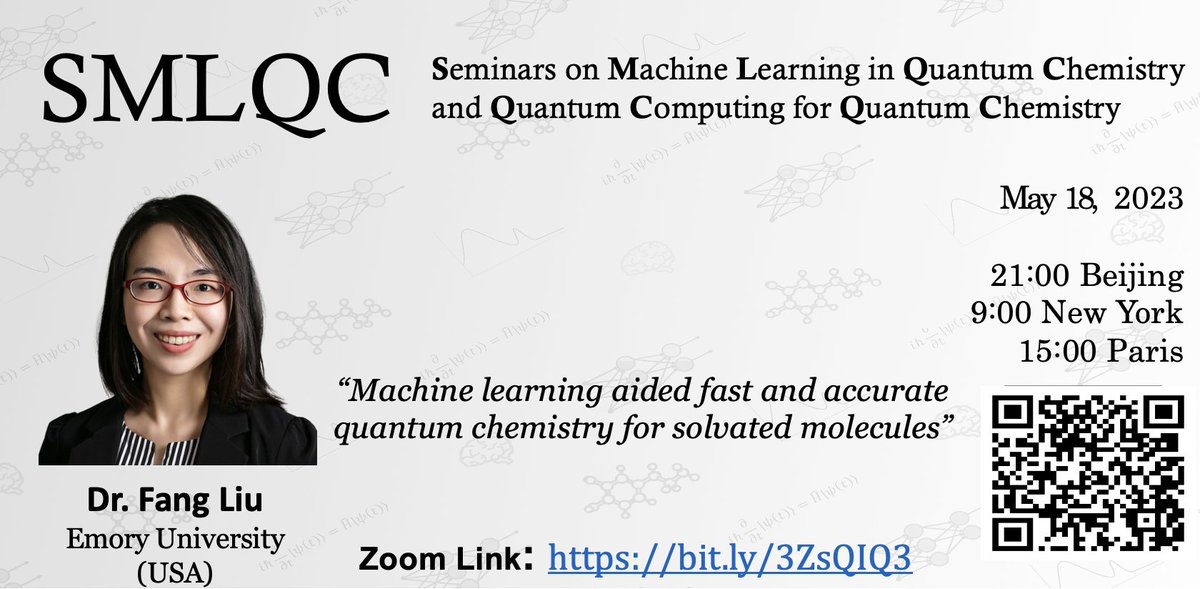
Join us for the 7th @Smlqc1Smlqc seminar on May 18th where @FangLiu_Emory from @EmoryUniversity will give a talk on "Machine learning aided fast and accurate quantum chemistry for solvated molecules."
For more: https://t.co/B0Vx6UIYhR
Signup for emails: https://t.co/lYJcu43F0H
Can #Fortran survive another 15 years?
Researchers @LosAlamosNatLab released an April 18 report evaluating the long-term risks of relying on Fortran for mission-critical code supporting nuclear security
https://t.co/6YoWlaXqWL
#HPC@GCNtech@fortranlang
𝗣𝗿𝗮𝗰𝘁𝗶𝗰𝗮𝗹 𝗱𝗲𝗲𝗽 𝗹𝗲𝗮𝗿𝗻𝗶𝗻𝗴 𝗰𝗼𝘂𝗿𝘀𝗲🌻𝗦𝗲𝘀𝘀𝗶𝗼𝗻 𝟯: 𝗹𝗼𝘀𝘀 𝗳𝘂𝗻𝗰𝘁𝗶𝗼𝗻 for classification, 𝗼𝗽𝘁𝗶𝗺𝗶𝘇𝗲𝗿𝘀, stacking layers, 𝗰𝗼𝗻𝘃𝗼𝗹𝘂𝘁𝗶𝗼𝗻𝗮𝗹 𝗻𝗲𝘂𝗿𝗮𝗹 𝗻𝗲𝘁𝘄𝗼𝗿𝗸, and 𝗱𝗿𝗼𝗽𝗼𝘂𝘁.
More than 3 notebooks to complete📋
🧵
Many local minima in Deep Networks are connected through low-loss valleys. Curious about the theoretical origin of such valleys? Check out our #ICLR2023 Paper on #symmetry, local minima and conserved quantities.
Paper: https://t.co/CHV8NGGmZg
(1/3)