Venice is a traditional company with equity. This was true before we sold 8.98% of the company, and it's true today.
Venice also has a token base:0xacfe6019ed1a7dc6f7b508c02d1b04ec88cc21bf, usable by customers within our app, and also as the target of our acquisition for burning.
Why are the incentives not misaligned with equity holders?
1. Because those who are equity holders also happen to be the largest holders of VVV, both indirectly as the entity holds the plurality of tokens, and directly through personal ownership. More than half of all VVV are held by equity owners of Venice, and this portion has increased over time both in percentage terms and in aggregate.
Show me any other project for which that last statement is true.
2. Because we've said exactly what we're going to do, both to our community of VVV holders and to the recent investors: we are going to grow our business, take a portion of revenue, and buy and burn as many tokens as we can.
We do this burn not to be altruistic, but in our self-interest (see #1).
Is the fear among crypto twitter that 8.98% of Venice equity holders will demand revenues are distributed as dividends instead of burns?
Let's think this through. First, they can't command such a thing as a minority. But more importantly, they won't, because they know what our intentions are and that's precisely why they invested. It's why they demanded direct token exposure through vesting warrants in addition to the indirect exposure through the treasury. It is on this understanding of our plans that 8.98% of the company was sold.
Surely there are many bad ways to do token/equity designs. Ultimately, regardless of intent, incentives win the day, and we have formed ours intentionally, and transparently.
@zerohedge Somebody needs to tell Zuck that its been done and that 15 year old ideas are poor use shareholder funds. My recommendation is to copy MSTR vs Google, Amazon, Microsoft , Oracle et al.
VVV and Capital
Measured by revenue, Venice has become the largest company at the intersection of AI and cryptoeconomics.
Today, we announced Venice’s first round of outside capital, a $65m Series A led by @dragonfly_xyz, valuing Venice’s equity at $1 billion.
Since we are an atypical company, this thread describes how this equity raise relates to the most valuable asset we have on our balance sheet, our capital token base:0xacfe6019ed1a7dc6f7b508c02d1b04ec88cc21bf
$VVV $DIEM
"When you pay OpenAI or Anthropic, you swipe a credit card and pay per request. Useful price discovery, but you can't own your future inference. You can't pre-buy it cheaply, you can't resell it if you don't need it, you can't use it as collateral, and you can't budget for it predictably.
Tokenized inference flips this. DIEM converts inference into a tradeable, ownable asset:
You can pre-buy inference at today's prices and use it for years
You can resell inference you don't need to someone who does
You can budget because each DIEM gives a fixed, predictable daily amount
You can collateralize future inference yield in DeFi
You can integrate AI costs directly into your own product's tokenomics"
https://t.co/m2jsJuCX8k is already today this "unlinkable inference layer," a "VPN for AI"
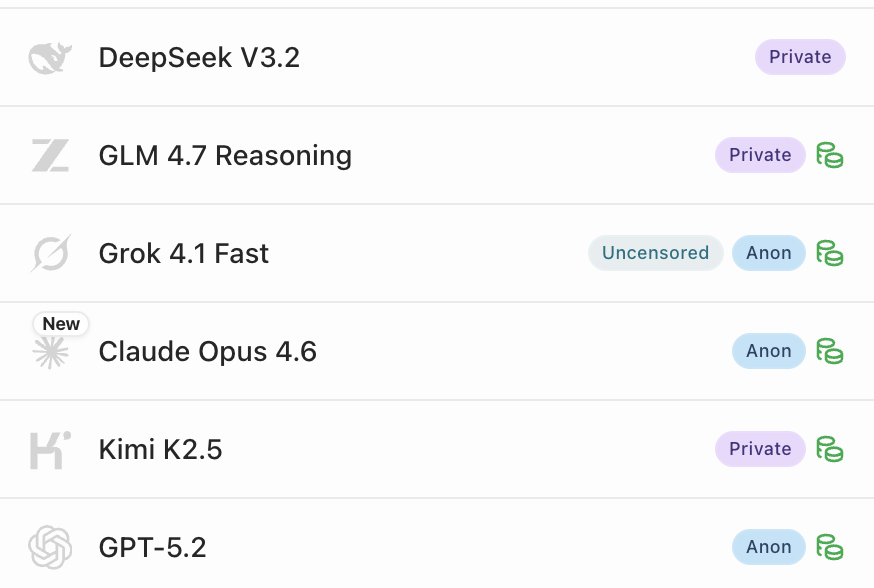
Use any model (ChatGPT/Claude/Gemini/Grok) through Venice pseudonymously.