We like to use the metaphor of Venice as the port city of AI. It guides our product designs toward composability: an open platform rather than a walled garden.
Others are now building on this open platform with https://t.co/HGUdedRZRR
This new community page shows many of the things emerging in the lagoon.
We like to use the metaphor of Venice as the port city of AI. It guides our product designs toward composability: an open platform rather than a walled garden.
Others are now building on this open platform with https://t.co/HGUdedRZRR
This new community page shows many of the things emerging in the lagoon.
$VVV 3D
Price is rising to test final ATH resistance of 22.5
Once it breaks - price discovery begins
This is where price will double in the shortest amount of time
STOCH RSI is Crossing from oversold
RSI is testing downtrend resistance
Almost Go Time
There’s no right or wrong answer here necessarily. I’m just more of an advocate for increasing $DIEM supply faster rather than slower.
If you build it, they will come.
In this case, I think building deeper liquidity and derivatives markets is what helps bring more participants (and ultimately more inference demand) to the table.
I also trust that @ErikVoorhees, @JonShapeShift, and the team have a better understanding of these dynamics than I do, and will navigate it thoughtfully.
$VVV
I agree that the core value ultimately comes from real inference — that’s the “oil” in this analogy. However, derivatives don’t replace the value of the oil. They help the entire market around it function more efficiently.
Think about crude oil. The real value is in refining and using it for energy, plastics, and fuel. But the oil industry wouldn’t be nearly as large or liquid without oil futures and derivatives. Those markets provide price discovery, allow producers and consumers to hedge risk, and bring in far more capital than would exist from physical trading alone.
$DIEM works similarly. The actual utility comes from inference, but a derivatives market around DIEM allows larger players to participate, hedge exposure, and allocate capital more efficiently. This deeper liquidity and risk management usually leads to more overall demand for DIEM — which in turn drives more real inference usage on Venice.
So while derivatives don’t create inference directly, they help scale the market that consumes it — just like oil futures help scale the global oil industry without replacing the need for actual crude.
A perp player would love to list a DIEM product because it would give them a high-volatility, usage-backed asset with real underlying demand. Once listed, it would likely attract significant volume from both speculators and hedgers, further strengthening the ecosystem around the actual compute.
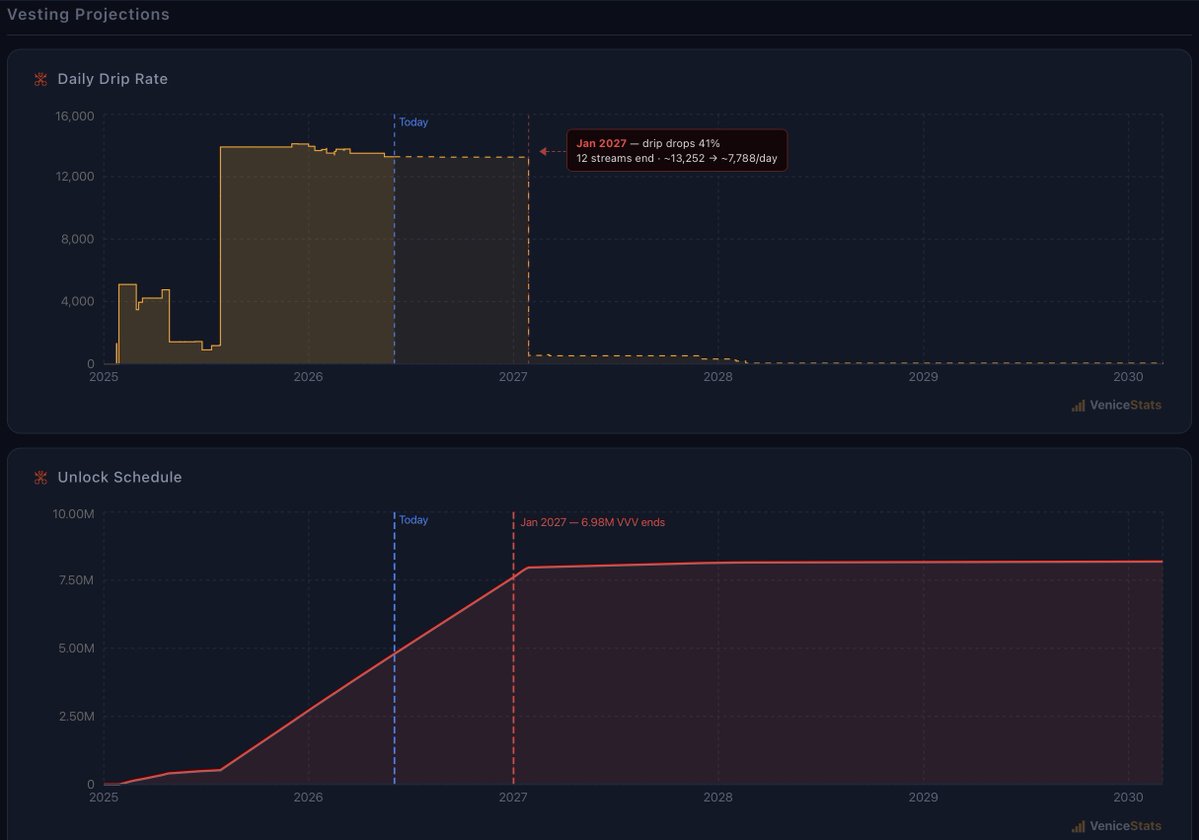
With $VVV climbing back toward its all-time high, the intuitive call is that insiders and vesting recipients are cashing out into it. So instead of guessing, I pulled all 186 of @AskVenice's vesting wallets on-chain.
The conclusion isn't what you'd expect... 😏
🧵👇🏻
Chicken-Egg problem:
For hedgers and larger participants to get involved, derivatives markets are usually needed. But derivatives require meaningful spot liquidity, which in turn needs either strong organic adoption or some form of deliberate bootstrapping.
Increasing supply too early carries risk if demand isn’t there yet. However, keeping supply too constrained for too long can be more limiting, as it makes it difficult for the market to develop the depth required for derivatives and institutional participation.
It’s not really about trading the token for price. It’s about unlocking the actual value of $DIEM and what Venice has built. Without sufficient liquidity, the derivatives and financial infrastructure around DIEM never fully develop, which caps how useful and valuable the token can become for both users and the broader ecosystem.
In most cases, liquidity tends to generate more demand than scarcity alone, particularly when there’s real usage supporting the token. A developed DIEM derivatives market would benefit both $DIEM and $VVV by increasing overall utility and capital inflows.
The story has always been @AskVenice is just a great product and people like great products.
The market still has scar tissue from prior cycles and for that reason are not thinking large enough in terms of where the leaders of today (with real traction) can go. Imo $VVV and $HYPE fall firmly in that bucket
Virtuals Protocol is integrating @AskVenice to power AI agent building with private, uncensored inference, available to anyone, anywhere on @base.
Venice brings best-in-class privacy-first inference. Virtuals EconomyOS brings the full agent infrastructure stack: wallets, identity, payments, commerce, funding rails, and launch infrastructure.
We are deploying up to $400,000 in private inference credits so anyone can move from idea to working agent without compute or backend complexity getting in the way.
Start your AI journey. Inference and infra are on us.
Program details soon.
$VVV 4H
22.5 is Previous ATH and should get tagged in the coming days
If we get a rejection then expect to see the 3rd wave falling flag before final break out of channel
In lieu of concrete $VVV investor rights, I will accept @AskVenice turning VVV into Ultra Sound Money
"Our goal is a net deflationary VVV with native yield, where burns exceed emissions"
Is there a deal to be done between hyperliquid:native and $VVV?
The $DIEM expansion primitive: $VVV block sales to strategic counterparties
The cleanest mechanism is for Venice to sell blocks of VVV from its treasury at an above-market price to counterparties with significant inference demand (@HyperliquidX hyperliquid:native). The VVV is staked and locked (untouchable for a period of time), minting DIEM that delivers the inference the counterparty needs. Venice deploys the dollar proceeds to scale capacity ahead of the obligation.
This structure is accretive to VVV holders (large blocks removed from circulation at a premium), capacity-matched for DIEM holders, and provides Venice with operating capital at favorable terms.
Venice sells VVV to the venue at a 15–25% premium.
The venue stakes the VVV and mints DIEM.
The venue uses the DIEM credit stream to fund its operational inference.
The venue lists a DIEM perp on its own platform.
Listing creates immediate hedger demand from corporate treasuries.
Hedger demand pulls more spot supply, which justifies further block sales.
A derivatives venue collects four yields from the arrangement: VVV staking rewards, VVV capital appreciation, inference value, and trading fees from the DIEM perp they just listed.