@ShuoYangAIR When I heard PhD Gao jokingly define SLAM as Super Large Action Model, it must be popular again. I didn't expect there to be more awesome explanations 🤣🤣
Happy to share our #IROS2022 paper—MotionSeg3D, which can segment the moving objects from a LiDAR sequence. 😀
Paper: https://t.co/oPh6lMHtQF
Project page: https://t.co/Bqa77QGFPD
Code: https://t.co/kyiTPptnbl
Similar to the "Explorer" robot that our team (Made in undergraduate years) developed to explore unknown environments.🤘🤘
Of course it is more expensive and robust in the video.
With no road maps on Mars, I’m building my own as I go. There are lots of places I want to explore, and mapping while I drive will help me see and do more. Let the road trip begin.
Shrödinger problem defines a dynamic interpolation between two distributions using Brownian bridges. The 0 temperature limit is Optimal Transport. https://t.co/I9LkrOz6fS
We added the visualisation of the attention patterns of Vision Transformer!
https://t.co/zKZGRLCTmp
Some heads learn translation equivarient attention to extract patches at fixed shifts. Other heads rely on color similarity or maybe more semantic features deeper in the network.
@CatherineYeee However, this learning-based approach is difficult to apply to tasks involving higher security. For example, if face recognition fails, try a few more times, but in the field of autonomous driving, some people may lose their lives because of these mistakes.
@CatherineYeee As far as I know, most of them still use the traditional solution because of its high interpretability. However, for some tasks, only the learning-based solution can be better (with higher accuracy), such as Object Detection , Face Recognition and 6D Pose estimation etc.
Testing out the LiDAR scanner on the iPad Pro, and added a visualization of the depth and confidence maps that it generates. It's really interesting to see how it behaves (especially on small/complex structures). This will be great data to leverage in the @EveryPointIO engine!
Scanned the basement again to compare the new #pointcloud quality with previous tests and check out that floor plan! 3.5 minutes of scanning (full video here: https://t.co/2PYX3yDqcE) for a dimensionally accurate 3D model 🙌 check it out on @Sketchfab: https://t.co/k30UBXCC7I
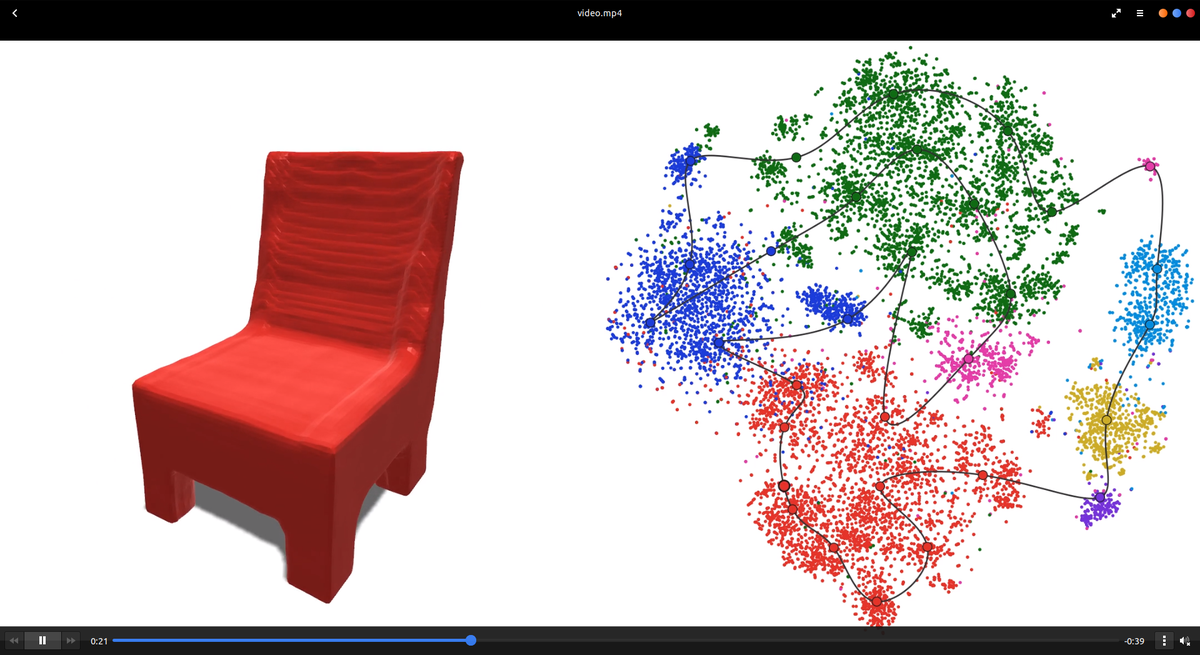
@marian42_ Great, I successfully generated the same animation as you, I will read the code carefully next, and wonder how this exciting work is achieved, hahaha👍👍
@marian42_ Thank you very much.👍👍👍 I guess right. It is indeed the demo code in your new paper. If I want to reproduce the video results, I need to download the data set provided and train the network myself, right?
@marian42_ Yes, I understand DeepSDF, maybe I didn’t say what I meant clearly. My focus is that this is this video generated by Blender, FFmpeg, pyrender, open3D or other. It looks very cool. The transition between the two object 3D models is very smooth.