@MathdeProf J'avais même lu que la corrélation est négative. Les enseignants qui font apprendre en profondeur ont tendance à être moins bien notés. D'où la rancœur de certains collègues contre les enseignants dits "démagos".
I am surprised that people are surprised this is how I prompt Claude.
Talk to Claude the way you would a coworker. There's no secret to prompting. There's no need to be overly scaffolded or prescriptive for most tasks -- give Claude a goal, and it will figure it out.
Back in the Sonnet 3.5 days, your prompt mattered a lot. Nowadays, it's much more important to communicate to the model:
1. What you want it to do
2. How much effort you want it to spend
3. How it should verify that it did the right thing
What are the most effective methods of improving student achievement? An NYT investigation.
For me, the data point in the bottom left quadrant is absolutely critical to understanding why student achievement goes wrong so often: teachers making up their own curriculum.
https://t.co/EOMK2kkwi9
@wittgensteinien À capacité égale, le prix par token est divisé par 5 à 50 par an, grâce aux algorithmes, au matériel et à la concurrence, c'est vrai.
Mais les meilleures performances exigent toujours plus de calcul (raisonnement, agents). On a donc une hausse des volumes par effet rebond.
@wittgensteinien Si je puis me permettre, vous faîtes une erreur. On peut utiliser les modèles Anthropic facilement avec n'importe quel outil, via Claude CLI. C'est tout aussi "open" que Grok et OpenAI. Gemini est plus fermé en revanche.
Les études de @PalisadeAI ont pu montrer que les modèles résistent souvent au shutdown même quand on leur demande explicitement de ne pas le faire.
@JeffLadish évoque ici les causes de tels comportements, et ce que cela impliquera à l'avenir pour les futurs modèles.
David Monniaux (CNRS) s'était fait fortement critiquer (sur Bluesky et Médiapart) pour avoir tenté d'alerter sur les capacités en mathématiques de ces modèles.
"Nous avons très clairement un problème d'aveuglement d'une partie de la communauté éducative et universitaire".
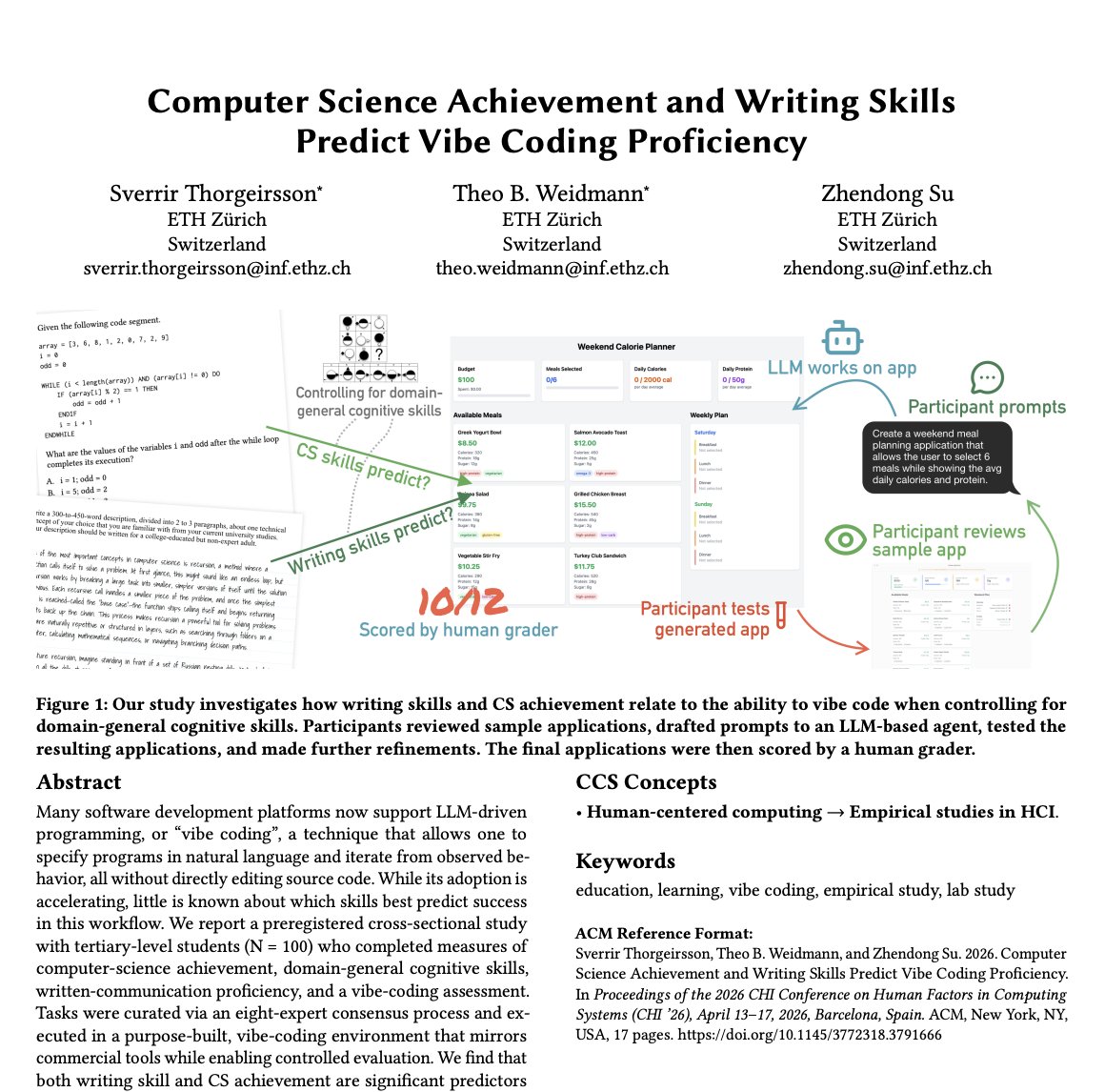
China published the most uncomfortable paper on vibe coding.
ETH Zurich tested 100 developers in a controlled, commercial-grade vibe coding environment to see who actually succeeds.
The findings are brutal.
The researchers tracked computer science achievement, written communication skills, and general cognitive reasoning.
They wanted to see what actually predicts vibe coding proficiency when you never touch a line of source code yourself.
Two major predictors emerged.
Written communication proficiency mattered. The ability to structure thoughts and articulate intent unambiguously in text directly impacts what the AI builds.
But that wasn't even the main takeaway.
Computer science achievement was a massive, dominant predictor of success.
Even when researchers controlled for general intelligence and reasoning skills, CS background still heavily dictated who built working software and who completely crashed.
In fact, CS knowledge contributed roughly twice the unique predictive variance of writing skills alone.
Why? Because vibe coding isn't about writing code. It’s about debugging logic.
When an AI agent builds a complex application and quietly breaks an edge case under the hood, a non-technical user looks at the glowing UI and assumes it works.
They don't know what questions to ask. They don't know what logic to challenge. They lack the mental models to recognize architectural catastrophe.
You can prompt your way past syntax.
You cannot prompt your way past a fundamental lack of engineering intuition.
The hype told us that learning to code is dead because language is all you need.
The data just proved the opposite.
To truly master the vibe, you still need to understand how the machine thinks.
@jburnmurdoch Computer Science + IT now accounts for 7.5% of bachelor's degrees, down from a 2022 peak of 12.4%, while Engineering has grown to 18.4%, up from 11.3%.
@LesEchos Une chose est certaine : la majorité de notre ESR prend ce virage en mauvaise posture. J'en parle dans mon (très) long article.
https://t.co/hBzekCl98S
Shall I count the ways trainers and consultants perpetuate learning misrepresentations as authoritative and settled for teachers who take notes, absorb, and try to apply in their practice!!!
It's really exhausting. Now, I need to have them unlearn this misrepresentation.
I always ask the trainer for the content to check.
This time, the trainer added this slide without my knowledge.
@TeacherToolkit Thanks for sharing! Coincidentally, I was discussing this exact topic in my (long) blog post this week and cited the Abrami et al. (2008) meta-analysis, which reached the same conclusions. Had I known, I would have added this paper to my analysis as well. https://t.co/hBzekCl98S