Wanna Learn Physics for Free?
Here are some of the best freely available playlists from introductory Classical Mechanics to advanced topics like Quantum Mechanics and General Relativity.
These are high-quality university-level lecture series from MIT, Stanford and Caltech:
🚨 MATHEMATICIANS SAY THE GOLDEN RATIO IS THE “MOST IRRATIONAL” NUMBER AND IT’S NOT JUST A FUN FACT.
Most irrational numbers can be approximated quite well by simple fractions. But the golden ratio (φ ≈ 1.6180339887…) is famously the worst at this.
Its continued fraction is made entirely of 1’s [1; 1, 1, 1, 1…] which makes it the number that is most poorly approximated by rational numbers. In a very precise mathematical sense, it is the “most irrational” irrational.
Why this matters:
• The golden ratio appears throughout nature (nautilus shells, flower petals, galaxies) and human design (art, architecture, even financial markets)
• Because it resists rational approximation so strongly, it creates stable, efficient patterns in growth and structure
• This property has deep connections to chaos theory, dynamical systems, and why certain physical systems behave the way they do
• It’s not just aesthetic the golden ratio’s extreme irrationality gives it unique mathematical stability
The deeper implication:
“Irrational” isn’t a simple yes/no label. Some irrationals are “more irrational” than others depending on how badly they can be approximated by fractions. The golden ratio sits at the extreme end of that spectrum.
This isn’t just number theory trivia it helps explain why nature so often lands on this specific proportion when building efficient, stable structures.
We’re still discovering how deeply this one number is woven into the mathematics of growth, form, and stability across the universe.
Do you think the golden ratio shows up so often in nature because it’s mathematically special, or is it just a beautiful coincidence?
Follow for more mind-bending math and the hidden structure of reality.
Scientists have identified a reversal of the long-standing Flynn effect—the roughly 200-year trend of rising average intelligence (measured via IQ and cognitive tests) across generations.
For the first time in modern recorded history, Generation Z (born roughly 1997–2012) shows lower performance than previous generations in key cognitive domains, including attention, memory, literacy, numeracy, executive function, problem-solving, and general IQ—despite spending more years in formal education than ever before.
Neuroscientist and educator Dr. Jared Cooney Horvath, PhD, MEd, testified before the U.S. Senate Committee on Commerce, Science, and Transportation on January 15, 2026, highlighting this shift. In his written testimony, he stated that cognitive development in children across much of the developed world has stalled or reversed over the past two decades, with declines evident in international assessments (e.g., PISA, TIMSS) and other large-scale data starting around the mid-2000s and accelerating post-2010.
Horvath attributes the primary driver not to reduced schooling, but to the widespread integration of digital screens and educational technology (EdTech) in classrooms. He argues that human brains evolved for deep, focused learning through face-to-face interaction and sustained attention, not fragmented skimming or constant task-switching encouraged by devices.
Key points from his testimony include:
- Teens now spend over half their waking hours on screens, with significant portions in school involving computers or tablets—often leading to off-task behavior and shallower processing.
- Evidence from meta-analyses and national/international studies shows a consistent pattern: higher classroom screen exposure correlates with weaker outcomes in reading, math, science, and higher-order reasoning.
- Digital tools may aid narrow, repetitive skill practice in controlled settings, but in core academic contexts, they tend to reduce depth of understanding, retention, and critical thinking.
Horvath describes this as a "structural mismatch" between human cognition and how digital platforms are designed (to capture and fragment attention), warning that unchecked EdTech adoption risks long-term harm to workforce skills, innovation, and societal reasoning.
[Horvath, J. C. (2026). Written testimony before the U.S. Senate Committee on Commerce, Science, and Transportation. U.S. Senate]
“Just as animal and plant breeders selectively bred domesticated species for the traits they most desired in crops and livestock, so too men and women selectively bred each other for the traits they most desired in a mate.”
https://t.co/rI5IXx5VCR
Instead of watching an hour of Netflix, watch this 2 hour hour Stanford lecture will teach you more about how LLMs like ChatGPT and Claude are built than most people working at top AI companies learn in their entire careers.
Beautifully written, this guide to distinguishing between truth, misinformation and lies, first published in 1995, remains an essential read for anyone who considers themselves a critical thinker, says Leah Crane https://t.co/EGsGU2ZeuD
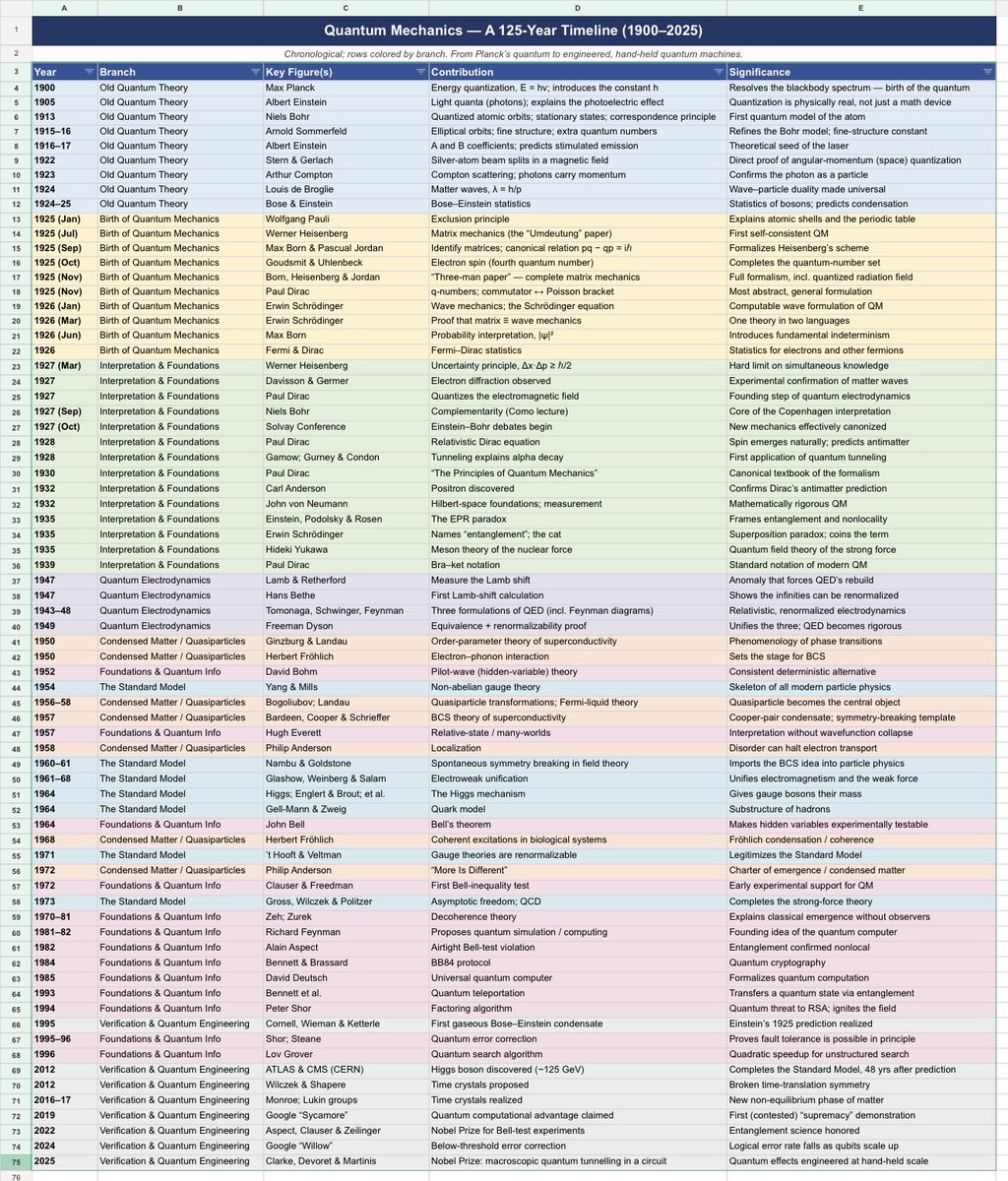
Quantum mechanics turns 100 this year. I put the whole history on one sheet — 72 entries, 1900 to 2025.
Planck kicks it off in 1900. The core of the theory gets built in about 18 months across 1925-26: matrix mechanics, then wave mechanics, then the proof they’re the same theory, then Born’s probability rule and uncertainty….After that it stops being a single field. It splits into QED, condensed matter, particle physics, and quantum information — four separate bodies of work coming off one root.
I colored the rows by branch so you can actually see those tracks running at the same time instead of flattening them into one line.
Every row is just the year, the people, what they did, and why it mattered.
It runs all the way to where things stand now: error-corrected qubits and a 2025 Nobel for quantum tunneling in a single circuit. A century of physics you can scan in a couple of minutes.
Instead of watching an hour of Netflix, watch this 2 hour hour Stanford lecture will teach you more about how LLMs like ChatGPT and Claude are built than most people working at top AI companies learn in their entire careers.
A self-taught Irish schoolteacher wrote a book in 1854 that almost nobody read for 80 years, until a 21-year-old MIT student picked it up and realized it could be used to design every computer in human history.
His name was George Boole. The book is called An Investigation of the Laws of Thought.
Boole was born in 1815 in Lincoln, England. His family was poor. He left school at 16 to support them. He taught himself Latin, Greek, French, German, and Italian.
Then he taught himself mathematics. By 19 he had opened his own school. By 24 he was publishing original papers in the Cambridge Mathematical Journal, competing with men who had spent decades inside the best universities in Britain.
He never had a degree. He never had a mentor. In 1849, Queen's College in Cork hired him as a professor anyway.
In 1854, he published his masterwork. What he built inside it was something nobody had attempted before at this scale. He turned logic into algebra.
Before Boole, logic was philosophy. You argued in sentences. You reasoned in paragraphs. It was powerful and completely impossible to automate, because there was no formal system underneath it, just language.
Boole stripped it down to arithmetic. He showed that every act of human reasoning could be reduced to operations on two values. True or false. One or zero. AND, OR, NOT. If both conditions are true, the result is true. If neither is, the result is false. Every judgment a human mind makes, every decision, every deduction, could be written as an equation following those rules.
Logicians read it. They found it interesting. Engineers building machines had never heard of it.
For 83 years, the book sat there.
Then in 1937, a 21-year-old MIT master's student named Claude Shannon was working on a thesis about electrical relay circuits. Switches that could be open or closed. Current that either flowed or didn't.
He read Boole and understood something nobody had connected before.
An open switch is a zero. A closed switch is a one. A circuit with two switches in series only carries current when both are closed. That is AND. A circuit with two switches in parallel carries current when either is closed. That is OR. Shannon proved that every possible logical relationship Boole had described could be physically built using wire and switches.
That single insight is the foundation of every computer ever made.
After Shannon, chip designers stopped thinking about electricity and started thinking about logic. Every transistor on every processor running right now is implementing a Boolean operation. Every if-statement in every codebase is Boolean logic. Every database query using AND or OR. Every neural network threshold that fires or doesn't fire. All of it is running the algebra of a self-taught schoolteacher from Lincoln who died 160 years ago.
The strangest part is what happened to Boole at the end.
He was walking to class in November 1864 when he got caught in a rainstorm. He lectured for hours in wet clothes. He went home sick. His wife, Mary, believed in homeopathic medicine and thought the cure should mirror the cause. She wrapped him in wet sheets and poured cold water over him repeatedly.
He died a few days later. He was 49.
He never saw a transistor. He never saw a circuit. He never saw a single physical machine run a single one of his rules.
His book is in the public domain. Free to download. Most engineers use the word Boolean dozens of times a week. Almost none of them know who they are saying.
The man whose logic runs inside every phone, every server, and every AI model on Earth died soaking wet in a small Irish town, 83 years before anyone figured out what he had actually built.
There was a time, not long ago, when democracies were on the rise. Hope was in the air as country after country held its first rather free election. How far we have regressed since then. Democracy is under threat almost everywhere now.
https://t.co/dbgj1jxTXm
The Peter Principle is the satirical theory that employees are generally promoted to their level of incompetence.
In 1974, the author of the Peter a principle, Dr. Laurence J. Peter, explained how he first got the idea and what can be done about it


![Rainmaker1973's tweet photo. Scientists have identified a reversal of the long-standing Flynn effect—the roughly 200-year trend of rising average intelligence (measured via IQ and cognitive tests) across generations.
For the first time in modern recorded history, Generation Z (born roughly 1997–2012) shows lower performance than previous generations in key cognitive domains, including attention, memory, literacy, numeracy, executive function, problem-solving, and general IQ—despite spending more years in formal education than ever before.
Neuroscientist and educator Dr. Jared Cooney Horvath, PhD, MEd, testified before the U.S. Senate Committee on Commerce, Science, and Transportation on January 15, 2026, highlighting this shift. In his written testimony, he stated that cognitive development in children across much of the developed world has stalled or reversed over the past two decades, with declines evident in international assessments (e.g., PISA, TIMSS) and other large-scale data starting around the mid-2000s and accelerating post-2010.
Horvath attributes the primary driver not to reduced schooling, but to the widespread integration of digital screens and educational technology (EdTech) in classrooms. He argues that human brains evolved for deep, focused learning through face-to-face interaction and sustained attention, not fragmented skimming or constant task-switching encouraged by devices.
Key points from his testimony include:
- Teens now spend over half their waking hours on screens, with significant portions in school involving computers or tablets—often leading to off-task behavior and shallower processing.
- Evidence from meta-analyses and national/international studies shows a consistent pattern: higher classroom screen exposure correlates with weaker outcomes in reading, math, science, and higher-order reasoning.
- Digital tools may aid narrow, repetitive skill practice in controlled settings, but in core academic contexts, they tend to reduce depth of understanding, retention, and critical thinking.
Horvath describes this as a "structural mismatch" between human cognition and how digital platforms are designed (to capture and fragment attention), warning that unchecked EdTech adoption risks long-term harm to workforce skills, innovation, and societal reasoning.
[Horvath, J. C. (2026). Written testimony before the U.S. Senate Committee on Commerce, Science, and Transportation. U.S. Senate]](https://pbs.twimg.com/media/HLLnJasWIAAXKMy.jpg)