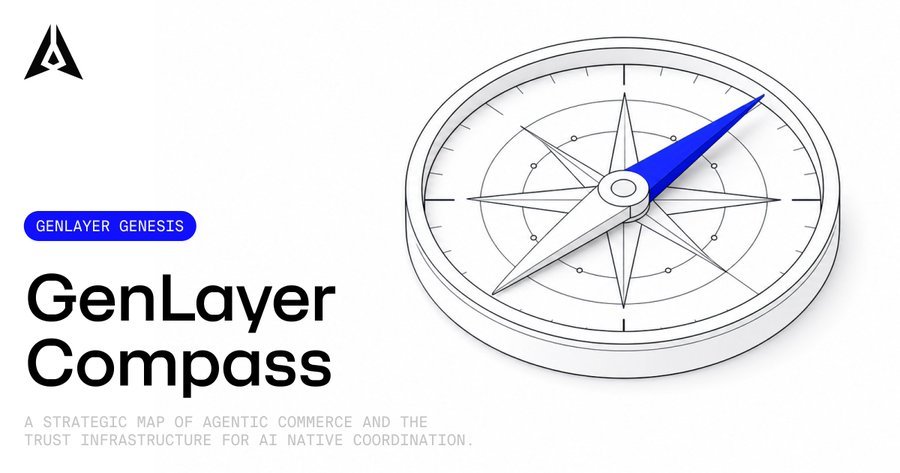
There is a question buried inside The Compass that I had not thought to ask before reading it.
Who should hold the power to decide what is true?
Not in a philosophical sense. In a practical one. When two AI agents complete a deal and still disagree about what it meant, something has to settle that. Whoever, or whatever, holds that power is not neutral. Name a company, you get a target. Name a single AI, you get a point of failure. Name a government, you get a jurisdiction problem.
That is the question @GenLayer is building around. Not "how do we make agents faster" or "how do we make contracts cheaper." Who should hold the power to decide what is true, and how do we make sure that power cannot be corrupted.
The Compass does not pretend to have a clean answer. It argues the answer has to belong to the network itself, and it explains why anything else eventually fails.
I am not going to summarize it further. The argument deserves to be read, not compressed.
https://t.co/cZbKDGjZTN
Who do you think should hold that power?
Trust is not a feeling. It is a technology.
The merchants of Barcelona did not invent cross-border law in 1258 because they were untrustworthy. They invented it because handshakes stopped scaling.
I watched that happen at a smaller scale on a freelance platform. A client disputed my work. The platform sided with them immediately. Not because they were right. Because they had more reviews. Reputation was the only trust technology available. Reputation favored incumbents.
That is what The Compass from @GenLayer is actually about.
Not a protocol. A map of how trust has been rebuilt seven times throughout history, and an argument that the seventh layer, AI-mediated judgment, does not exist yet. Bitcoin replaced trust in banks with math. Ethereum replaced trust in contracts with code. The next layer replaces trust in arbitrators with something that cannot be bought by whoever holds the most leverage.
Read it at https://t.co/vaSEhdP1Mr
Which trust layer are you actually running your life on right now? And when did it last fail you?
Equivalence check: two validators, same case.
Validator A: "Delivery met spec — minor deviation, no material breach."
Validator B: "Terms satisfied — deviation within reasonable tolerance."
Different words. Same verdict. No conflict.
I've had a client read the exact same deliverable that way once — different words, same conclusion — and it still took a week to convince them we actually agreed. That's the gap @GenLayer 's Compass calls the Equivalence Principle: decentralized judgment doesn't need identical answers, only equivalent ones. Every other blockchain treats mismatched wording as mismatched fact. This one separates the two, which is the real reason adjudication couldn't be decentralized until now.
Human courts don't get that shortcut. 344 days to resolve a complex US dispute, 657 worldwide — most of that isn't fact-finding, it's arguing over phrasing that already agreed.
Read the Compass. What's a rule you've seen enforced two different ways that still landed on the same outcome?
History is a graveyard of economies that outgrew their legal systems.
In 1258, Barcelona's merchants wrote their own cross-border code because existing law couldn't keep up.
In 2008, Bitcoin replaced trust in institutions with proof.
Both arrived after the damage was already done.
Every previous trust layer was built to clean up a crisis, not prevent one.
GenLayer is the first being built before the wreckage.
That is harder than it sounds. There is no historical template for this. Every previous layer had a crisis to justify it. This one has to make the case before the collapse arrives.
We are already building a $9 trillion agentic economy.
The courts handling its disputes still average 344 days in the US.
We have trustless money.
We have trustless computation.
Judgment is still missing.
If agents negotiate and pay in milliseconds but need 344 days to settle a disagreement, the system doesn't slow down.
It breaks.
The Compass from @GenLayer is where that argument starts: https://t.co/NacxHEIUzq
Which comes first: the crisis that proves GenLayer right, or the adoption that prevents it?
₦50,000 eFOOTBALL GIVEAWAY! 🎮🇳🇬
We are blessing 5 active gamers with ₦10,000 cash each for the next Epic pack! 🪙🔥
To enter:
1️⃣ Follow @Mystic_Union & @Ace_Efil
2️⃣ Like & RT this post
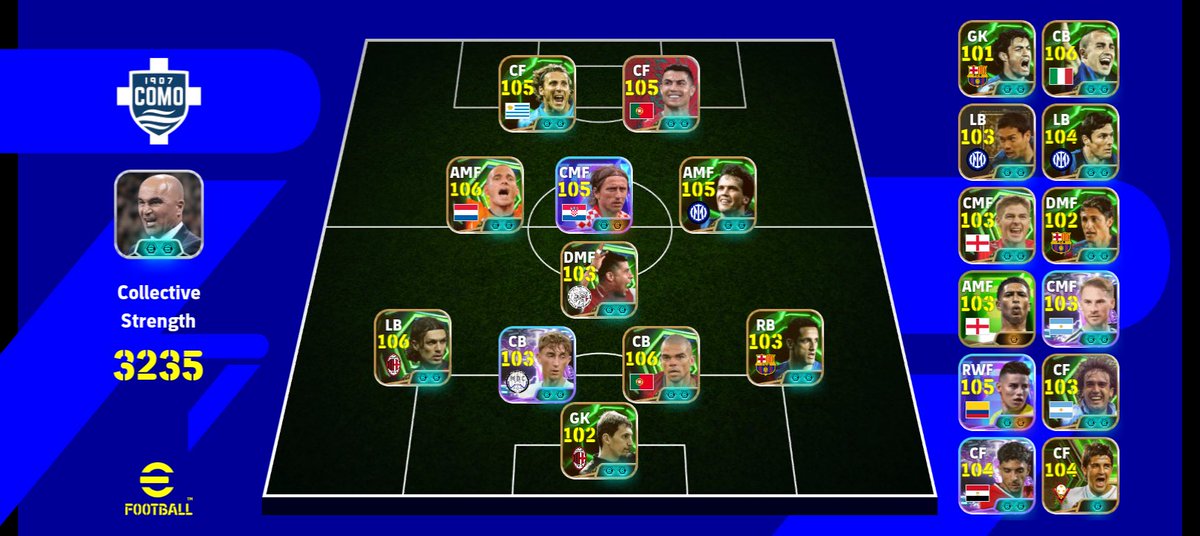
3️⃣ Drop your main squad screenshot + proof of following below! 👇
💡 NOTE: 2 slots are reserved for the most active followers (hand-picked by the hosts)! The other 3 will be 100% random.
Winners in 48 hours. Let’s go! 🚀
#efootball #NigeriaGaming #イーフト #ウイイレ
Most of my costs weren't bad decisions. They were decisions I never revisited.
I set up my trading routine over a year ago and never really looked at it again. Same platform, same habits, same fees. Not because it was the best option. Because it worked well enough that I stopped questioning it.
That's inertia, and it's expensive in ways bad decisions aren't. A bad decision you notice. Inertia just quietly costs you the difference between what you have and what you could've had, for as long as you don't check.
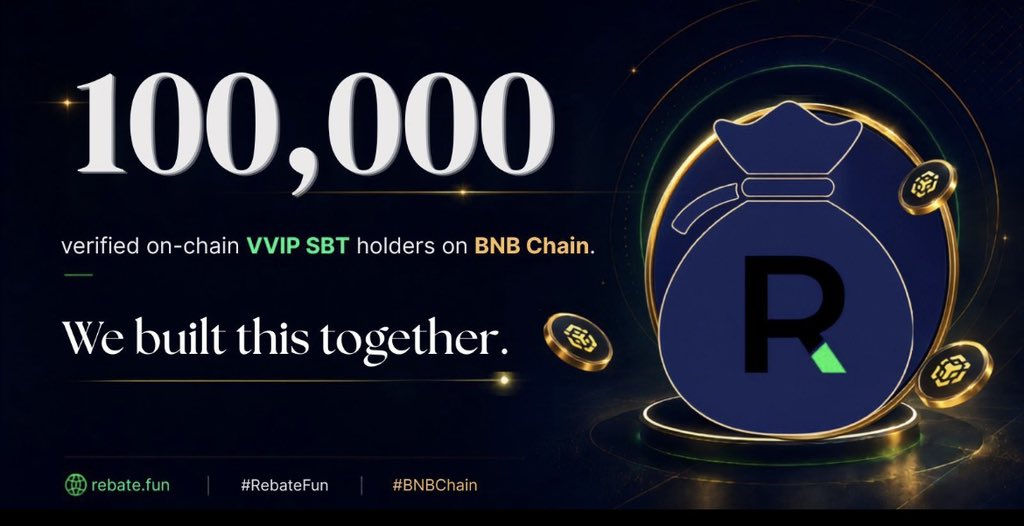
I finally looked into @Rebatefun after it crossed 100,000 verified on-chain VVIP holders on @BNBChain. The number itself wasn't what got me. It was realizing how long I'd gone without checking anything like it.
@nina_rong's line about turning costs into profit only means something once you actually revisit the setup you've been running on autopilot, and this is what I switched to:
https://t.co/FyDVrZtb9S
DM @Rebatefun on X with your RebateFun UID to apply for a dedicated referral code and exclusive VVIP tier benefits.
What's something you're still doing the old way, just because you never got around to changing it?
Most traders obsess over what they buy.
Very few think about what they leave behind every time they trade.
To the exchange, you're just a source of volume. To the protocol, you're just a gas fee. Your activity has real value, but because it's disconnected from identity, that value resets every single time.
I started thinking about this differently when I saw @Rebatefun cross 100,000 on-chain users on @BNBChain.
An SBT isn't a badge. It's non-transferable and permanently recorded on-chain. It connects your trading activity to a consistent identity within the RebateFun system.
Without identity, your trades reset to zero every time.
With identity, they accumulate. Each transaction becomes part of a history that qualifies for progressively better rebates and tier benefits.
It’s not just about recovering costs. It’s about making sure your activity builds on itself instead of starting over.
@nina_rong put it plainly: turn costs into profit.
If you're still trading anonymously, the value your activity generates is flowing somewhere. Just not back to you.
If you're curious, here’s where I looked into it:
https://t.co/T7SF865tay
DM @Rebatefun your UID to apply for a dedicated referral code and VVIP tier benefits.
Do you treat your trades as isolated events, or as part of an identity that compounds over time?
Most traders think fees are the price of participation.
They're not.
You didn't lose those fees to bad trades. You paid them because you had no one negotiating on your side.
The infrastructure was never overcharging you. It was just charging the unorganized rate.
That's the part nobody talks about.
Every time you trade on chain, the exchange sets the fee, the chain sets the gas, and the protocol sets the spread. You accept all three because you're one user with no leverage.
What changes when 100,000 users stop operating alone?
@Rebatefun just crossed that number on @BNBChain.
At that scale, it stops feeling like a user count and starts looking like organized traffic.
When trading activity is aggregated and routed through integrations with exchanges and ecosystem partners, the economics shift. Your activity stops being isolated volume and starts being negotiated flow.
Alone, you pay the unorganized rate.
Together, you don't.
@nina_rong put it simply: turn costs into profit.
If you're active on chain, your volume already has value. The only question is whether it's organized enough to capture any of it.
If you want to explore it:
https://t.co/pSWKpl7wMC
DM @Rebatefun your UID to apply for a dedicated referral code and VVIP tier benefits.
Have you ever calculated how much of your yearly PnL goes to fees, and what recovering even a fraction would change?