People are are critical of this are “uncomfortable with themselves”
Says the girl so uncomfortable with herself she used medical intervention to make herself appear like a 14 year old pre pubescent boy before his growth spirt.
If you love Jesus you should love what Jesus loves, and that ultimately means you should be an official, active, and serving member of your local church (Eph. 5:25).
Church membership should be normal for Christians. Lives lived in regular accountability demonstrate the gospel’s reality to the world, particularly through the mutual love that Jesus identified as the mark of his followers. This is both biblical and strengthens evangelistic witness. Weaker and newer Christians gain feeding and accountability through membership, and mature and seasoned believers demonstrate authentic Christian living.
Hebrews calls believers to “consider one another to provoke unto love and to good works,” explicitly warning against forsaking assembly “as the manner of some is” (Heb. 10:24–25). This suggests participation isn’t optional but essential to spiritual health.
Church membership preserves biblical truth by establishing who bears responsibility for rooting out false teaching and protecting the gospel when leadership itself becomes compromised. Paul’s letter to the Galatians exemplifies this. I say this as a positional elder in my church — Paul appealed to the whole congregation rather than leadership alone to address doctrinal corruption. Think about it: how are you to “bear one another’s burdens, and so fulfill the law of Christ” (Gal 6:2), which positions mutual care as a central Christian obligation, if you’re not actively in a membership role? Thessalonians similarly exhorts believers to “encourage one another and build one another up” (1 Thess 5:11), framing encouragement as a reciprocal responsibility that requires presence and investment.
Healthy membership equips believers to recognize heresy when taught or communicated and transforms them from passive consumers into active defenders of the faith.
Acts depicts the early church persevering in apostolic teaching, communion, and gathering daily, with believers holding possessions in common (Acts 2:42–47), a portrait of intensive communal engagement rather than individual isolated devotion or nominal affiliation.
Ultimately, practicing membership glorifies God as Christians gather to form his body, living under the life giving words of scripture, fellowshipping with one another sacrificially, and reflecting his character.
In short, Brian Simmons is a delusional, lying hack.
And his translation butchers the word of God based on false claims of revelation and linguistic insights.
In the example below Brian copies a false claim that sources not from study or revelation but from a man who shows deep signs of delusion himself.
Bill Johnson was just a little bit off when he endorsed TPT and said it was one of the best things to happen in Bible translation in his lifetime. Yet Bill’s endorsement sure led to a lot of sales for TPT and after TPT was exposed YEARS ago they just doubled down on it and served their people up to the Bible twisting personal enrichment of Brian Simmons.
Flee Bethel.
Today's Daily Smoking Gun of plagiarism in the Passion Translation comes in Philippians 3:19.
Instead of the words "their god is their belly" which appear in all other translations, TPT (2013) gives "their god has possessed them and made them mute."
Christianity survived crucifixions, lions, fires, Nero, Decius, Diocletian, Islam, Mormonism, Communism, The Da Vinci Code, Richard Dawkins, progressivism, Obama, and the DNC.
But Spielberg has aliens.
The Great Falling Away is here. 👽😂
@MikeWingerii@AccordanceBible offers some problematic translations like Eugene Peterson’s “The Message.”
But at least they don’t offer The Brian Simmons “Passion Translation” or Brent Miller’s “Pure Word” text.
It’s a problem no major app excludes problematic translations entirely.
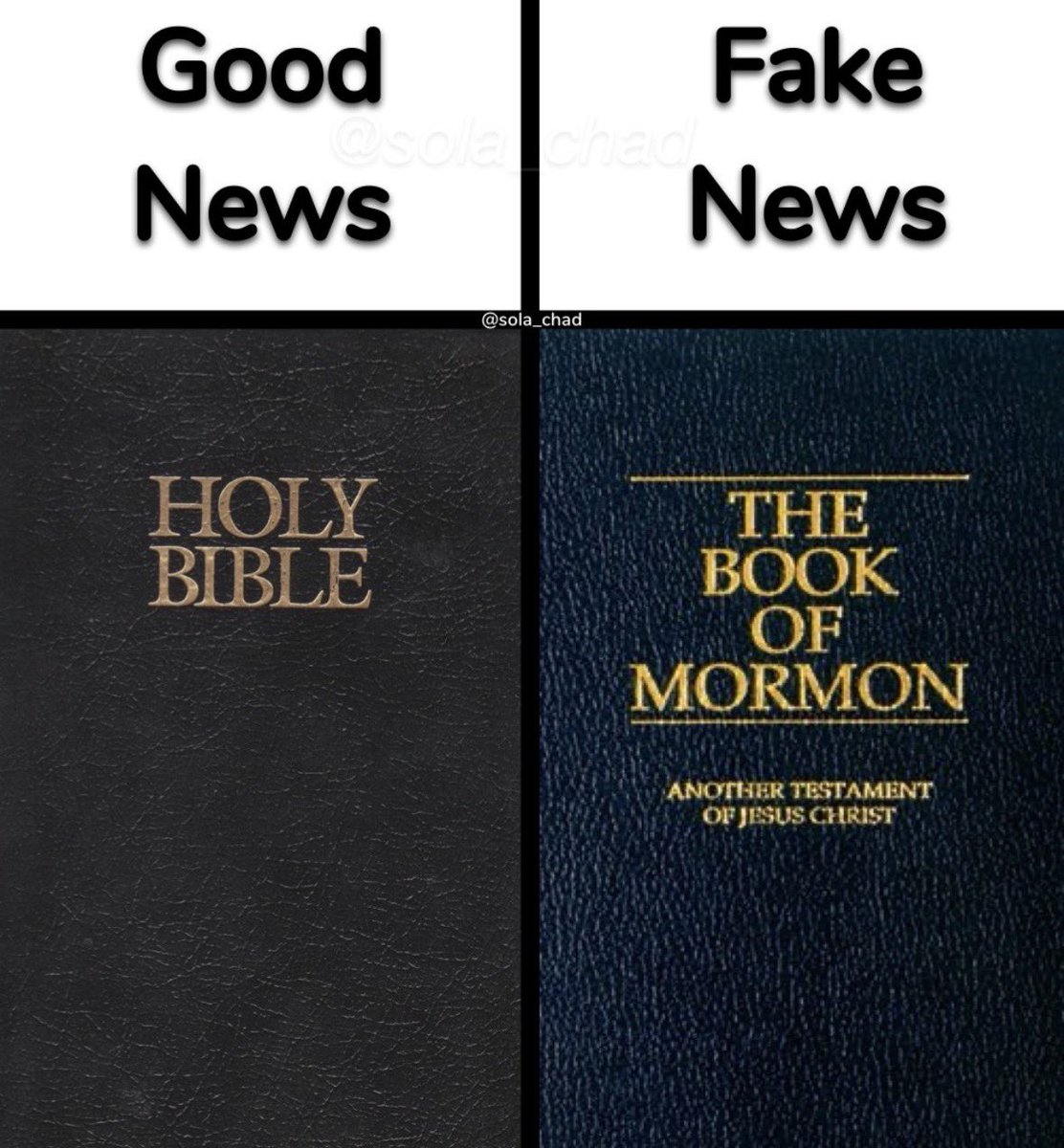
Mormonism was based on the belief that the Apostles’ Creed is an abomination to God.
Joseph Smith said this is what God told him.
Yet they want to be called “Christian.”
Come out of Mormonism and come to Jesus.
Social media is filled with the righteous indignation of the Mormons---who claim to be the only true Church, all other churches are corrupt, their creeds an abomination, their ministers the hirelings of Satan---that they, the Mormons, are not really Christians. It's just a tad ironic, but it does play on the ignorance of most LDS, and non-LDS, about LDS history and teachings.
Their current modus operandi is to use the phrase "creedal Christians" and try to make the issue post-biblical. Here's the problem. The fundamental distinction between Christianity and Mormonism goes back to about 1400 BC, not 400 AD. Here is the foundational contrast:
Before the mountains were born,
Or Your brought forth the earth and the world,
Even from everlasting to everlasting,
You are God. (Psalm 90:2)
...for I am going to tell you how God came to be God. We have imagined and supposed that God was God from all eternity. I will refute that idea, and take away the veil, so that you may see.
Joseph Smith, 1844
Now, two quick things: 1) Psalm 90 is a song of Moses, hence the early date. 2) The King Follett Funeral Discourse is not LDS Scripture. But it is the most often cited sermon of Joseph Smith by the leaders of the LDS Church itself, and is one of two foundational sermons preached within the last months of his life.
Hence, the issue is stark and clear. Monotheism vs. polytheism, one transcendent Creator God vs. an exalted man from another planet. Just a reminder from Brigham Young as to how Smith's words were interpreted by those who heard him initially:
“Mankind are here because they are the offspring of parents who were first brought here from another earth, and were enabled to propagate their species, and they were commanded to multiply and replenish the earth. How many Gods there are, I do not know. But there never was a time when there were not Gods and worlds, and when men were not passing through the same ordeals that we are now passing through. That course has been from all eternity, and it is and will be to all eternity.”
Brigham Young, JD 7:333, August 28, 1859.