The bronze serpent challenges both iconoclasts and iconodules.
The iconoclasts must wrestle with God commanding people to look at an image which is somehow connected to Christ. (Num. 21:8-9; John 3:14-15)
Iconodules must reckon with the fact that veneration of the bronze serpent did turn into idolatry over time and Hezekiah was right to destroy it. (2 Kings 18:4)
Images are not absolutely evil nor are they absolutely good. Sensitivity is needed to know if images are helpful or harmful.
The church must use wisdom and cultural contextualization to determine the role images should play in the devotional life of each individual and congregation.
@TheRemnantRadio With that many crazy linguistic errors, that man should clearly write his own Bible translation and get it endorsed by dozens of major Charismatic leaders.
@Protestia Lentz: "I'm not disqualified."
Also Lentz: *uses an analogy of a doctor who killed someone via malpractice*
My brother in Christ, that doctor would never practice again.
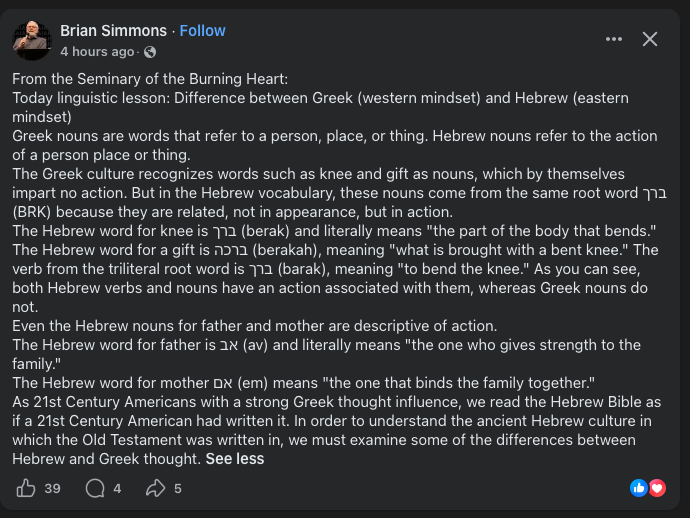
Every time Brian Simmons, author of the Passion "Translation," attempts to explain the languages of the Bible, he does so in an unreliable and anachronistic fashion.
Basically every statement in this "linguistic lesson" is either totally false or at least misleading as far as I can tell.
1. The distinction between "referring to a person, place, or thing" vs. "the action of a person, place, or thing" is nonsense. It's a false distinction. Every Hebrew speaker knew that the word "hand" corresponded to the thing with five fingers attached to your arm just as Greek speakers did.
2. "The Greek culture recognizes words such as...gift as nouns."
But the word for gift in Greek (δῶρον) is likely derived *from a verb* (δίδωμι) exactly as the Hebrew word is. Many languages derive nouns from verbs and Greek is no exception.
3. The etymological fallacy rears its ugly head once again as Brian implies that the root of each Hebrew word defines how that word was understood after it evolved.
4. "Hebrew verbs and nouns have an actions associated with them, whereas Greek nouns to not."
This is honestly just beyond parody. There are numerous Hebrew nouns that do not correspond to any primitive verbs as far as we can tell. mayim = water and has no verbal root.
There are also Hebrew verbs which are commonly considered to have derived FROM nouns, the exact opposite process described by Simmons.
In both languages verbs can be derived from primitive nouns and nouns can be derived from primitive verbs.
Furthermore, the Greek language is even more apt to turn verbs into nouns: infinitives and participles, for example, though they are technically "verbs" can (and often do) function as nouns.
5. "Even the Hebrew nouns for father and mother are descriptive of action."
The words for father and mother in most languages are not descriptive of anything. They are the noises children make when they first begin to utter sounds. Infants are not thinking, "How do I derive a noun from the action performed by my mother and father?"
This is why the word in Aramaic (abba) is almost identical to the word in Tamil (appā) despite being from completely unrelated language families separated by thousands of miles.
The rest of the explanation is "pictographic Hebrew" Gnosticism that attempts to read fanciful "secret meanings" into Hebrew means by referring to their original "pictographs."
The irony is that none of the "pictographic Hebrew" proponents can agree on what the original "pictures" even meant.
Are there differences between Ancient Hebrew and Ancient Greek thought? Of course.
But those differences don't produce a chasmic disparity between languages that requires a kind of linguistic "secret knowledge" to understand.
"Oneness just takes the Bible"
The Bible translated by numerous scholars who translated based on critical editions compiled by numerous scholars who worked from numerous manuscripts copied and preserved by numerous Christians down through the ages.
The Trinity took hundreds of years, Greek philosophy, and councils to define.
Oneness just takes the Bible.
“Hear, O Israel: the LORD our God is one LORD.”
That's basically the whole doctrine.
Yes. In my research it begins mainly with the medieval Kabbalistic authors who saw every letter as a mystical portal to hidden knowledge. It passed from there into various esoteric sects like Anthroposophy and Theosophy etc.
Interestingly, though, the early proponents of this didn’t make any attempt to connect them to ancient pictographs as far as I have seen
The verse no Protestant wants you to read:
For those who eat and drink without discerning the body of Christ eat and drink judgment on themselves. (1 Corinthians 11:29)
Isn't it fascinating that many far left folks who talk about "wage slavery" and the "means of production" hate the one company that willingly sacrifices profit for the mental and spiritual well being of its employees?
Chick-fil-A isn't budging on its Sunday closures, no matter how much money the company could be missing out on.
CEO Andrew Cathy says the policy, rooted in the founding family's Christian faith, remains a priority because it guarantees workers a day for rest and worship.
He even admits he's never calculated the potential lost revenue because opening on Sundays simply isn't something the company is considering.
But Chick-fil-A is making another change to its menu. See what's coming next: https://t.co/98s9loHO5A
@Jovenesfutmx Ustedes siempre dicen que Tillman, Dest, etc. "no son Estadounidenses" porque nacieron en otro pais pero ahora si son Estadounidenses porque hay una conspiración en PSV? Y de repente Esmir Bajraktarević si es estadounidense aunque represente Bosnia?
@HeritageSparks If you're going to read something by Andy Stanley, that's the book to read. He may not be able to coherently exegete a Scriptural text, but he is a great communicator!