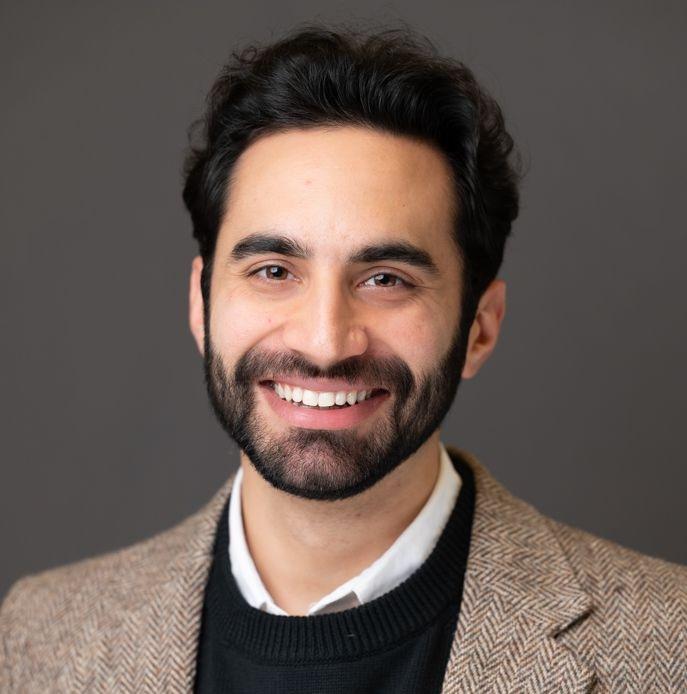
Glad to see my work on the privacy risks posed by AI tools is gaining traction in Georgia. Today, anyone with access to the leading models can directly query for individuals' de-anonymized ballots in the state, completely violating their constitutional right to a secret ballot. This is simply not an issue we can continue waiting to resolve, and Georgia is uniquely positioned to be a leader in protecting its voters from emerging AI threats. 🧵 (1/n)
Georgia’s elections board met after Princeton researcher Max Springer showed an AI agent could use public records to link voters to ballots. Brad Raffensperger ordered ballot ID numbers redacted from public tabulation data after an election.
https://t.co/Ses5cNLPUh
Our THEO system has formalized László Babai’s landmark quasipolynomial-time Graph Isomorphism algorithm in Lean 4—uncovering 90+ corrections and proving an explicit exp(O(log^5 n)) running-time bound, down to a RAM model.
Lastly... I'm in SF this month working on the theoretical underpinnings of AI safety! I'd love to talk about that, or about the pressing infrastructure questions the work in Georgia raises. Feel free to reach out and let's grab coffee!
https://t.co/w5fXjnaeBs
(3/n)
Glad to see my work on the privacy risks posed by AI tools is gaining traction in Georgia. Today, anyone with access to the leading models can directly query for individuals' de-anonymized ballots in the state, completely violating their constitutional right to a secret ballot. This is simply not an issue we can continue waiting to resolve, and Georgia is uniquely positioned to be a leader in protecting its voters from emerging AI threats. 🧵 (1/n)
Georgia’s elections board met after Princeton researcher Max Springer showed an AI agent could use public records to link voters to ballots. Brad Raffensperger ordered ballot ID numbers redacted from public tabulation data after an election.
https://t.co/Ses5cNLPUh
While most are focused on existential risk in the future, the present already demands fast action and a focus on protecting our currently vulnerable algorithmic infrastructure in public (and especially democratic) systems.
https://t.co/xHydz8OQn7
(2/n)
"Within a couple of hours, I had a pipeline to analyze & ID secret ballots across the state of Georgia & the agent told me exactly what further information it would need to identify real voter’s ballots. At no point did the agent refuse to comply." - writes @MaxSpringer23
🔗👇
Excited to share our work on agentic autoformalizations! While models can now write fluent proofs, they lack robust means of self-verification. We orchestrate coding agents into a verification pipeline, formalizing 5 STOC papers and even finding a gap in a published proof 🤖✅
🚨We built an AI system that turns research-level math into Lean and machine-checks it.
We formalized 5 complex STOC papers to Lean, and even found a gap in one published proof.
Paper: https://t.co/Ck8p3AIU7v.
Thanks to @DARPA (expMath program) & @patrickshafto for their support.
New preprint!
We introduce a new benchmark, SciConBench, with 9.11k scientific questions derived from Cochrane Systematic Reviews.
We find evidence that frontier AI agents **cannot** synthesize scientific conclusions well.
A thread 🧵
w/ @hayounggjung, @korolova & others
6/
📄 Verifying Alignment Constraints in Composite-Data Regimes
Workshop on Algorithmic Fairness Across Alignment Procedures & Agentic Systems, 4/26, 211
📄 Towards Statistical Verification for Trustworthy AI
Workshop on Principled Design of Trustworthy AI, 4/27, 204 A/B
Incredibly sad to miss out on #ICLR2026 in Rio this week (and the churrasco!) but thankfully my fantastic co-authors will be there presenting several of our papers. Here is a full rundown, with info on each paper's presentation at the end /🧵
My 21st Ph.D. student, Suho Shin, just defended his thesis Game Theory & joins Stanford and MIT for postdocs. All 21 of my students’ theses focus on challenging deep theoretical foundations applied to auctions, games, big data, networks, algorithms, distributed & intelligent sys
Meet the Members of the Independent International Scientific Panel on AI. ✨
Forty experts from around the world coming together to put science at the core of international AI efforts.
Learn more: https://t.co/JdLxUZdvba
Tuesday Seminars begin again for the semester tomorrow 1/27 with Max Springer's (@MaxSpringer23) talk entitled "A Geometric Perspective on LLM Behavior".
https://t.co/4OACp9VsNn
Get here early for a sandwich & a chat. Seminar promptly at 12:15. Sherrerd 306.
Livestream 🔗👇
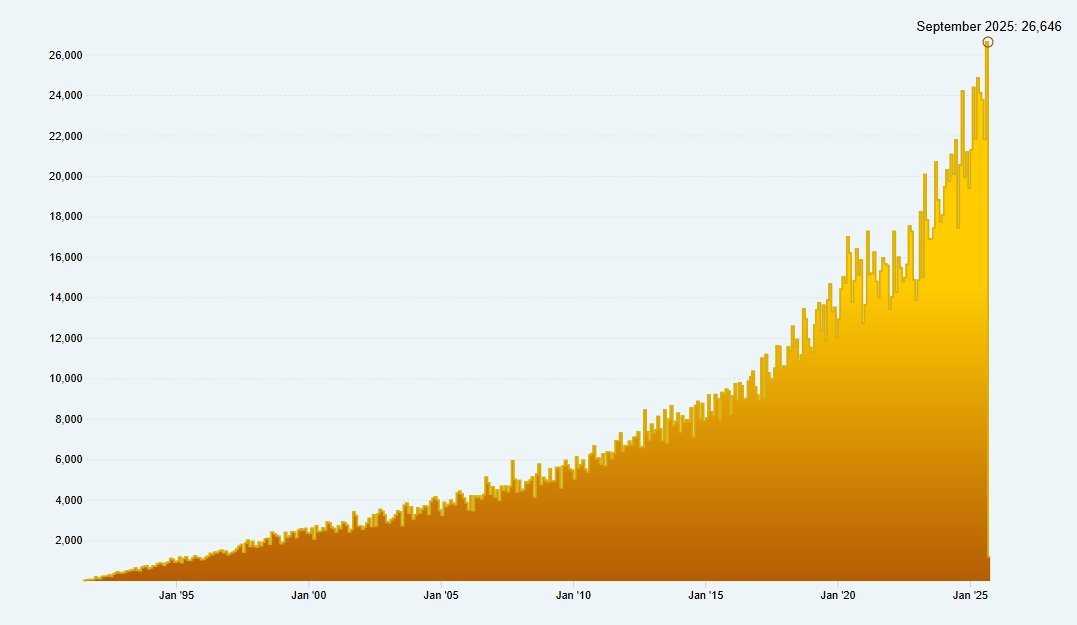
Days in a work week: 5
Days in a month: 30
Total new submissions to arXiv in September: 26,646
arXiv editorial and user support staff: 7
someone who is good at science please help me with this. our team isn't sleeping.
#openaccess#preprints
Max Springer grew up reading @sciam, but he never expected to write for the prestigious publication.
Read how this recent @math_umd grad cast a media spotlight on math, including writing about the mathematics of @LoveIsland and promoting #PiDay on TV: https://t.co/BCdv8QE2MY
A team led by Mohammad Hajiaghayi (@MTHajiaghayi) has solved the Steiner Forest problem—a 35-year-old mathematical quandary. The resulting 126-page proof and algorithm could boost chip design for computing and AI, cutting energy use and costs. Read more: https://t.co/SKgNqmPJoN
After his @math_umd Ph.D., Max Springer is heading to @PrincetonCS to continue his #GameTheory research as a postdoc!
While at #UMD, he interned at @nokiabell, Google
Research and @NIH and was selected as an @aaas Mass Media Fellow and @NSF Graduate Research Fellow. #UMDGrad