One of the most important divergences in global markets:
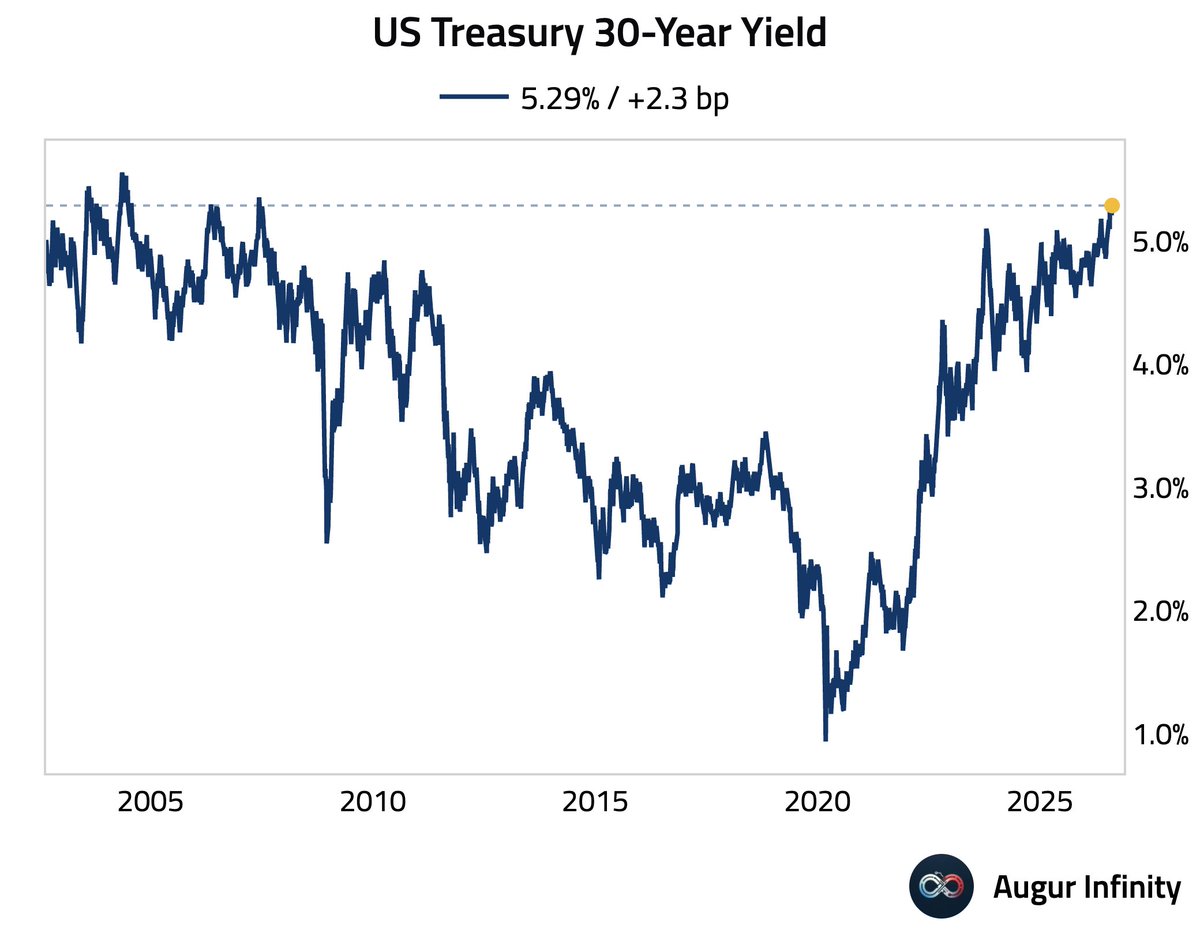
The 10-year Treasury yield has surged to 4.65%, while the U.S. Dollar Index has fallen below 100.
Higher yields normally attract foreign capital and strengthen the dollar.
Instead, investors are demanding more compensation to hold long-term U.S. debt while the dollar weakens.
Yields are rising less because of economic strength and more because of inflation, deficits, policy uncertainty, and a growing term premium.
The U.S. is paying more to borrow without receiving the stronger currency that typically comes with higher rates.
Stanley Druckenmiller renders an unfavorable opinion of Treasury Secretary Scott Bessent's use of buybacks to defend against higher yields in a market that is functioning normally.
"I have spent five decades trading on a simple premise: Markets aggregate information no committee possesses, and prices are how that information reaches decision makers. The long-term Treasury yield is the most important price in the world. It is also the only fiscal disciplinarian the U.S. has left."
"Every basis point of artificial yield suppression is a subsidy to procrastination."
"Return buybacks to their stated purpose: small, scheduled, off-the-run liquidity operations announced at quarterly refundings, never off-cycle responses to yield levels. Term out the debt honestly and pay the price the market sets."
"If the 30-year must trade at 5.5% to clear, that isn’t a crisis. It is an invoice. Then do the only thing that durably lowers long-term yields: address the primary deficit."
https://t.co/Xe8Vi38WiI
The rise in US yields since Chair Warsh’s first FOMC meeting has been driven primarily by a higher term premium, while yield increases in other countries have been driven more by rising rate expectations.
Today’s news: Treasury may start using its nearly $1 trillion TGA cash balance to fund bond buybacks.
Here is what that actually means.
The TGA — Treasury General Account, is basically the U.S. government’s bank account at the Federal Reserve.
Normally the flow is simple:
Taxes + Treasury borrowing
→ cash enters the TGA
→ government spends that cash
But Treasury is now considering using part of that cash balance to buy back long-duration government bonds from the market.
Suppose Treasury has $950B sitting in the TGA and decides to use $100B for bond buybacks.
The flow becomes:
Treasury buys $100B of long bonds
→ TGA falls by $100B
→ that cash moves back into the banking system
→ bank reserves/liquidity rise
→ long-duration Treasury supply held by the market falls
So Treasury achieves two things at once:
Liquidity goes up Pumping markets
duration pressure goes down
And this is where it gets interesting.
Treasury does not necessarily have to issue $100B of new bills at the same moment.
It can use the existing cash first.
That means:
Buy long bonds today
→ relieve pressure on the long end
→ inject short-term liquidity
→ wait for calmer market conditions
→ issue bills later to rebuild the TGA
So in effect, Treasury is using the government’s bank account to buy time.
It is separating two transactions that normally happen together:
support the bond market now
finance/replenish the cash later
This is still not QE.
The Fed is not creating new money.
The TGA cash already came from previous taxes and borrowing.
Eventually, if Treasury wants to rebuild the TGA balance, it has to issue more debt again.
So the full cycle looks like this:
Long-duration bonds bought back
→ TGA cash released
→ liquidity injected
→ long-end supply reduced
→ bills issued later
→ TGA rebuilt
The end result is effectively a shift from:
long-duration debt → short-duration debt
But the timing matters enormously.
If the 20Y or 30Y bond market is under stress, Treasury can use the TGA as a temporary shock absorber, rather than dumping more issuance into the market immediately.
That gives Treasury more control over:
when debt is issued
where duration sits
when liquidity is injected
when liquidity is drained
So the government is not solving the debt problem.
it is being shifted forward and shortened in maturity.
More bills mean more refinancing risk and greater dependence on stable short-term funding.
And if Treasury increasingly has to manage duration and liquidity to keep long yields contained, pressure eventually moves toward the Fed.
That is the path toward fiscal dominance, financial repression and a weaker fiat system.
🦔Private credit is the $2 trillion world where investment firms, not banks, lend money to companies. They report a default rate near 2% and call it safe. I dug into that number, and I don't buy it. Apologies for the long post, but felt like this needed to be explained.
My Take
When a borrower can't pay, the lender often reworks the loan instead of admitting a default. The favorite trick lets the company stop paying cash interest and pile it onto the loan balance instead. The lender books that as income even though no money came in, so the loan looks fine while it grows in the background. This stressed kind of rework has tripled since 2021 to about 6% of these loans. Lincoln International, a firm that values a third of the market, calls that the shadow default rate, roughly three times the 2% everyone advertises.
To put 6% in perspective, defaults hit around 10% in the 2008 crash, so we're already past halfway to that level, and regulators expect the number to keep climbing through the year. A big share of these loans went to software companies, and software is what AI is coming for. When OpenAI or Anthropic ships a model that does the job a mid-size software product used to do, that borrower's revenue is suddenly in doubt. JPMorgan saw it early and marked down its software private credit this year over AI disruption. So AI didn't create this debt, but for some of these borrowers it becomes the reason they never recover, and that turns the hidden losses into cash losses.
And the same firms that paper over these old loans, Blackstone, Apollo, and the rest, are the ones arranging the giant AI financing deals I've written about. The Anthropic debt, the Broadcom guarantees, the Nvidia half-trillion. One balance sheet holds a stressed loan book and hundreds of billions in fresh AI risk at the same time, and all of it flows into the pension funds and insurers that hold regular people's money.
I'm not calling a crash. I'm saying the same players are exposed to the old economy going bad and the new one never paying off, and the savers who never knew they were in either bet are the ones who would pay for both.
Hedgie🤗
This is a bleak July jobs report:
-23,000 jobs lost in July. (Losses occurred in retail, finance, hospitality, local gov't education)
-264,000 people leave the labor force
-Wage growth falls to 3.2% = lowest in 5 years (and totally wiped out by inflation right now)
***Lowest labor force participation rate since February 2021***
The Fed's job just got a lot harder. The labor market is stalling again. Many industries shedding jobs or flat.
NEW POST: "European gas storage remains under pressure despite easing Middle East tensions"
Available to members for download here: ➡️ https://t.co/0tGEvH7CKk #NaturalGas
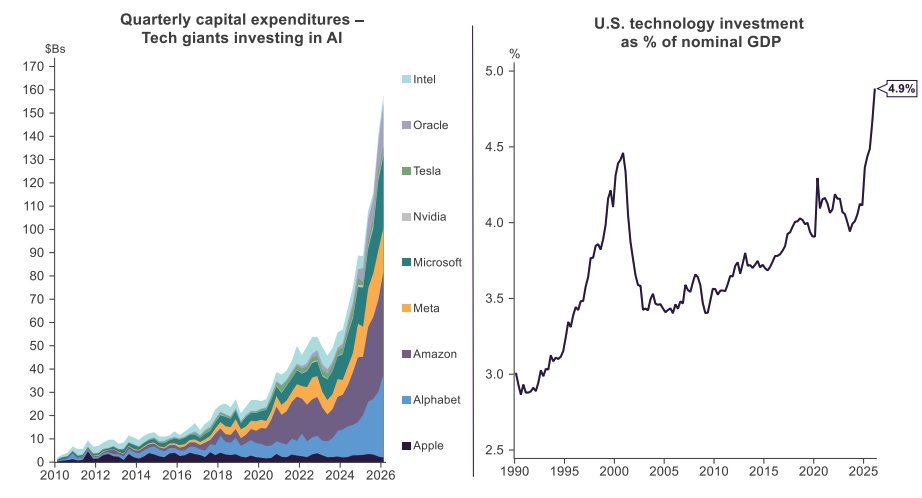
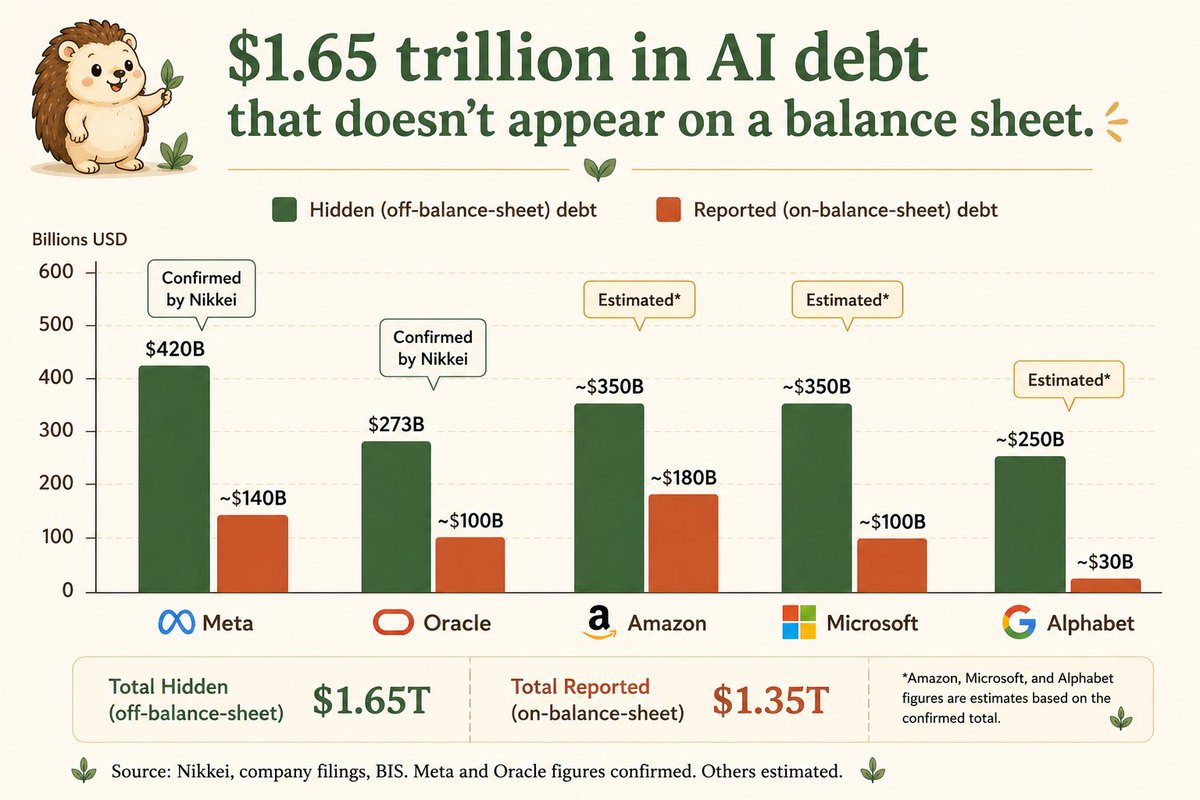
🦔A Nikkei investigation found that Alphabet, Microsoft, Amazon, Meta, and Oracle have $1.65 trillion in debt that doesn't appear on their balance sheets, more than the $1.35 trillion they officially report. These are GPU contracts, data center leases, and joint ventures that don't count as debt under accounting rules until the facilities go live. Meta's hidden debt is $420 billion, triple its reported debt. Oracle's grew 30-fold in four years. All five declined to comment.
My Take
Nikkei examined the actual filings and put a number on something the BIS already flagged as "shadow borrowing" back in March. These companies owe more off their balance sheets than on them, and the accounting rules let them keep it that way until the data centers go live. That's legal, but it means investors looking at quarterly earnings this week are seeing less than half the picture.
Four of these five report earnings in the next two weeks. The reported debt will look manageable. The $1.65 trillion in footnotes won't make the headlines. But when those data centers start operating, the leases hit the books all at once. If AI demand comes in below projections, those facilities get marked down and the losses land on the investors and insurance policyholders who funded the construction through private credit and project bonds without realizing how much total exposure they were carrying.
Hedgie🤗
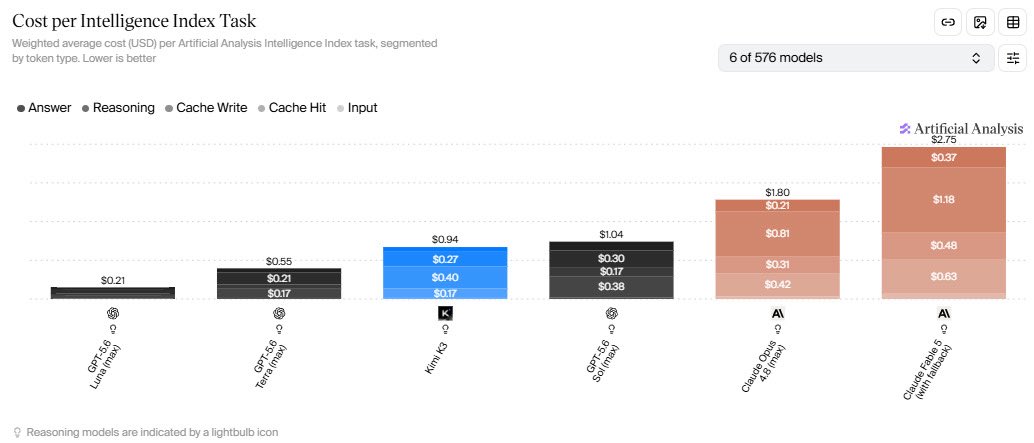
Kimi K3 may be an important inflection point for AI. Potentially negative for Anthropic and OpenAI while being net positive for essentially every other company in the world. I mean that very literally. Although the real “Sputnik moment” would be an open-source frontier model that was also token efficient unlike Kimi K3 which is 50-70% more expensive to run than GPT 5.6 per Artificial Analysis.
Rationale:
A world where there are only 2-3 dominant frontier labs with 90% inference margins is net negative for every other layer while being awesome for those 2-3 labs. Those labs would become monopsonies for power, data centers, semiconductors and hyperscalers and would obviously vertically integrate over time into all those layers while also completely subsuming the application/software layers.
Anything that lowers margins and increases competition at the model layer is good for every other AI layer: power, semiconductors, hyperscalers, neoclouds and yes even software.
This is why Jensen is so supportive of open-source. An open-source model requires the *exact* same amount of compute to run as a closed frontier model of similar size and architecture. Kimi K3 is roughly the same price as GPT 5.6 Terra on a per token basis, which actually suggests that it is less computationally efficient as I am sure that GPT 5.6 is priced to a higher margin than K3. And given that K3 is a token wastrel, i.e. token inefficient, it is significantly more expensive per task than GPT 5.6 and Grok 4.5, which are much more token efficient. Cost per token and token efficiency (i.e. intelligence density per token) are the drivers of intelligence per unit of cost. The winning AI companies will be those that offer the most intelligence per $ over time.
Lower margin % at the model layer = more margin $ at every part of the infrastructure layer and is a godsend for software. This can happen either through open-source models like K3 at the frontier *or* having a vertically integrated model company like Meta, SpaceX or Google at the frontier. Both outcomes result in a lower margin % at the model layer as vertically integrated model companies don’t really care where the margin $ come from. This is why it was so painful for OpenAI and Anthropic when Google was right there with them from a model competitiveness perspective and why Grok 4.5 and Muse 1.1 were just as important as Kimi K3.
The reason Kimi K3 is only *potentially* negative for Anthropic and OpenAI is 1) the @ericvishria point that the Claude and ChatGPT products and harnesses may be more important than their models today and 2) the hypothesis that they have much more advanced model checkpoints internally that are already being used for RSI. In the latter scenario, reaching RSI even a few months ahead of other labs might be enough to cement a permanent lead.
Time will tell on both points. And likely fairly quickly.
Caveat would be that since Kimi K3 is not token efficient and thereby actually more expensive than ChatGPT 5.6, we may need to see a more token efficient open-source model at the frontier or see Grok 5/Composer 4/Muse 2 at multiple points on the Pareto frontier for this potential risk to Anthropic and OpenAI to play out. And I am sure they will both vertically integrate as quickly as possible while continuing the product/harness strength they have shown over the last 8 months.
VIX is only the index-volatility headline.
VIXEQ is the Cboe S&P 500 constituent volatility index: it tracks the volatility priced into the underlying stocks. It is at 50.01, up +4.96 over 21 trading days, with a 1Y z-score of +2.44.
That means the index can look calm while single-stock movement stays hot.
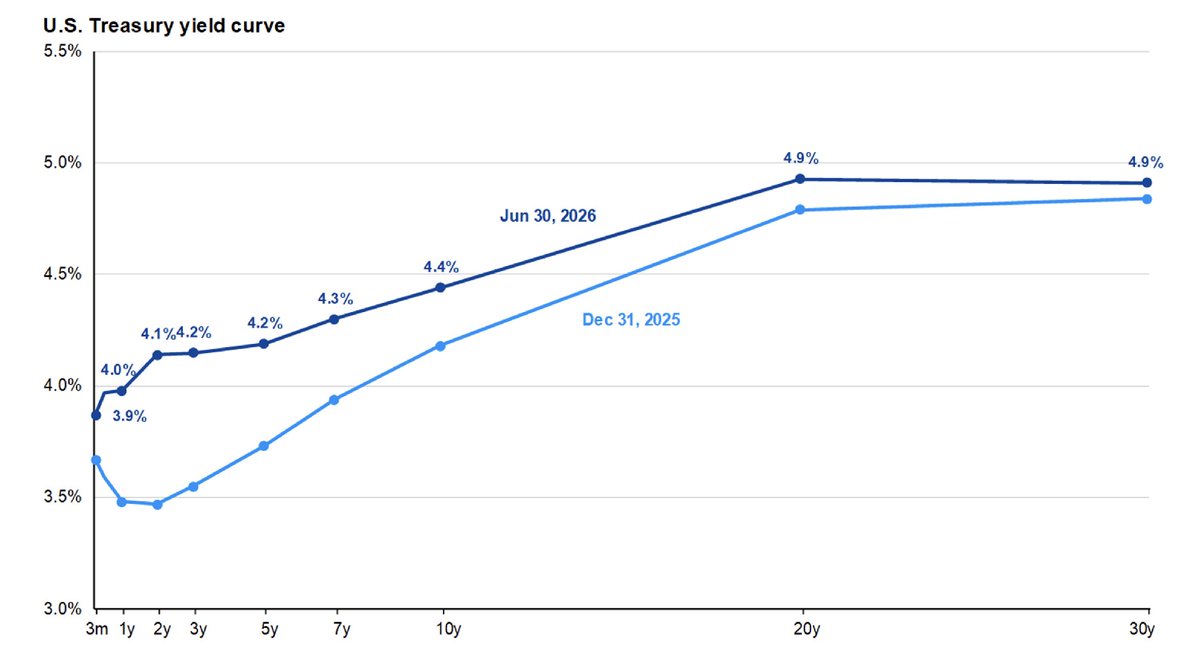
The Treasury yield curve has shifted higher across nearly every maturity in 2026.
Compared to the end of 2025, yields are now higher from the short end to the long end:
3M: 3.9%
2Y: 4.1%
10Y: 4.4%
20Y: 4.9%
30Y: 4.9%
The curve is no longer deeply inverted.
Investors are demanding higher yields to lend money for longer periods of time
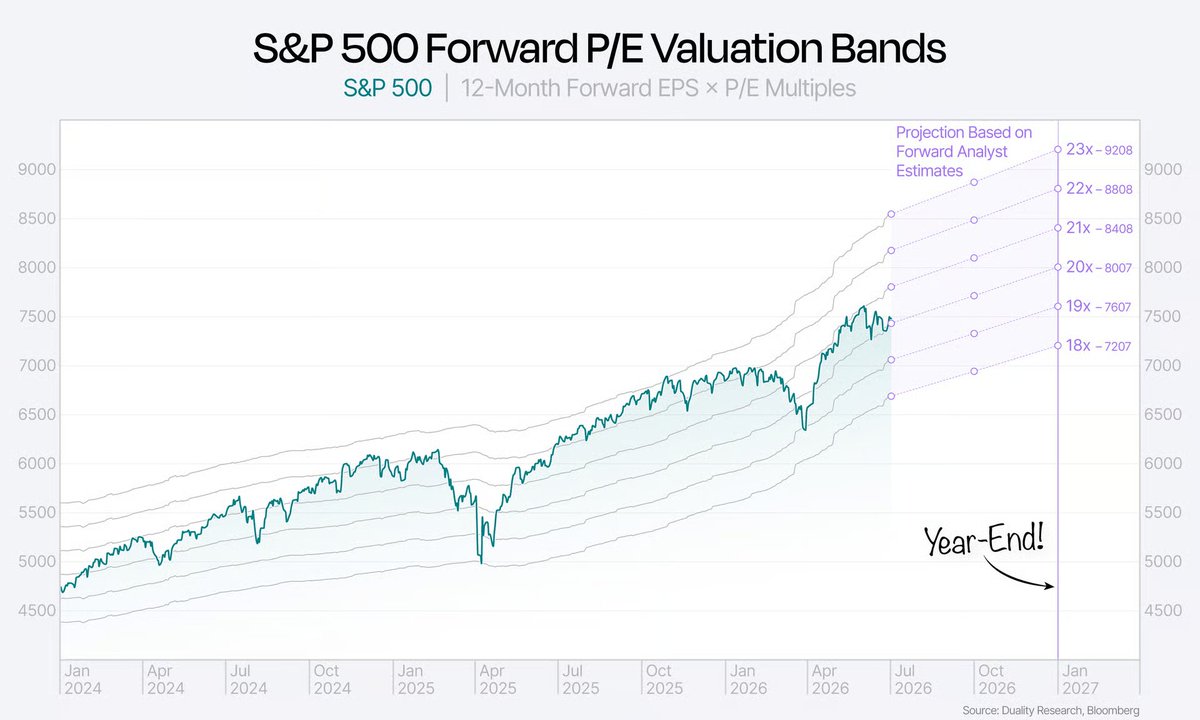
"Consensus currently expects 2027 EPS at around $400. If that number doesn't really change by year-end and valuations stay around where they are today, that gets you comfortably to around 8000 on the S&P 500."
@DualityResearch
Trump and his allies lambasted Obama’s Iran nuclear deal for a decade.
Yet their proposed deal is objectively weaker than the JCPOA: fewer conditions, more money for Iran, and less nuclear oversight.
My @Morning_Joe Chart












![dailychartbook's tweet photo. "CDS spreads [are] widening for hyperscalers. In contrast to overall IG CDS spreads"
-Apollo Slok https://t.co/DOLV0vvAxr](https://pbs.twimg.com/media/HNLg9M4WIAAA6si.jpg)