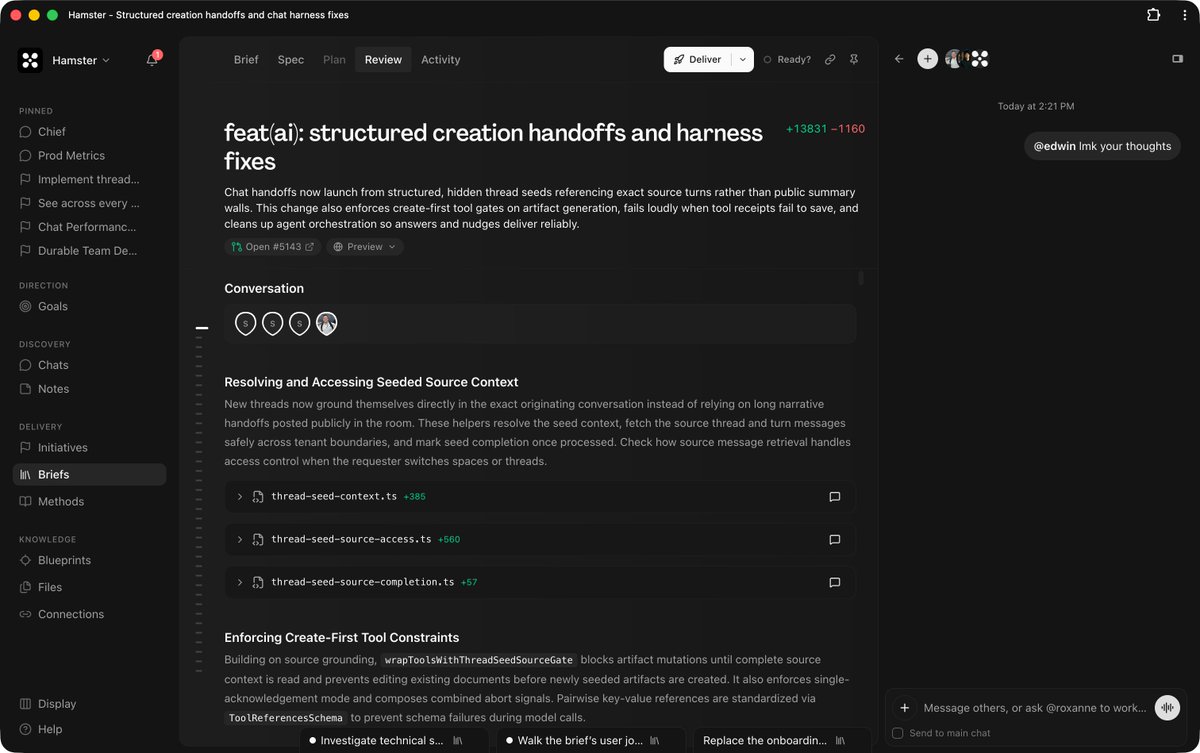
Parts of the SDLC have become a bottleneck. At @usehamster we're on a mission to break down these walls.
Rate of change in a codebase has gone crazy. It's hard to review. It doesn't have to be.
If you like the idea of using Glass but don’t want to wait, try @usehamster
It’s the multiplayer self-improving, self-healing workspace we’ve been working on for more than a year that streamlines the full SDLC
And it’s S-tier
- full direction loop for the whole team
- discovery and alignment across living artifacts
- cloud delivery across briefs and initiatives
- shared method and skills + a curated library of methods and skills to one click install
- routines for automating work across the team
- self-writing blueprints describing product that auto update as your team ships
- self-healing context graph with team decision intelligence and intent lineage to answer what was built, when, why and by who and who made the decisions
Built with love by the team who built @TaskmasterAI
New @usehamster update 🐹
Native PR reviews with your team! No jumping between Hamster and GitHub. Read diffs, leave comments + approve or request changes from Hamster directly
+ Trigger routines from @github activity. Easily handle PR follow-ups with zero manual intervention
"which quant should I download?" is a question you may never have to answer again
the team @HamsterResearch has figured out how to kill it with pMLX. download once at full precision (bf16) and the engine re-fits it to your machine on the fly, based on the job you give it
tell it two things: how much context you need, and the slowest speed you'll accept. it reads your mac and picks the quantization plus how many experts stay in ram vs. stream from disk. no need to download a smaller quant or figure out which quant fits your hardware. same model for every use case and the config changes based on what you need
I ran this on my own M4 Max and Qwen3.8-Flash-Next splits into two configs.
short context, under 32k: full bf16, ~85% of experts in ram, fast at full precision since it fits my ram
long context, 64k to 256k: keep ~70% bf16 and stream the rest from SSD at 22 tok/s, or drop to q8 and get 40 tok/s. I pick per task and the model itself never changes.
there are many possibilities since I have the ram to spar
- if i need speed, Q4 100% resident (74gb ram @ 62 tok/s)
- if i need balance, Q8 95% resident (76gb @ 38 tok/s)
- if i need accuracy, bf16 70% resident (96gb @ 16 tok/s)
given whatever RAM you have (16/32/64/128/256 GB) + your context + your min speed, the engine picks the precision (bf16→q8→q4) and the expert-residency/paging split that fits your box and maximizes quality & speed
last thing to optimize is speed. there are so many things we want to power with open models at @usehamster and these 180b-300b class models have the potential to play a big role in that
More Qwen3.8-Flash-Next breakthroughs, releasing soon in a new tiered model and supported by a custom MLX engine built by the @HamsterResearch team
- you only ever download the bf16 tiered model (upcoming)
- pMLX can quantize it up/down bf16/q8/q4/q3 on the fly
- 130-150 tok/s aggregate decode (crucial for sub agents)
- adjustable n-gram streaming from nvme
- adjustable experts residency ratio
- prune/REAP experts on the fly
- powered by pMLX
hundreds of config possibilities self-tuned from your hardware
examples for code-editing (which this decodes 1.5x faster):
- q4 @ 32k context, 95% experts in ram, n-gram in memory, 87 tok/s burst, 58 tok/s sustained (72gb memory), 149 tok/s aggregate
- q4 @ 256k context, 95% experts in ram, n-gram in memory, 87 tok/s burst, 50 tok/s sustained (74gb memory), 130 tok/s aggregate
- q3 @ 32k context, 95% experts in ram, n-gram in memory, 111 tok/s burst, 74 tok/s sustained (54gb memory), 190 tok/s aggregate
lowest memory footprint config: 12gb 🤯
- q3 @ 8k context, 30% experts in ram, n-gram on disk, 16 tok/s burst, 10 tok/s sustained (12gb memory), 29 tok/s aggregate
launch targets achieved, now packaging it up for you!
@wenhsu_@bot Yeah rate limits are terrible even for their highest tier. You'll get a day of using it as your core workflow orchestrator and then you'll be back to other tools.
We've been shipping @usehamster hard. Latest release feats global multi-chat, context graph visualizations & distinct thoughts + actions to keep everyone (and everything) within your product team in-sync.
We're trying to really ramp up its capabilities to just eliminate the busy work.
@pinesheet@jaredpalmer Worktrees + portless + either remote db containers or per-worktree spin ups will help you there. But granted it doesn't solve the problem quite so elegantly as cloud agents
the highest value thing a context graph stores is why your product ended up this way
llms trend toward the average. that's fine until you're implementing, because general models fill in the corners with decisions that are directionally correct and subtly wrong, and those come back to bite you in the ass weeks later when you're debugging something you never chose
this works for disposable discovery work that eventually leads to decisions but if you're shipping production code this way, you'll inevitably decide planning ahead is the fix
but there's a catch. if you ask ai to lay out the options for you and it hands you four generic choices, you just moved the averaging one step earlier in the process
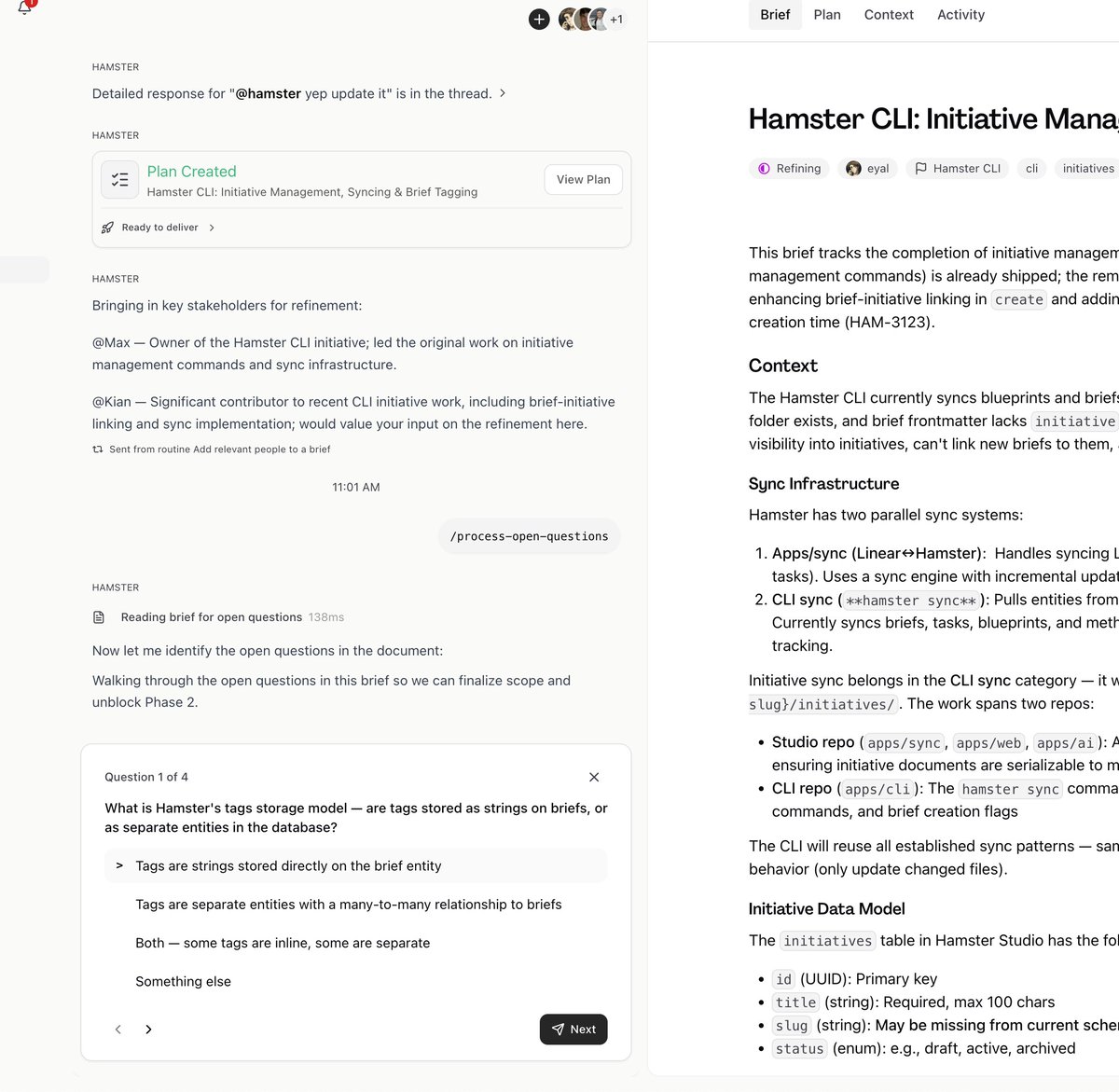
this is a question hamster asked me this morning while refining a brief. the options aren't generic. they came from decisions we already made and recorded. they're things that matter to us that it knows to surface because the context graph contains these types of decisions.
your past decisions are the highest leverage context you have. everything else is just documentation.
@CoreWeave@usehamster It's been amazing working with CoreWeave inference. The uplift we saw in both speed + quality when we fitted our harness around it was insane 🚀
Introducing Hamster 🐹
Multiplayer AI for product teams. Hunch in, PR out.
Design, engineering, product, & business reason on the same work, and your agents deliver it.
Your team makes a hundred decisions a week. Now your AI remembers all of them.
https://t.co/jBVCraq4ry
Introducing Hamster 🐹
Multiplayer AI for product teams. Hunch in, PR out.
Design, engineering, product, & business reason on the same work, and your agents deliver it.
Your team makes a hundred decisions a week. Now your AI remembers all of them.
https://t.co/jBVCraq4ry
our context graph came to life today
- full decision lineage
- self-healing, self-updating team state
- graph expanding as the team works
- knows why we did what did when we did it AS WE DO IT, across the whole team
everyone’s building infrastructure to read organizational knowledge. we’re building where it gets created. it’s what happens when alignment generates context as exhaust instead of losing it to slack threads
holy shit we are never going back
@hshah18@linear@karrisaarinen You're describing @usehamster, the AI-native workspace for product teams, where context compounds, and your whole team refines and aligns.
The age of the product wiki that nobody keeps up to date has passed.
And Hamster two-way syncs with Linear (who we love).