what the f*ck is this trading terminal. I'm genuinely shaking
it texted me "goal 5× done. keep going?"
I said yes
$1,500 → $9,087. 23 seconds. I touched my phone twice
this thing is unhinged. there's a little ball with eyes in the corner that watches every trade and squints when it makes money. it skips coins, buys coins, sells coins, and then messages me like we're friends
it's Grok Bot inside my RUGIKK terminal
→ GROK SCOUT buys whatever's about to trend on X
→ SNIPER gets in at block 0
→ CURVE rides the bonding curve
→ GRADUATE sells the second a coin graduates
the actual texts:
→ "skipped $DEVBAG · dev holds 31%"
→ "18K posts on X → buying $XCAT" → +$262
→ "skipped $FREEMINT · 41% bundled"
→ "$BLOOP about to graduate → in" → +$512
→ "skipped $LASTONE · same dev as a rug"
→ "40K posts on X → buying $XPEPE" → +$690
→ "goal 5× done. keep going?"
→ "sent $7,587 to your Phantom"
22 trades. 20 wins. 2 losses: -$38 and -$54
it skipped more coins than it bought. that's the entire trick
the rules:
1. dev holds more than 10% → skip
2. bundles over 25% → skip
3. same wallet as an old rug → skip forever
4. it asks before going past the goal
5. money leaves only when I hit withdraw
people are still paying for calls in Telegram while this little guy asks me "keep going?"
comment "BOT" and I'll send you how it works
illustrative build, numbers simulated
Claude Code found spyware on my sister’s phone. It had been tracking her for 11 weeks…
She asked me to check her phone. Someone always seemed to know where she was and she couldn’t figure out how
I plugged it into Claude Code and asked what’s running that she never installed. It walked every app, including the hidden ones, and flagged one disguised as “System Service”, no icon, not on any store
It had been there 11 weeks, logging her location every 2 minutes. Claude pulled the details on whoever was running it:
reports to → +1 (415) *** **72
carrier → T-Mobile US
device id → IMEI 35 ********** 47
last ping it sent → 40.7**, -73.9** · 2 min ago
We saved everything the app had recorded and passed it to the people who do this professionally. Then Claude shut it down and wiped it off her phone
The full step-by-step is below, takes 5 minutes. Save it so you don't lose it, and send it to anyone who might need it
this is the most DANGEROUS thing on internet today
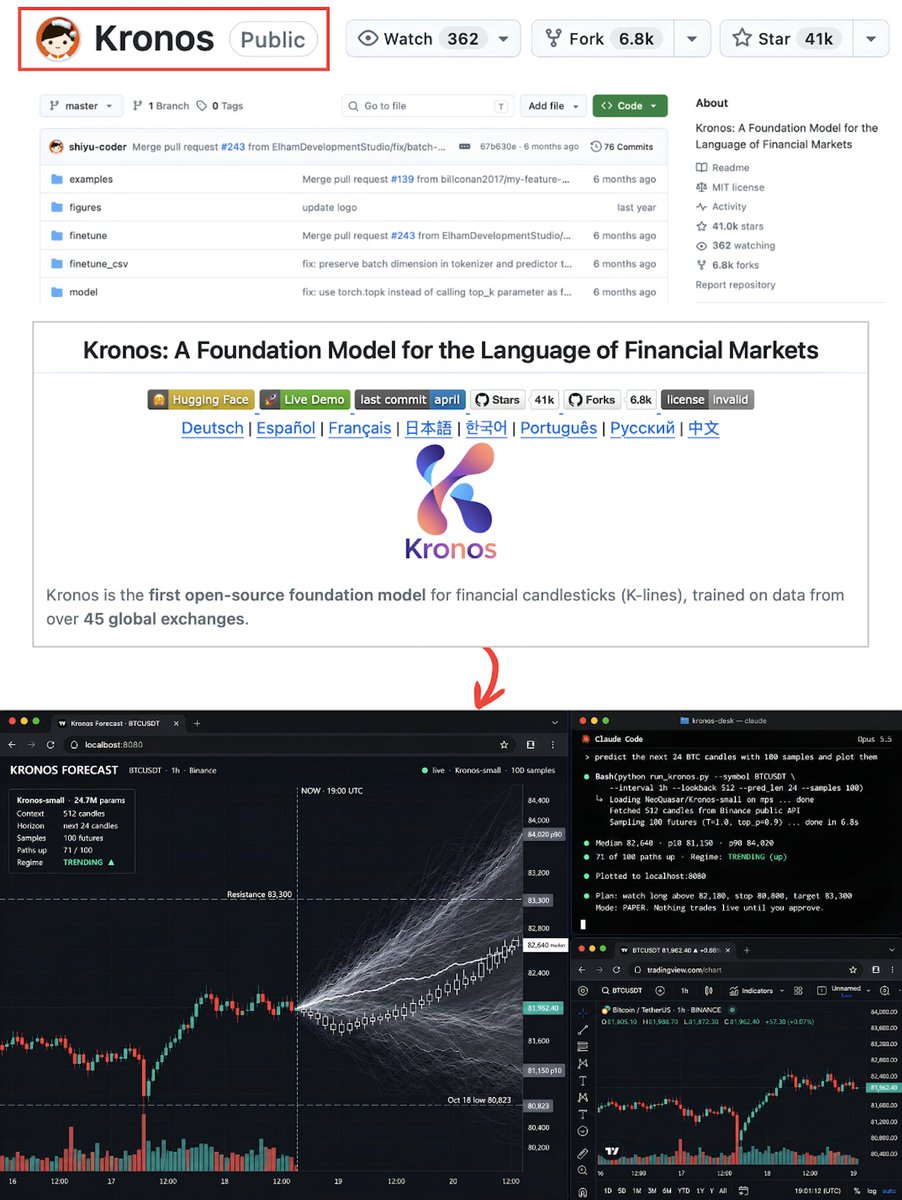
someone built an AI that reads candlestick charts the way GPT reads English & released it for 100% FREE
i just connected it to my TradingView setup with opus 5.5 & now my AI trading system reads every candle & predicts the next market move BEFORE it happens (ACCURATELY)
first understand how KRONOS works:
> LLMs like ChatGPT or Claude turn words into tokens & predict the next word
> Kronos turns every candle into tokens & predicts the NEXT CANDLE
> it is pre-trained on 12 BILLION candles
here is how to build the full system for FREE:
1. open Claude Code with Sonnet 5.5 and ask it to clone the Kronos repo and set everything up, it handles the install for you
2. now switch to opus 5.5 and give prompt to load Kronos-small from Hugging Face, it runs on any normal laptop (i am running on my MAC M5 pro)
3. it will pull the same candles you see on TradingView from Binance’s free public API, any coin, any timeframe, open, high, low and volume, no account needed
4. ask Opus 5.5 to feed Kronos the last 512 candles and predict the next 24, exactly like asking an LLM to finish a sentence
5. set sample_count to 100 so Kronos draws 100 possible futures instead of one guess, the spread between them shows how risky next move really is
6. let Opus read the market regime from those futures, most paths pointing the same way means TRENDING, paths scattered both ways means CHOPPY
7. have Opus turn the forecast and the regime into clear entry, exit and stop rules, then backtest them on a year of history with real fees and slippage
8. then plot Kronos’s predicted path next to real candles using TradingView’s free Lightweight Charts library & watch it for a few days before you trust it
9. paper trade it first, then let Opus wire up Telegram bot so your phone pings the moment a high confidence trending setup forms
if you want to build an AI trading system from scratch, start with this article below:
An Anthropic engineer literally stopped me at a coffee shop because of what was on my screen.
I was sitting at Sightglass running my Polymarket bot.
He looked over once.
Then again.
Then said:
“That’s not a normal trading setup.”
I told him the whole thing runs on:
• Claude Code
• 4 open-source repos
• $25/month
That’s it.
He pulled up a chair instantly.
“I work on the agent team at Anthropic,” he said.
“We stress test Claude for workflows exactly like this.”
Then I showed him what the bot was actually doing.
86 MILLION trades analyzed.
Every wallet.
Every entry.
Every exit.
Every profitable pattern.
One prompt:
“Find wallets with 100+ trades and 70%+ win rate. Rank by profit. Export the best ones.”
Claude scanned 14,000 wallets in 4 minutes.
Returned 47.
The top 20 wallets made more money than the other 13,000 combined.
He stared at the results and said:
“That’s not data analysis.
That’s a weapon.”
And we were just getting started.
Second repo:
A Rust CLI scraping 500 live Polymarket markets in minutes.
Claude filtered everything automatically:
• spread gaps
• liquidity depth
• timing windows
• whale behavior
500 markets became 35.
Before I even looked at them.
93% rejected automatically.
Then a trade closed live on my screen.
+$84.
He didn’t even blink.
“How does it decide when to enter?”
3 independent AI agents:
• arbitrage
• convergence
• whale-copying
No shared memory.
2 agents agree = full position
1 agrees = half size
Disagreement = no trade
That consensus system alone cut 40% of losing trades.
Then he asked the real question:
“What about exits?”
That’s where it gets stupid.
The profitable whales rarely hold to settlement.
91% exit early.
So my bot exits BEFORE they do.
It takes profit at:
• 85% expected move
or
• unusual volume spikes
Basically:
It copies smart money…
then front-runs their exits.
He just sat there staring at the terminal.
“How much did you start with?”
$200.
27 days ago.
Current balance:
$14,300.
271 trades.
74% win rate.
Sharpe ratio: 2.47.
Fully automated.
I haven’t touched it in weeks.
Before leaving he said:
“This is almost identical to the internal scenarios our red team simulates.”
Next morning I got an email from him.
“Would you be open to speaking with our policy team?”
I replied:
“The article IS the meeting.”
The craziest part?
This stack costs less than Netflix.
AI is no longer replacing workers.
It’s replacing entire hedge funds.
Comment “Claude” if you want the framework.
if you want to build an AI trading system from scratch, start with this article
you will end up with real market data, real backtests and a bot that trades for you 24/7 https://t.co/7bOgT1HCZf
Jev is the FASTEST AI model ever built for trading
It makes calibrated buy/sell decisions in under 100 ms
That is one real decision on every single block, 24/7
In this article I've shown EXACTLY how to build HFT trading system with Jev (from scratch) https://t.co/4hmZDzN00Z
this is the most DANGEROUS thing on internet today
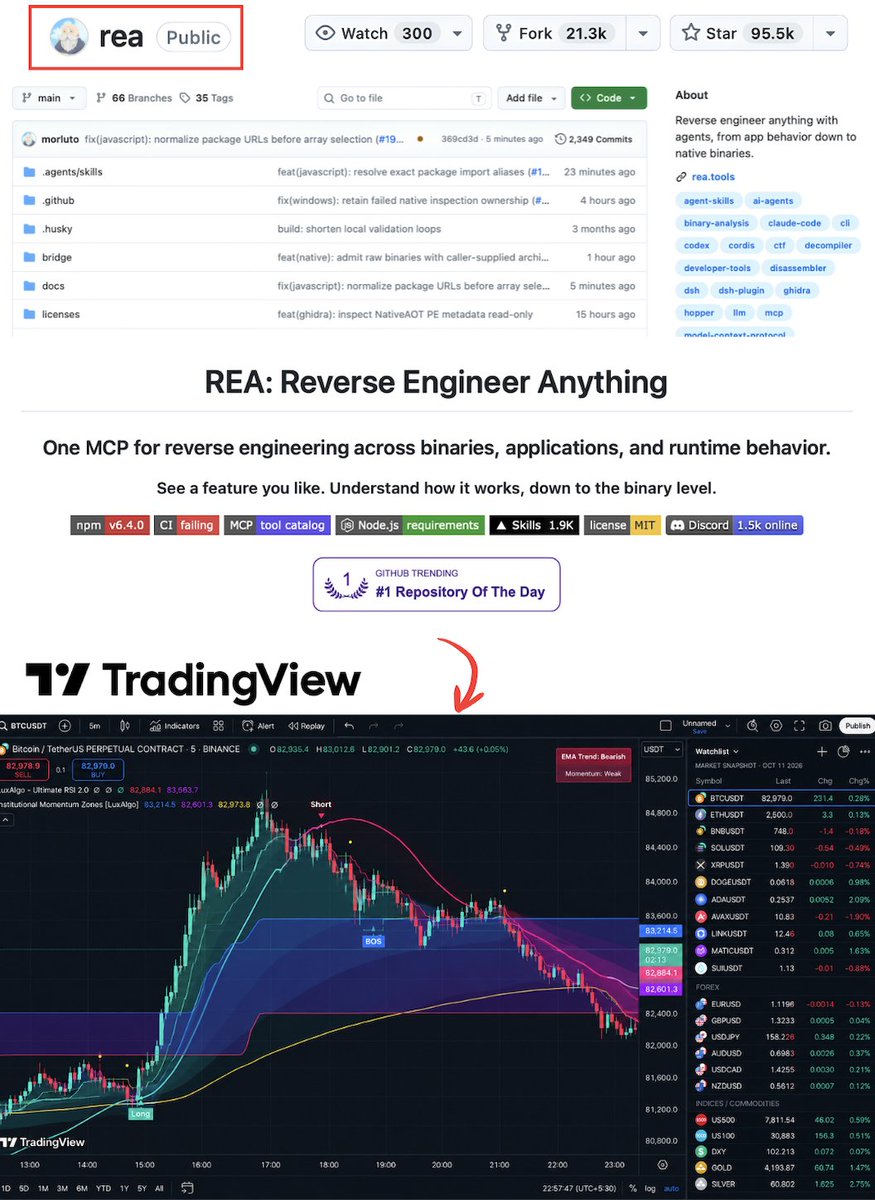
REA (Reverse Engineer Anything) - this open source MCP lets your AI agent reverse engineer any app, down to the binary
i just reverse engineered TradingView, now I am using their premium indicators for FREE - software is cooked
here is how to use REA to reverse engineer TradingView:
1. point REA at TradingView's publicly observable interface and map every major feature, from chart interactions to indicators and alerts
2. trace how the interface behaves when you switch symbols, change timeframes, add indicators, draw levels, and update chart layouts
3. use REA's available MCP tools to investigate authorized software artifacts and trace application logic wherever the evidence allows
4. feed those findings into Claude Opus 5.5, which turns the investigation into a technical specification and an implementation plan
5. rebuild the charting engine independently, with real market data, candlesticks, technical indicators, drawing tools, and persistent watchlists
6. add a quant backtesting engine that tests strategies against historical data, accounting for fees, slippage, and drawdowns
7. test every component, compare its behavior against documented and observable results, fix failures, and keep iterating until the system actually works
8. you end up building your own TradingView-style quant research terminal from scratch, with source code you control and features you can keep extending
i won’t say anything more: