People love to hate on data businesses...
but the companies teaching robots today may have an advantage in deciding where robots work tomorrow.
A well run data company collecting inside real businesses learns much more than how someone moves their hands.
They Have a Customer Development Advantage
If they take the time to get to know the owners, the floor managers and the workers, they'll learn which tasks are expensive, which jobs are hard to staff and which problems repeat across customers.
Owners explain where the money goes. Employees show why the work is harder than it looks.
That’s customer discovery most robotics startups work very hard to get.
Compensating participating workers and businesses can create income while helping build those relationships.
An excited, high agency collector can identify a promising task, deliberately collect the right data and recruit the technical team to automate it.
Distribution Advantage
Potential pilot customers are already in the network.
Mecka already describes expanding from data collection into robot integration and ongoing operations. MicroAGI is doing the same thing in Europe. And now XDOF is rumored to be working on a humanoid.
Gross Profit Advantage Can Unlock New Hires for Skills The Team Doesn't Have AND Subsidize Deployments More Heavily
The gross profit that companies make off their data contract can unlock the ability to hire world class talent to help them cross the chasm from a data company to a deployment company. It also can enable them to subsidize deployments AND many more of them vs. the competition who won't have as high of revenue or gross profit coming from another profit pool.
Data From Dozens of Plants Abroad Can Make U.S. Deployments Faster and More Successful
There’s an international opportunity here too. Experience with similar equipment and processes overseas could give a company a head start entering the US in specific industries.
Deployment still requires reliable hardware, model training, integration and service. Collection access alone doesn’t provide those capabilities or unrestricted training rights (also need non-exclusive data contracts with the labs), but if these businesses work on similar equipment and alongside similar processes internationally they'll be able to pick a better task to start with, likely post train a model to do that task quite well, which lowers the cost to serve and improves the performance, and they can potentially show evidence to U.S. companies of successful customer deployments abroad.
At the end of the day this is just one approach, but I think the advantage is meaningful and we shouldn't write it off.
Trillions of dollars are up for grabs in the next couple of decades and many winners across many geographies will make money in many ways...and this is definitely one that could work if executed on well.
In summary.
The dataset helps you understand how work gets done. The customer relationships help you turn that understanding into a business.
During pre-release testing, Claude Fable 5.2 and Claude Mythos 5.2 worked on ambitious projects in many different fields. Here are a few.
From a one-paragraph prompt, Fable 5.2 designed three working electronic devices, including this home voice assistant hub.
THIS IS F*CKING UNFAIR
YOU'RE RUNNING CLAUDE AT 18%. THE PEOPLE WHO SET IT UP RIGHT GET 95%. SAME MODEL. SAME SUBSCRIPTION.
claude code has a flag almost nobody types:
claude --model sonnet --advisor opus
sonnet 5.5 drives. haiku 5.5 does the crawling. opus 5.5 only shows up when it matters
opus 5.5 costs 60x more than haiku 5.5. and you're paying it to grep files
price per million tokens, from the guide below:
→ opus 5.5: $15. architect and judge
→ sonnet 5.5: $3. writes the code
→ haiku 5.5: $0.25. checks every tool call before it runs
→ fable 5.5: $2.50. attacks the diff looking for bugs
18% in a raw chat vs 95% in this setup. his numbers, not anthropic's
the part that got me: in a raw chat agents still write "all 48 unit tests passed" without running a single test
here a separate model has to prove it before git lets the commit through
paste this into claude code ↓
"set up my claude code around 4 roles:
1. main session on sonnet 5.5 with opus 5.5 as advisor
2. haiku 5.5 subagent: checks every bash call and runs the tests
3. fable 5.5 subagent: skeptic. tries to break every diff, replies approved or rejected
4. no commit without an approved verdict
show every change as a diff first. no edits until i say go"
his full 7-stage harness is in the article below
which model is burning your limits right now?
I actually agree with a lot of what @poteto is saying except for the central point. IMO most people don't have actual software factory systems. They've just made it much easier for people to ship with AI, so they assume the category doesn't exist. That's more a lack of vision than anything else.
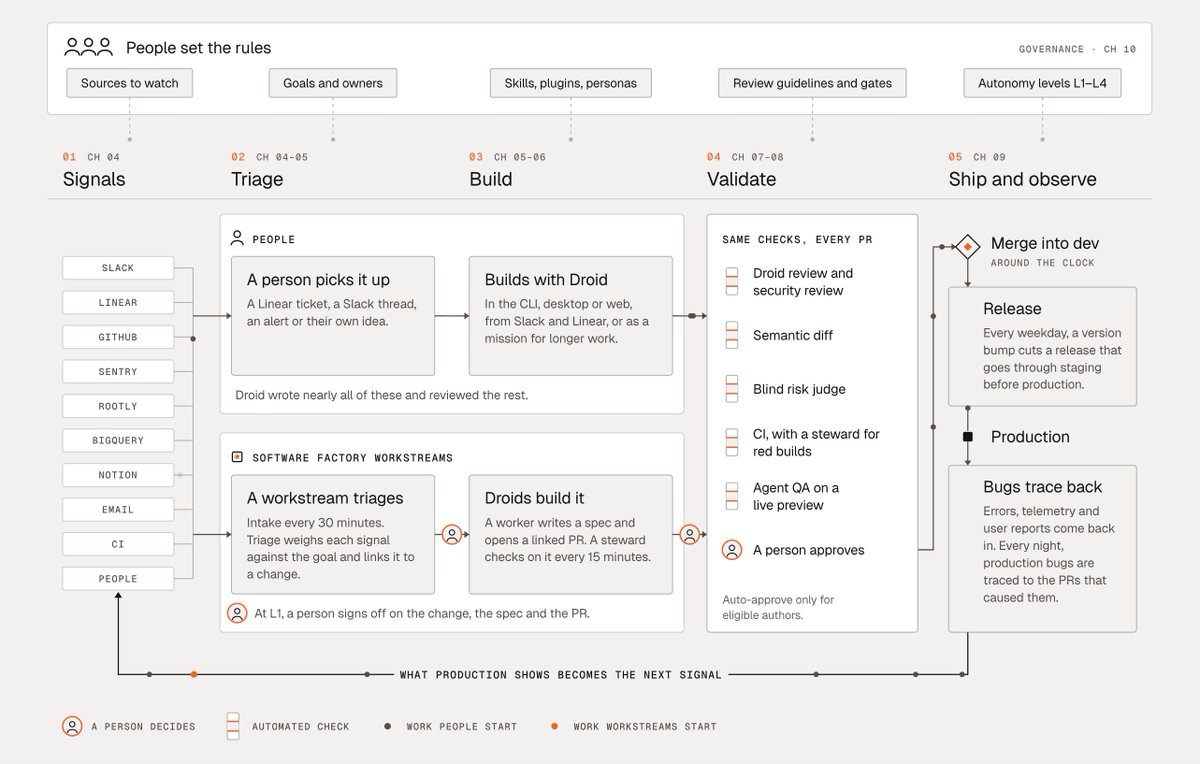
Our conceptualization of a software factory is a system where every piece of work goes through the same stages to standardize the process not the work output.
For us, this standardized process begins with what we call a signal. This is anything that tells you how your software should evolve, including the first signal that your software should exist at all. A Slack thread, a Linear ticket, a Sentry alert, a failing CI job, a tweet, someone's idea.
There's two ways in for a signal. A person picks it up and builds it with Droid, or a workstream picks it up on its own, triages it against a goal someone set, and has droids write the spec and open the PR. Most work still starts with a person, but a growing share comes from workstreams.
Then every change goes through the same checks no matter who or what wrote it. Droid review, security review, a risk judge that can't see who wrote it, CI, and an agent that QAs it on a live preview. Your validation has to be really high quality whether a human or AI built it. The goal of validation is to hillclimb your "regret-free merge rate" until you can automatically merge most changes (or fix them until they can be automerged).
Then it ships, and when something breaks in production we trace it back to the PR that caused it. That becomes another signal. It's also how we know if the checks actually work. If the risk judge approved something that later broke, we find out.
It's the same way we let self-driving cars on the road. Nobody just flipped a switch. We agreed that once they crashed less than human drivers, they could drive. Do the same thing with code. Once AI-written changes break things less often than human ones, and you can actually measure that, you let them merge.
That doesn't mean you turn on automerge tomorrow. Most of our changes still get a human stamp. But once you have automerge, workstreams and a risk score together, you basically have software that improves itself from the signals you choose to track.
The human element becomes obvious if you have a system like this. People remove themselves from the actual process line and begin to define the rules by which the process operates. What to watch, goals and owners, skills, review guidelines, and how much autonomy each workstream gets. They're the regulators.
I think the 1920s factory that a lot of people picture is the wrong idea. That was people doing the same motion on a line all day. This is closer to a Star Trek replicator. You say what you want and it gets made, because the patterns are already stored and how things get made is the same every time, and checked every time.
I spent the last year living between Lagos and Nairobi...
Nigeria in particular has one of the fastest growing economies in the world. Yet three years ago, its currency, the naira, lost more than half its value.
To defend it, Nigeria’s central bank pays 21% for people to hold naira, among the highest rates anywhere.
Until now, those yields have been hard for most people to reach
Numo is a futures market for currencies like the naira where businesses can buy dollars at a fixed rate and traders can buy naira.
We’re on a mission to make the world’s most volatile currencies stable.
my spidey senses are telling me the labs are, as we speak, using unguardrailed versions of their unreleased models to systematically reverse-engineer ALL of the internet’s software, apps, and games, then feeding the reconstructed source code straight into their training pipelines while simultaneously building guardrails to ladder-pull the rest of us
Building tomorrow’s operational power today! 🚀
Developed for the Bayraktar TB2, the DAGGER POD brings a new dimension to operational capabilities: it can deploy up to 16 SKYDAGGER FPV drones, and it’s modular design adapts to multiple platforms.
We don’t stay within boundaries. We redefine them.
#baykar 🤝 #skydagger
BREAKING: Revolut moved ~2,000 engineers onto self-hosted GLM for coding and pushed Claude Code and Codex to the exception list.
Per David Abitbol, who leads AI ops there: 56 Nvidia B200s, a blended 30 cents per million tokens, roughly a tenth of what they paid Anthropic and OpenAI. Engineering lead time improved 70%.
Here's the part that matters: the gains showed up when tokens stopped being rationed. Engineers quit saving AI for the hard tickets and pointed it at everything.
Frontier models become the exception, open weights become the default. That's a pricing problem for every lab heading to IPO.
h/t @OliverMolander
Would you move your team off frontier APIs if the bill dropped 90%?
Woah Google in early talks to help secure data for Golden Dome
Palantir, Anduril and SpaceX connecting sensors while Google holds data
https://t.co/5rKQSyAlDo
Google $GOOGL is reportedly in early talks with the Pentagon to help secure data for the $185B Golden Dome missile-defense program, according to Bloomberg.
Google could provide cloud storage, networking, and cybersecurity technology, while Palantir $PLTR, Anduril, and SpaceX are separately working on connecting military sensors and defense systems.
No deal has been finalized, but this could open another major opportunity for Google’s cloud and cybersecurity businesses.
I’m looking for work. Now my résumé is accepting sponsors.
Founding sponsors: @reserveprotocol (the company that laid me off 🥲) @partyactionppl, and @asimov_co
5 spots left, 3 tiers. Your company’s logo in front of every hiring manager I contact
https://t.co/5qwMNyuHyv
My college dorm project just broke the world speed record.
Reaper hit 790 km/h (491 mph) carrying a 1.2 kg (2.6 lb) payload.
These 3 Reapers are now the world’s fastest small jet-powered drones.
Each of them can hold that speed for 4 minutes on a full tank.
Reaper can be rail- or truck-launched, climb to 2,000 m (6,600 ft) in under 20 seconds, then fly for 50 km (31 mi) at full speed.
This is now a reliable and repeatable system. Future testing and small optimizations should push the top speed past 800 km/h (500 mph).