On the watchlist! Anyone talking about China missing the point that (a) it’s a smaller drag on profits today — went from mid/high teens of revenues to 9-10% and (b) 90% of EBIT comes from service (maintenance & repair and modernization).
Issue is mgmt. credibility. CFO missed expectations in all but one of the last 8 quarters, indicative of an inability to set expectations.
That said, they’re doing the right things to fix their maintenance customer issues; just need 1-2 qtrs. of solid results to believe they’ve got a clean grasp of the business.
I know this is garbage engagement bait, but I think it's worth calling out this mindset for the young kids that get hooked on hustle culture, or think of abusively hard work as something virtuous.
A few things I have learned to be true:
1. One day you will be dead and shortly after nobody will remember you. They certainly won't give a shit about your work. The ones that do will be the people you loved and who loved you. Not your stakeholders, colleagues or business associates.
Shit, most people forget about you the day you change jobs. Even the CEO. Once you leave, you just kind of...fade away. Your work mostly doesn't matter. Also, as you get older you start to watch people die...way way earlier than they should. You genuinely don't know how much time you have. Do you really want to spend it all hustling...or even worse...pumping out engagement slop celebrating hustle culture?
2. More people are like Walter White than they care to believe.
At the end of Breaking Bad, Walt finally confronts the truth. He wasn't doing it for the family. "I did it for me. I liked it. I was good at it. And, I was really... I was alive.” Most people find value in their work, which is great. But my old man gave me incredible advice when I was younger, "Beyond a certain point, a successful career is a selfish act." The people who really get themselves into trouble are the ones who convince themselves they are doing it for someone else.
3. You don't know the cost until too late
I've watched friends wreck their health and their relationships chasing the next promotion, the next round, the higher salary. Justifying each step along the way as the right thing to do. Mostly they were just addicted to the work. Or they felt trapped. I don't think any of them would have made the trade if they could go back and know the cost from the start.
@F_Compounders Seen this to the round on X. I’m a little lost. Why does a book full of stock charts be valuable to a fundamental investor? Please lmk what I may be missing
A wise man once said:
"Lot of people seem to forget that a stock that doubles in three years is a 26% CAGR, independent of which year the returns actually come."
~@ragingbullcap
The piece was good. Just adding on top of what @Fred_Abyss said:
1. Lifetime unit sales of S2. If 3DS sold 50% of DS on a nominal price difference of 13%, can S2 sell 50% of S on a nominal price difference of 50%? I’d argue revenues is what matters, and a 50% price premium requires S2 to sell 37% of S to match S on revenues. Second counter is that you’ve got to look at an inflation-adjusted figure. Doing so collapses the S2 to S price difference down to about 15%
2. Software attach S2 vs S. Good call out. Console economics break when attach is lower, but similar to above, have to consider revenue impact. If the incremental software attached comes at a higher price, S2 doesn’t nearly need as much to match S1 in software revenues
3. Memory pricing. Fully agree here. Look at $HSY $MDLZ to see how they traded when cocoa began to inflate. Risk for downward revisions is high at the earlier part of the inflation curve. No telling how long memory will remain inflated, but if $SKHY’s gross margins is of any guide, we’ve got another 2-3 years of high memory prices before seeing signs of deflation. That said, consider whether 22x P/E is on depressed earnings
@JohnHuber72@valuefisherman So I’m a little confused at your comment about an overstated incremental ROIC given a characteristic feature of any sound accounting policy is matching revenues to expenses.
@JohnHuber72@valuefisherman I believe AMZN depreciates on a straight-line basis, so asset cohorts depreciate at a constant rate over time. Maybe you’re referring to D&A to capex mismatches where $100 in capex spent today doesn’t get depreciated til the asset comes online, but revenues aren’t booked either
$SFM think the stock is cheap here. 50% upside on my numbers vs 20% downside in case comps take longer to normalize to 3%.
Substack post (free) in comments.
Yep, Buffett has almost always had some level of leverage: starting with his personal account in the early 50’s, to his partnership where he often was 125% invested, to Berkshire where he has typically has had around $1.50 of assets for every $1 of equity. I think his portfolio construction in his early years should be studied more. The diversification (in number of stocks and type of strategy) is underappreciated imo.
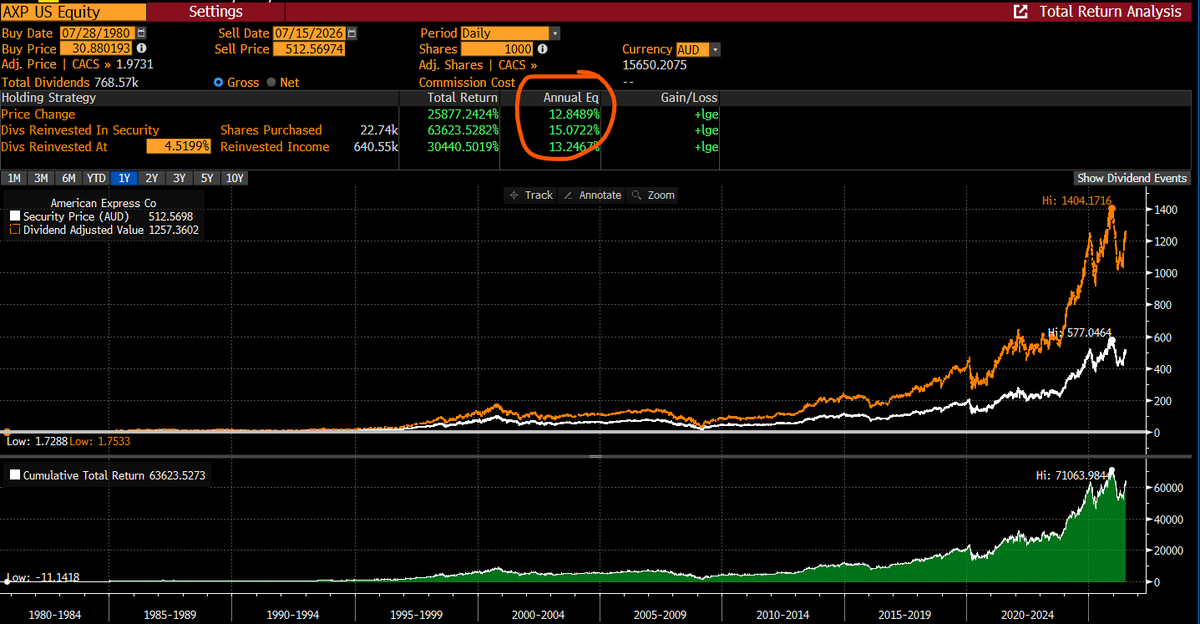
Buffett .. July 2026 .. Becky Quick interview .. STILL TEACHING....
"... if you take something like American Express, there are, most of the banks earn 13, 14 percent on capital.
If I asked everybody to guess what American Express would, they would come up with some figure similar, but it’s so different that it earns 30 percent-plus on capital and does not incur more risk in doing so than the banks that earn 13 or 14 percent.
And the trick in life is to find, I mean, in investing, is to find businesses that are going to earn high returns on capital for an extended period of time.
And that’s what happened with Berkshire for a long period of time.
A long period of time gets to be very important, because it doubles later on the, of very big numbers."
As a younger man, I probably would have dunk on this guy.
As an older man, I read this, look in the mirror, and ask myself: how different am I really from this ?
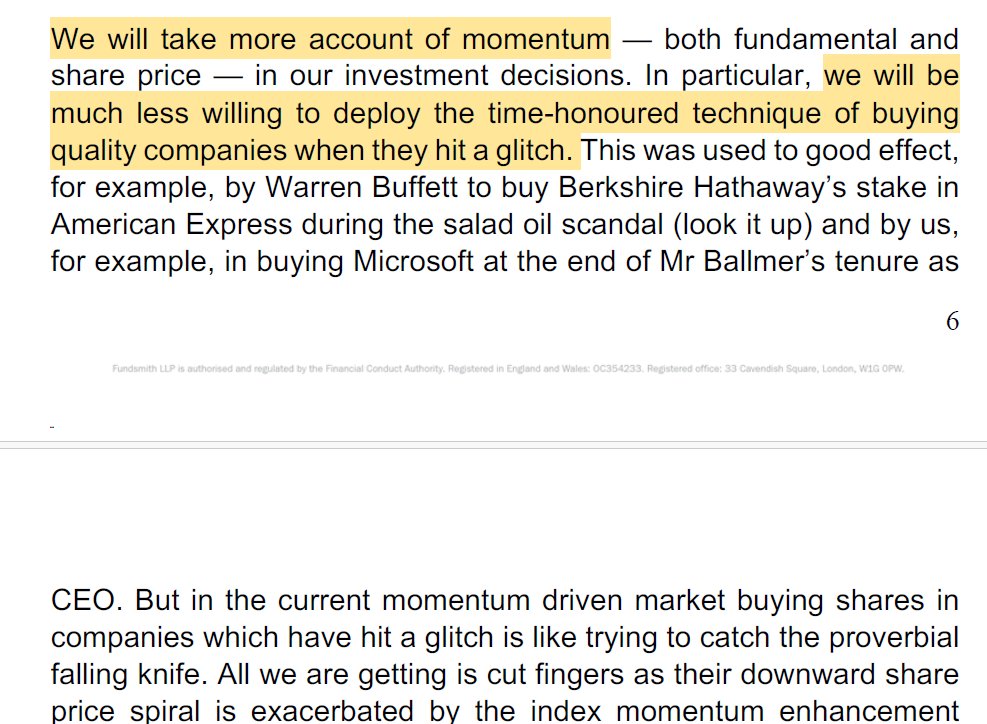
Very confused what this dunk on Terry is all about. The man runs an open-ended fund structure subject to outflows at a time when liquidity pipes of markets have changed. He optimizes for survival by incorporating FUNDAMENTAL momentum into his process. What’s wrong with that?
This is what the beautiful game is all about.
A young Cape Verde fan shows love to his team after the hard-fought battle with defending Champions Argentina in the Round of 32 🇨🇻