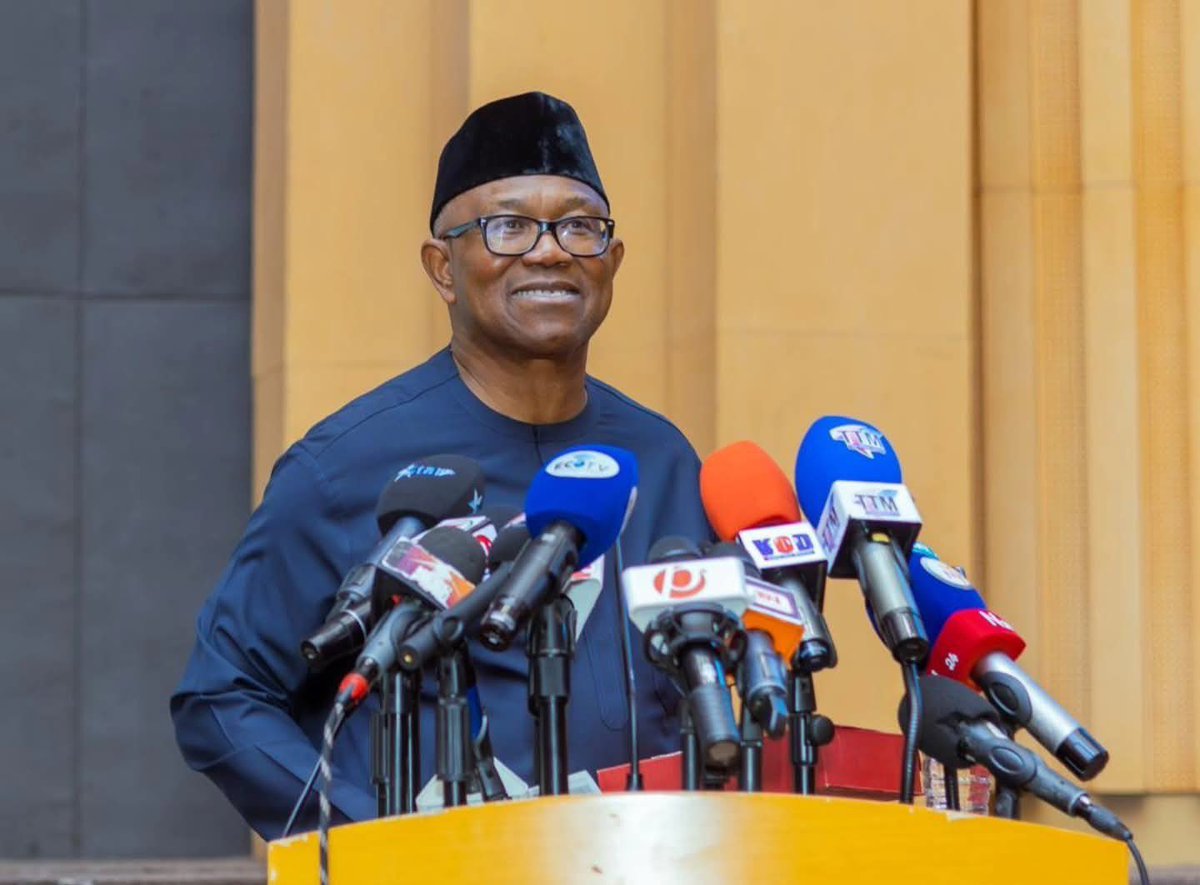
"Police released Armed Fulani Militia, we arrested & gave them their AK-47's back to them"
Gov. Udom - *"We arrested persons with fake army uniforms carrying 18 AK-47's rifles and handed them over to the police"*
However, the police hierarchy gave express orders that those persons should be released and their guns handed back to them.
We want to let the world know that if there is a breakdown of law and order tomorrow, the police should be held responsible.
All attempts to speak with the top hierarchy of the police in the zone and at Abuja were rebuffed.
- Gov. Emmanuel Udom. Akwa Ibom State.
🙇🏾♂️ 🙇🏾♂️
When the government wants to work, it will work
A government that can build this in 24 months can also build a 1004 complex of one and two-room apartments in Abuja, and destroy the high cost of rent and win elections
The same way the government used solar to power itself out of darkness, but left you in band A
Notice how corruption did not affect these projects
You, who are writing a draft to attack this post, tell me what the government has done for you personally
8 Years of the Fraud Tinubu as Governor of Lagos, he did not construct ONE SINGLE BRIDGE, Peter Obi built 28(Twenty Eight) Bridges.
We will demystify that crooked in Aso Rock!
In Fidelity Bank alone BEFORE HE BECAME GOVERNOR, Peter Obi’s 695,190,178 million shares @ ₦18 was worth ₦12.5B as far back as 2005!!!
$1 was ₦131 - that’s $95.42 million
Today,
$1=1,375
$95.42m x ₦1,375
= ₦131.20billion
I tell you what? PO is doing you and I enormous favour for running to make our lives better whether you like to hear it or not.
If anything, politics has made him poorer, there’s nothing else to be said.
BREAKING!!! ONE OF THE BEST DOCUMENTARIES ON PETER OBI IS OUT... As an Obidient, you should be proud of your choice in Peter Obi. Retweet massively pls.
Accountable Borrowing: The South Africa Example.
I have consistently maintained that borrowing, in itself, is not a bad thing. Every nation borrows. The critical issue is not the act of borrowing, but what the borrowed funds are used for and whether citizens can clearly see and measure the impact of such borrowing in their daily lives.
There is a lot to learn in the open and transparent manner in which South Africa handled its recently secured a $1 billion loan from the New Development Bank, with a clearly defined purpose. Publicly announcing the targeted purpose of the loan for all to know and monitor, upgrading water supply systems, modernising sanitation infrastructure, improving electricity distribution, and strengthening waste management services across eight major metropolitan cities, including Johannesburg, Cape Town, and Durban.
This is indeed what accountable borrowing should look like; the purpose is clear, the projects are identifiable, and the expected benefits to citizens are measurable. Such investments directly improve living conditions, enhance productivity, and stimulate economic growth.
In Nigeria, however, the opposite is the case: public debt has risen dramatically under the current administration, and its deployment is shrouded in secrecy from the people who will indeed pay back the loan. Today, our total public debt has increased from about ₦87 trillion in 2023 to nearly ₦200 trillion.
Yet, despite this unprecedented accumulation of debt, Nigerians are often left without a clear and detailed account of how these borrowings are being deployed to improve critical sectors such as education, healthcare, power, security, and infrastructure.
Borrowing must never become an end in itself. Every loan obtained in the name of the Nigerian people must be tied to specific, productive investments capable of generating economic value, creating jobs, reducing poverty, and improving the welfare of citizens.
Good governance demands transparency and accountability. The government must be able to clearly explain what was borrowed, where it was invested, and what measurable outcomes have been achieved. The ordinary Nigerian should be able to see and feel the benefits of every debt incurred on their behalf.
At a time when millions of Nigerians are struggling with rising costs of living, unemployment, insecurity, and declining purchasing power, fiscal discipline and prudent management of public resources are no longer optional; they are imperative.
Every borrowing decision should answer one simple question: How does this improve the life of the ordinary Nigerian? If that question cannot be convincingly answered, then we risk merely transferring today's burdens to future generations.
A New Nigeria is POssible. - PO
BRICS bank approves $1 billion lifeline for South Africa’s struggling cities | Business Insider Africa https://t.co/VN0C0Xo8zp
Under Tinubu And Buhari Administrations, Nigeria Loses 16 Top Military Officers To Terrorists As Killers Remain Unarrested, While Apprehended Suspects Were Freed And Reintegrated Into Society https://t.co/KiM0pe3pUA